Department of Earth Sciences, University of Cambridge, CB2 3EQ, Cambridge, United Kingdom.
British Antarctic Survey, CB3 0ET, Cambridge, United Kingdom.
Sci Rep. 2018 Feb 12;8(1):2865. doi: 10.1038/s41598-018-20122-9.
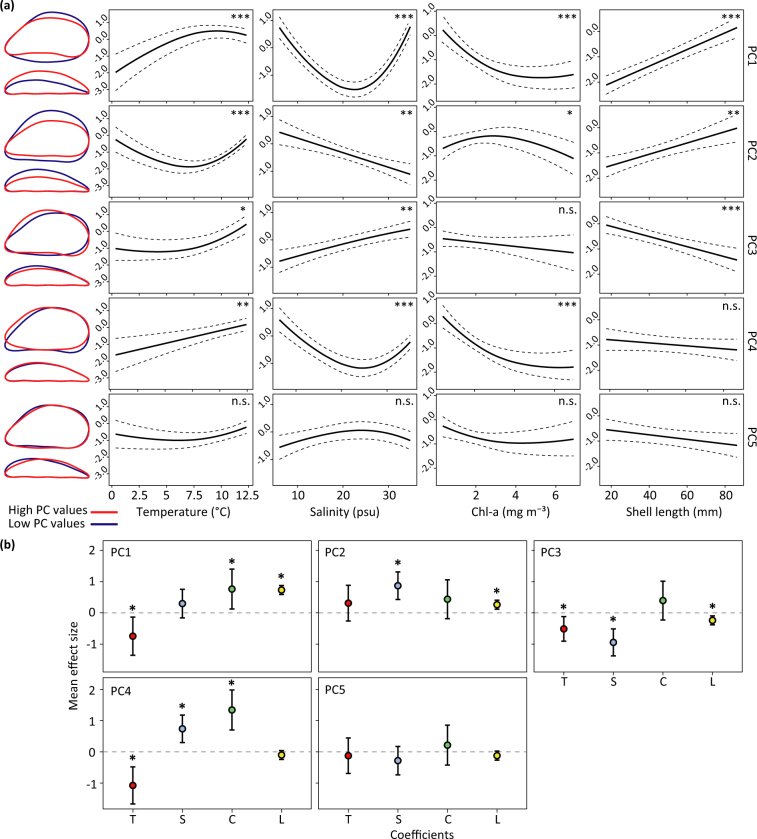
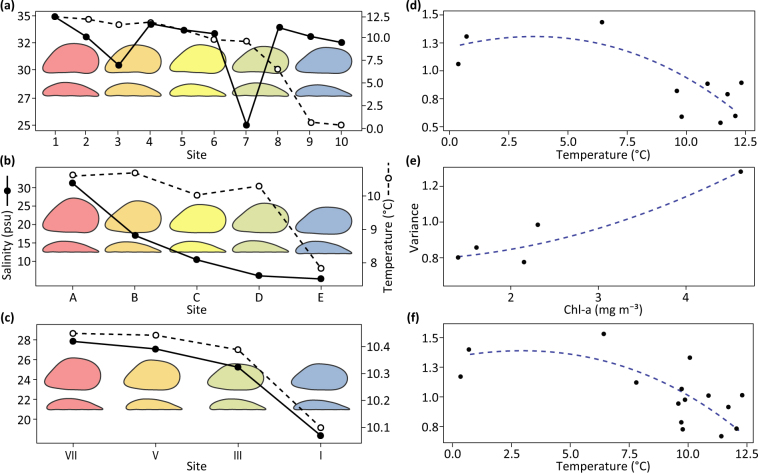
Shape variability represents an important direct response of organisms to selective environments. Here, we use a combination of geometric morphometrics and generalised additive mixed models (GAMMs) to identify spatial patterns of natural shell shape variation in the North Atlantic and Arctic blue mussels, Mytilus edulis and M. trossulus, with environmental gradients of temperature, salinity and food availability across 3980 km of coastlines. New statistical methods and multiple study systems at various geographical scales allowed the uncoupling of the developmental and genetic contributions to shell shape and made it possible to identify general relationships between blue mussel shape variation and environment that are independent of age and species influences. We find salinity had the strongest effect on the latitudinal patterns of Mytilus shape, producing shells that were more elongated, narrower and with more parallel dorsoventral margins at lower salinities. Temperature and food supply, however, were the main drivers of mussel shape heterogeneity. Our findings revealed similar shell shape responses in Mytilus to less favourable environmental conditions across the different geographical scales analysed. Our results show how shell shape plasticity represents a powerful indicator to understand the alterations of blue mussel communities in rapidly changing environments.
形态变异性是生物体对选择环境的重要直接响应。在这里,我们结合几何形态测量学和广义可加混合模型(GAMMs),以鉴定北大西洋和北极地区贻贝(Mytilus edulis 和 M. trossulus)的自然壳形变化的空间模式,这些贻贝的环境梯度包括温度、盐度和食物可利用性,横跨 3980 公里的海岸线。新的统计方法和多种研究系统在不同的地理尺度上,使我们能够分离壳形的发育和遗传贡献,并确定贻贝形状变化与环境之间的一般关系,这些关系独立于年龄和物种的影响。我们发现,盐度对贻贝形状的纬度模式有最强的影响,在低盐度下产生更细长、更窄和更平行的背腹边缘的壳。然而,温度和食物供应是贻贝形状异质性的主要驱动因素。我们的研究结果表明,在不同的地理尺度分析中,贻贝对不同的地理尺度下的较不利环境条件有相似的壳形响应。我们的研究结果表明,壳形可塑性如何代表一个强大的指标,以了解在快速变化的环境中贻贝群落的变化。