Department of Veterinary and Biomedical Sciences, University of Minnesota, St. Paul, MN, USA.
Biotechnology Institute, University of Minnesota, St. Paul, MN, USA.
Sci Rep. 2018 Feb 12;8(1):2857. doi: 10.1038/s41598-018-21255-7.
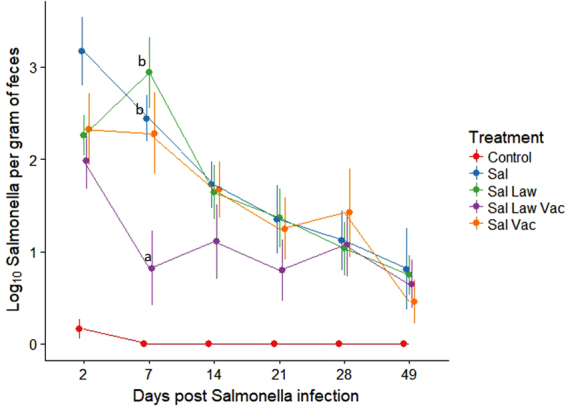
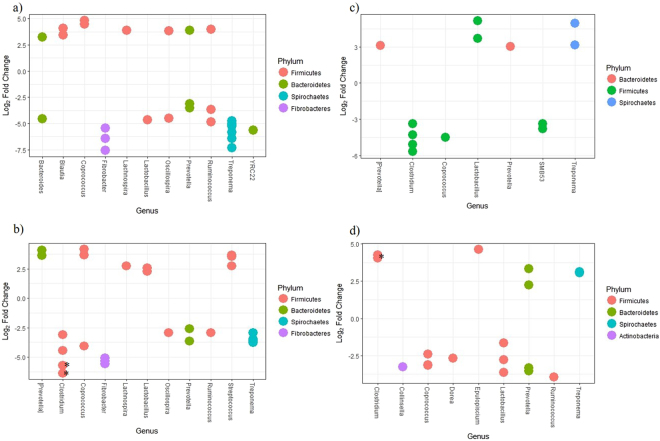
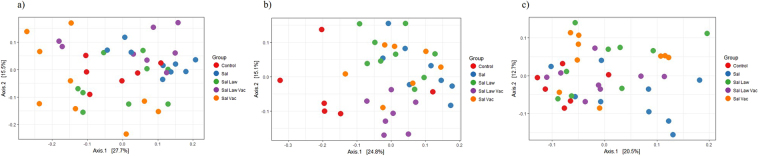
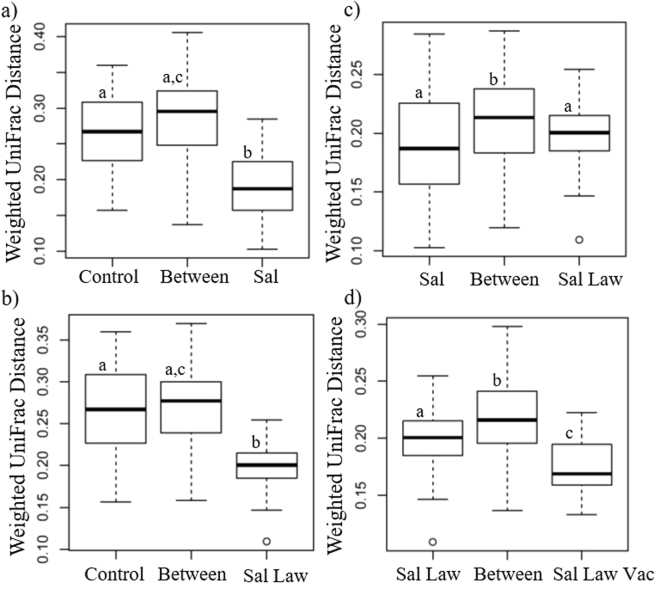
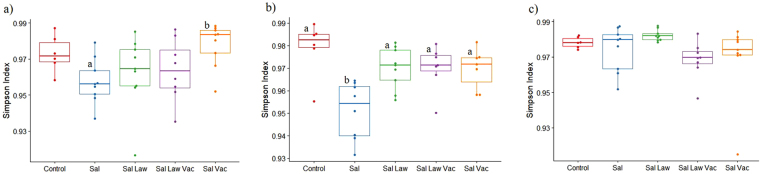
Salmonella enterica serovar Typhimurium continues to be a major cause of foodborne illness worldwide and pork can serve as a source of infection. Co-infection of S. enterica with Lawsonia intracellularis, a common intestinal pathogen of swine, has been found as risk factor for increased S. enterica shedding. The objective of this study was to investigate if vaccination against L. intracellularis could lead to decreased S. Typhimurium shedding. To test this hypothesis, pigs were challenged with either S. Typhimurium or S. Typhimurium and L. intracellularis, with and without L. intracellularis vaccination (n = 9 per group). A non-challenged group served as a negative control. Vaccination decreased the shedding of S. Typhimurium in co-infected animals by 2.12 log organisms per gram of feces at 7 days post infection. Analysis of the microbiome showed that vaccination led to changes in the abundance of Clostridium species, including Clostridium butyricum, in addition to other compositional changes that may explain the protection mediated against S. Typhimurium. These results indicate that vaccination against L. intracellularis in co-infected herds may provide a new tool to increase food safety by helping to prevent S. enterica without the need for antibiotics.
鼠伤寒沙门氏菌血清型 Typhimurium 仍然是全球食源性疾病的主要原因,而猪肉可能是感染源。已发现沙门氏菌与猪常见肠道病原体细胞内劳森菌共同感染是增加沙门氏菌脱落的危险因素。本研究的目的是调查针对细胞内劳森菌的疫苗接种是否会导致鼠伤寒沙门氏菌脱落减少。为了验证这一假设,用沙门氏菌或沙门氏菌和细胞内劳森菌对猪进行了攻毒,同时接种了或未接种细胞内劳森菌疫苗(每组 9 头猪)。一组未攻毒的猪作为阴性对照。感染后 7 天,接种疫苗使感染动物粪便中鼠伤寒沙门氏菌的脱落量减少了 2.12 个对数生物体/克粪便。微生物组分析表明,接种疫苗导致梭菌属物种(包括丁酸梭菌)的丰度发生变化,此外还发生了其他组成变化,这可能解释了对鼠伤寒沙门氏菌的保护作用。这些结果表明,针对共同感染牛群中的细胞内劳森菌的疫苗接种可能为增加食品安全提供一种新工具,有助于在无需抗生素的情况下预防沙门氏菌。