• 文献检索
  • 文档翻译
  • 深度研究
  • 学术资讯
  • Suppr Zotero 插件Zotero 插件
  • 邀请有礼
  • 套餐&价格
  • 历史记录
应用&插件
Suppr Zotero 插件Zotero 插件浏览器插件Mac 客户端Windows 客户端微信小程序
定价
高级版会员购买积分包购买API积分包
服务
文献检索文档翻译深度研究API 文档MCP 服务
关于我们
关于 Suppr公司介绍联系我们用户协议隐私条款
关注我们

Suppr 超能文献

核心技术专利:CN118964589B侵权必究
粤ICP备2023148730 号-1Suppr @ 2026

文献检索

告别复杂PubMed语法,用中文像聊天一样搜索,搜遍4000万医学文献。AI智能推荐,让科研检索更轻松。

立即免费搜索

文件翻译

保留排版,准确专业,支持PDF/Word/PPT等文件格式,支持 12+语言互译。

免费翻译文档

深度研究

AI帮你快速写综述,25分钟生成高质量综述,智能提取关键信息,辅助科研写作。

立即免费体验

转身冻结:帕金森病患者在社区生活中的转身行为

Turn Around Freezing: Community-Living Turning Behavior in People with Parkinson's Disease.

作者信息

Mancini Martina, Weiss Aner, Herman Talia, Hausdorff Jeffrey M

机构信息

Department of Neurology, School of Medicine, Oregon Health & Science University, Portland, OR, United States.

Center for the Study of Movement, Cognition and Mobility, Neurology Department, Tel Aviv Sourasky Medical Center, Tel Aviv, Israel.

出版信息

Front Neurol. 2018 Jan 26;9:18. doi: 10.3389/fneur.2018.00018. eCollection 2018.

DOI:10.3389/fneur.2018.00018
PMID:29434567
原文链接:https://pmc.ncbi.nlm.nih.gov/articles/PMC5790768/
Abstract

Difficulty in turning while walking is common among patients with Parkinson's disease (PD). This difficulty often leads to significant disability, falls, and loss of function; moreover, turning is a common trigger for freezing of gait (FoG). We hypothesized that the quantity and quality of turning mobility while walking during daily life would be different among subjects with PD with and without FoG. Here, we investigated, for the first time, the turning quality during daily life as it relates to FoG in people with PD using a single inertial sensor. Ninety-four subjects with PD (among whom 25 had FoG) wore an inertial sensor attached by a belt on the lower back during normal daily activity consecutively for 3 days. An algorithm identified periods of walking and calculated the number and quality metrics of turning. Quality, but not the quantity, of turning at home was different in freezers compared to the non-freezers. The number of turns (19.3 ± 9.2/30 min in freezers, 22.4 ± 12.9/30 min non-freezers;  = 0.194) was similar in the two groups. Some aspects of quality of turns, specifically mean jerkiness, mean and variability of medio-lateral jerkiness were significantly higher ( < 0.05) in the freezers, compared to non-freezers. Interestingly, subjects with FoG showed specific turning differences in the turns with larger angles compared to those without FoG. These findings suggest that turning during daily activities among patients with PD is impaired in subjects with FoG, compared to subject without freezing. As such, clinical decision-making and rehabilitation assessment may benefit from measuring the quality of turning mobility during daily activities in PD.

摘要

行走时转身困难在帕金森病(PD)患者中很常见。这种困难常常导致严重残疾、跌倒和功能丧失;此外,转身是步态冻结(FoG)的常见诱因。我们假设,在日常生活中行走时,有和没有FoG的PD患者的转身移动数量和质量会有所不同。在此,我们首次使用单个惯性传感器研究了PD患者日常生活中与FoG相关的转身质量。94名PD患者(其中25名有FoG)在正常日常活动期间连续3天佩戴一个通过腰带系在下背部的惯性传感器。一种算法识别出行走时段并计算转身的数量和质量指标。与无冻结者相比,有冻结者在家中转身的质量而非数量存在差异。两组的转身次数相似(有冻结者为19.3±9.2次/30分钟,无冻结者为22.4±12.9次/30分钟;P = 0.194)。与无冻结者相比,有冻结者转身质量的某些方面,特别是平均急促度、中侧急促度的平均值和变异性显著更高(P < 0.05)。有趣的是,与无FoG者相比,有FoG的受试者在角度较大的转身中表现出特定的转身差异。这些发现表明,与无冻结的受试者相比,有FoG的PD患者在日常活动中的转身功能受损。因此,临床决策和康复评估可能受益于测量PD患者日常活动中转身移动的质量。
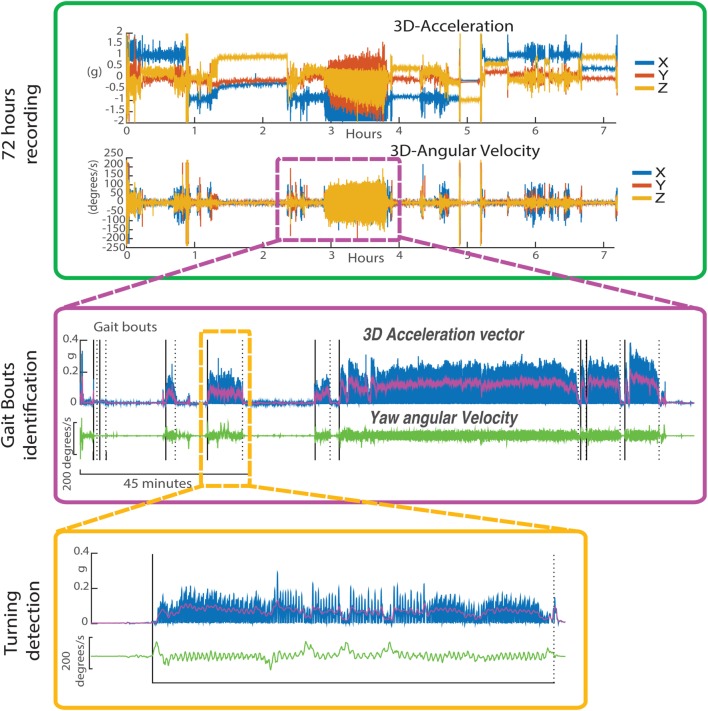
https://cdn.ncbi.nlm.nih.gov/pmc/blobs/5779/5790768/66d5beda2157/fneur-09-00018-g004.jpg
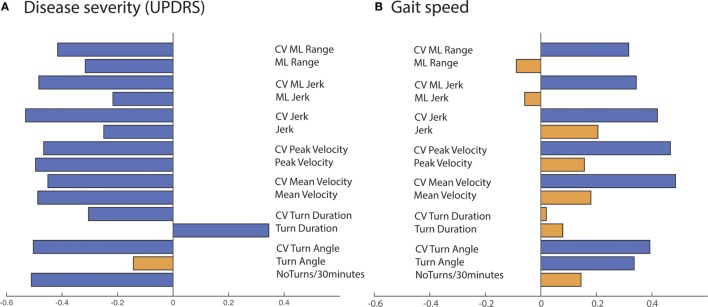
https://cdn.ncbi.nlm.nih.gov/pmc/blobs/5779/5790768/1ccd081bad1d/fneur-09-00018-g001.jpg
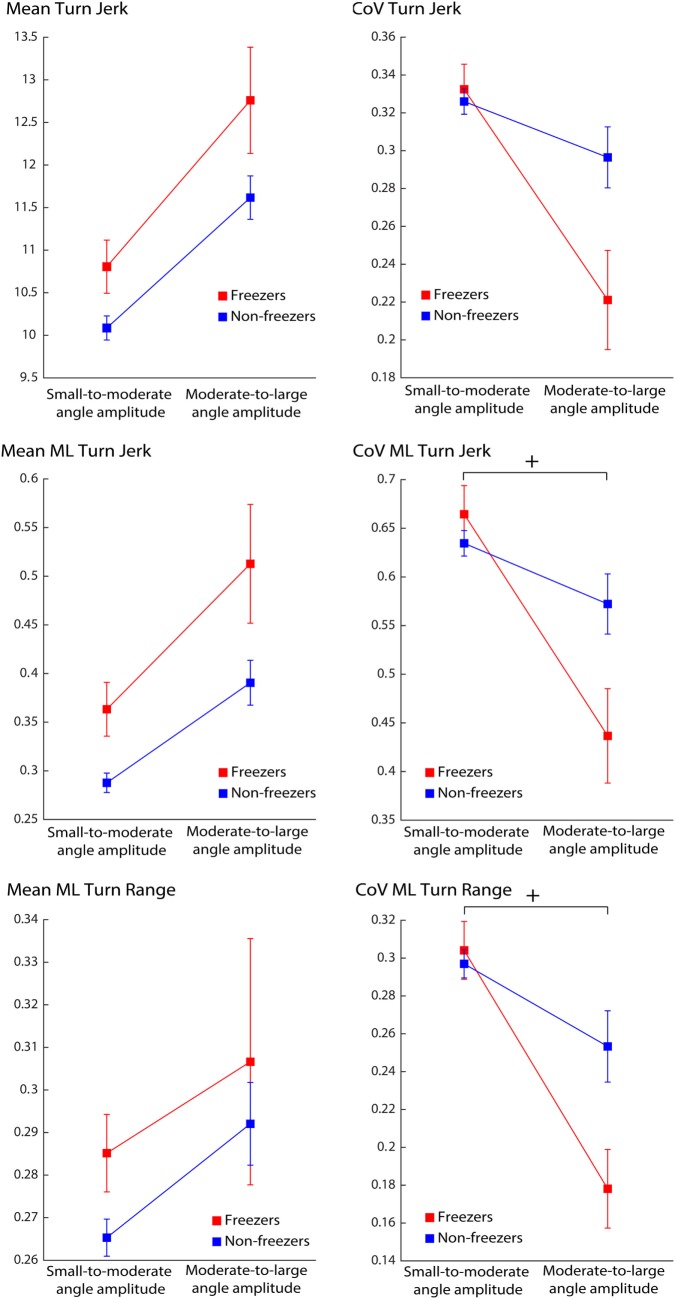
https://cdn.ncbi.nlm.nih.gov/pmc/blobs/5779/5790768/2e07eaf6d6a1/fneur-09-00018-g002.jpg
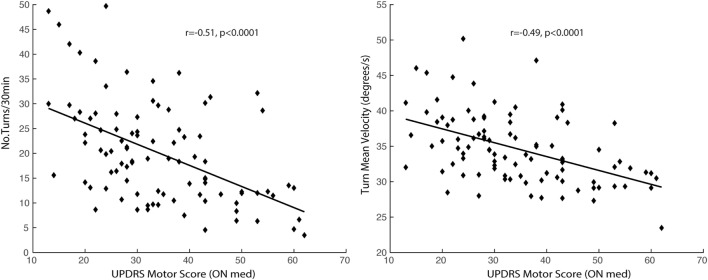
https://cdn.ncbi.nlm.nih.gov/pmc/blobs/5779/5790768/7de83a8ce355/fneur-09-00018-g003.jpg
https://cdn.ncbi.nlm.nih.gov/pmc/blobs/5779/5790768/66d5beda2157/fneur-09-00018-g004.jpg
https://cdn.ncbi.nlm.nih.gov/pmc/blobs/5779/5790768/1ccd081bad1d/fneur-09-00018-g001.jpg
https://cdn.ncbi.nlm.nih.gov/pmc/blobs/5779/5790768/2e07eaf6d6a1/fneur-09-00018-g002.jpg
https://cdn.ncbi.nlm.nih.gov/pmc/blobs/5779/5790768/7de83a8ce355/fneur-09-00018-g003.jpg
https://cdn.ncbi.nlm.nih.gov/pmc/blobs/5779/5790768/66d5beda2157/fneur-09-00018-g004.jpg

相似文献

1
Turn Around Freezing: Community-Living Turning Behavior in People with Parkinson's Disease.转身冻结:帕金森病患者在社区生活中的转身行为
Front Neurol. 2018 Jan 26;9:18. doi: 10.3389/fneur.2018.00018. eCollection 2018.
2
Objective measures to investigate turning impairments and freezing of gait in people with Parkinson's disease.客观测量帕金森病患者的转弯障碍和步态冻结。
Gait Posture. 2019 Oct;74:187-193. doi: 10.1016/j.gaitpost.2019.09.001. Epub 2019 Sep 5.
3
Center of mass trajectories during turning in patients with Parkinson's disease with and without freezing of gait.帕金森病患者在有和没有步态冻结情况下转身时的质心轨迹
Gait Posture. 2016 Jan;43:54-9. doi: 10.1016/j.gaitpost.2015.10.021. Epub 2015 Nov 1.
4
Continuous monitoring of turning in Parkinson's disease: Rehabilitation potential.帕金森病翻身动作的持续监测:康复潜力
NeuroRehabilitation. 2015;37(1):3-10. doi: 10.3233/NRE-151236.
5
The Association between Prefrontal Cortex Activity and Turning Behavior in People with and without Freezing of Gait.前额叶皮质活动与有和无冻结步态者转弯行为的关系。
Neuroscience. 2019 Sep 15;416:168-176. doi: 10.1016/j.neuroscience.2019.07.024. Epub 2019 Jul 19.
6
Increased foot strike variability during turning in Parkinson's disease patients with freezing of gait.帕金森病冻结步态患者在转弯时足触地方式的可变性增加。
Gait Posture. 2022 Feb;92:321-327. doi: 10.1016/j.gaitpost.2021.12.012. Epub 2021 Dec 10.
7
New evidence for gait abnormalities among Parkinson's disease patients who suffer from freezing of gait: insights using a body-fixed sensor worn for 3 days.帕金森病步态冻结患者步态异常的新证据:使用佩戴3天的身体固定传感器的见解
J Neural Transm (Vienna). 2015 Mar;122(3):403-10. doi: 10.1007/s00702-014-1279-y. Epub 2014 Jul 29.
8
Visual Cues for Turning in Parkinson's Disease.帕金森病转向的视觉提示。
Sensors (Basel). 2022 Sep 7;22(18):6746. doi: 10.3390/s22186746.
9
Digital measures of freezing of gait across the spectrum of normal, non-freezers, possible freezers and definite freezers.步态冻结的数字测量在正常、非冻结者、可能冻结者和确定冻结者的范围内。
J Neurol. 2023 Sep;270(9):4309-4317. doi: 10.1007/s00415-023-11773-4. Epub 2023 May 19.
10
The clinical significance of freezing while turning in Parkinson's disease.帕金森病中转身时冻结现象的临床意义。
Neuroscience. 2017 Feb 20;343:222-228. doi: 10.1016/j.neuroscience.2016.11.045. Epub 2016 Dec 9.

引用本文的文献

1
Continuous Movement Monitoring at Home Through Wearable Devices: A Systematic Review.通过可穿戴设备进行家庭连续运动监测:一项系统综述。
Sensors (Basel). 2025 Aug 8;25(16):4889. doi: 10.3390/s25164889.
2
Using machine learning to identify Parkinson's disease severity subtypes with multimodal data.利用机器学习通过多模态数据识别帕金森病严重程度亚型。
J Neuroeng Rehabil. 2025 Jun 2;22(1):126. doi: 10.1186/s12984-025-01648-2.
3
Management of freezing of gait - mechanism-based practical recommendations.步态冻结的管理——基于机制的实用建议

本文引用的文献

1
Everyday Stepping Quantity and Quality Among Older Adult Fallers With and Without Mild Cognitive Impairment: Initial Evidence for New Motor Markers of Cognitive Deficits?老年人跌倒者和无轻度认知障碍者的日常步数数量和质量:新的认知缺陷运动标志物的初步证据?
J Gerontol A Biol Sci Med Sci. 2018 Jul 9;73(8):1078-1082. doi: 10.1093/gerona/glx187.
2
Validation of a Step Detection Algorithm during Straight Walking and Turning in Patients with Parkinson's Disease and Older Adults Using an Inertial Measurement Unit at the Lower Back.使用下背部惯性测量单元对帕金森病患者和老年人在直线行走和转弯过程中的步幅检测算法进行验证。
Front Neurol. 2017 Sep 4;8:457. doi: 10.3389/fneur.2017.00457. eCollection 2017.
3
Nat Rev Neurol. 2025 Apr 1. doi: 10.1038/s41582-025-01079-6.
4
Gait characteristics in people with Friedreich ataxia: daily life versus clinic measures.弗里德赖希共济失调患者的步态特征:日常生活与临床测量对比
Front Neurol. 2025 Mar 17;16:1544453. doi: 10.3389/fneur.2025.1544453. eCollection 2025.
5
Foot-Floor Contact Sequences: A Metric for Gait Assessment in Parkinson's Disease after Deep Brain Stimulation.足底-地面接触序列:一种用于深部脑刺激后帕金森病步态评估的指标。
Sensors (Basel). 2024 Oct 13;24(20):6593. doi: 10.3390/s24206593.
6
The Role of Wearable Devices in Chronic Disease Monitoring and Patient Care: A Comprehensive Review.可穿戴设备在慢性病监测与患者护理中的作用:一项全面综述。
Cureus. 2024 Sep 8;16(9):e68921. doi: 10.7759/cureus.68921. eCollection 2024 Sep.
7
Assessing the clinical utility of inertial sensors for home monitoring in Parkinson's disease: a comprehensive review.评估惯性传感器在帕金森病家庭监测中的临床应用:一项综合综述。
NPJ Parkinsons Dis. 2024 Aug 20;10(1):161. doi: 10.1038/s41531-024-00755-6.
8
Triggers for freezing of gait in individuals with Parkinson's disease: a systematic review.帕金森病患者步态冻结的触发因素:一项系统综述
Front Neurol. 2023 Dec 21;14:1326300. doi: 10.3389/fneur.2023.1326300. eCollection 2023.
9
Identification of motor progression in Parkinson's disease using wearable sensors and machine learning.使用可穿戴传感器和机器学习识别帕金森病的运动进展
NPJ Parkinsons Dis. 2023 Oct 7;9(1):142. doi: 10.1038/s41531-023-00581-2.
10
The 'Postural Rhythm' of the Ground Reaction Force during Upright Stance and Its Conversion to Body Sway-The Effect of Vision, Support Surface and Adaptation to Repeated Trials.直立姿势时地面反作用力的“姿势节律”及其向身体摆动的转换——视觉、支撑面和重复试验适应的影响
Brain Sci. 2023 Jun 21;13(7):978. doi: 10.3390/brainsci13070978.
Algorithm for Turning Detection and Analysis Validated under Home-Like Conditions in Patients with Parkinson's Disease and Older Adults using a 6 Degree-of-Freedom Inertial Measurement Unit at the Lower Back.
使用位于下背部的六自由度惯性测量单元,在帕金森病患者和老年人的类似家庭环境条件下验证的翻身检测与分析算法
Front Neurol. 2017 Apr 10;8:135. doi: 10.3389/fneur.2017.00135. eCollection 2017.
4
Toward a low-cost gait analysis system for clinical and free-living assessment.迈向用于临床和日常活动评估的低成本步态分析系统。
Annu Int Conf IEEE Eng Med Biol Soc. 2016 Aug;2016:1874-1877. doi: 10.1109/EMBC.2016.7591086.
5
Towards holistic free-living assessment in Parkinson's disease: Unification of gait and fall algorithms with a single accelerometer.迈向帕金森病整体自由生活评估:使用单一加速度计统一步态和跌倒算法。
Annu Int Conf IEEE Eng Med Biol Soc. 2016 Aug;2016:651-654. doi: 10.1109/EMBC.2016.7590786.
6
Freezing of gait and fall detection in Parkinson's disease using wearable sensors: a systematic review.使用可穿戴传感器检测帕金森病中的冻结步态和跌倒:一项系统综述。
J Neurol. 2017 Aug;264(8):1642-1654. doi: 10.1007/s00415-017-8424-0. Epub 2017 Mar 1.
7
The clinical significance of freezing while turning in Parkinson's disease.帕金森病中转身时冻结现象的临床意义。
Neuroscience. 2017 Feb 20;343:222-228. doi: 10.1016/j.neuroscience.2016.11.045. Epub 2016 Dec 9.
8
Free-living monitoring of Parkinson's disease: Lessons from the field.帕金森病的自由生活监测:来自现场的经验教训。
Mov Disord. 2016 Sep;31(9):1293-313. doi: 10.1002/mds.26718. Epub 2016 Jul 25.
9
Technology in Parkinson's disease: Challenges and opportunities.帕金森病中的技术:挑战与机遇。
Mov Disord. 2016 Sep;31(9):1272-82. doi: 10.1002/mds.26642. Epub 2016 Apr 29.
10
The quality of turning in Parkinson's disease: a compensatory strategy to prevent postural instability?帕金森病中的转身质量:一种预防姿势不稳的代偿策略?
J Neuroeng Rehabil. 2016 Apr 19;13:39. doi: 10.1186/s12984-016-0147-4.