Pham Minh H, Elshehabi Morad, Haertner Linda, Heger Tanja, Hobert Markus A, Faber Gert S, Salkovic Dina, Ferreira Joaquim J, Berg Daniela, Sanchez-Ferro Álvaro, van Dieën Jaap H, Maetzler Walter
Department of Neurodegeneration, Center for Neurology, Hertie Institute for Clinical Brain Research (HIH), University of Tübingen, Tübingen, Germany.
German Center for Neurodegenerative Diseases, DZNE, Tübingen, Germany.
Front Neurol. 2017 Apr 10;8:135. doi: 10.3389/fneur.2017.00135. eCollection 2017.
Aging and age-associated disorders such as Parkinson's disease (PD) are often associated with turning difficulties, which can lead to falls and fractures. Valid assessment of turning and turning deficits specifically in non-standardized environments may foster specific treatment and prevention of consequences.
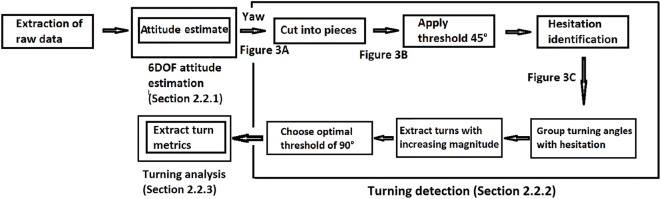
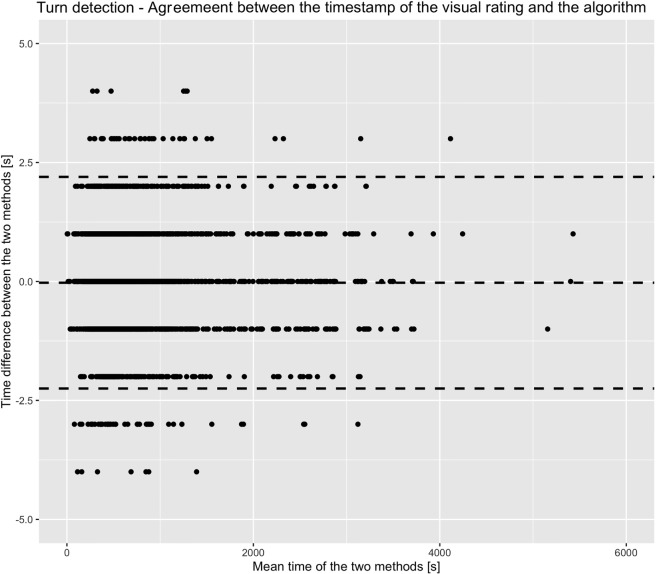
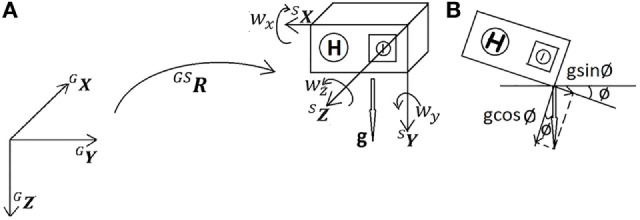
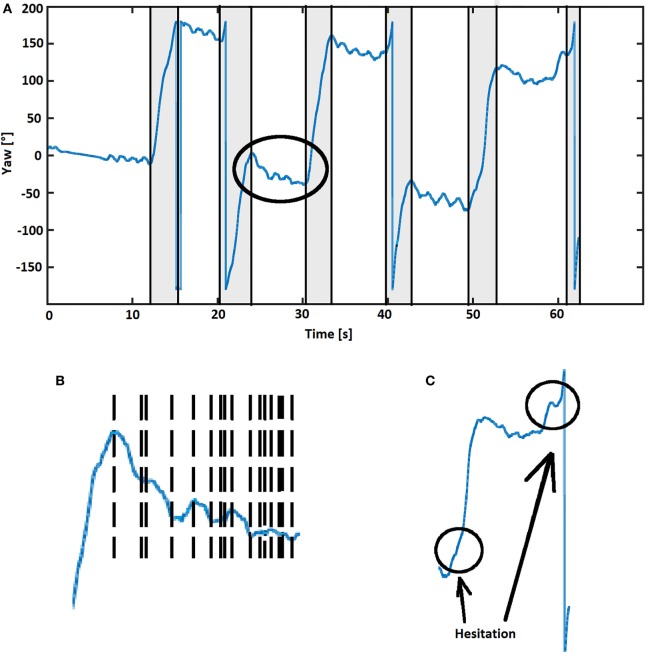
Relative orientation, obtained from 3D-accelerometer and 3D-gyroscope data of a sensor worn at the lower back, was used to develop an algorithm for turning detection and qualitative analysis in PD patients and controls in non-standardized environments. The algorithm was validated with a total of 2,304 turns ≥90° extracted from an independent dataset of 20 PD patients during medication ON- and OFF-conditions and 13 older adults. Video observation by two independent clinical observers served as gold standard.
In PD patients under medication OFF, the algorithm detected turns with a sensitivity of 0.92, a specificity of 0.89, and an accuracy of 0.92. During medication ON, values were 0.92, 0.78, and 0.83. In older adults, the algorithm reached validation values of 0.94, 0.89, and 0.92. Turning magnitude (difference, 0.06°; SEM, 0.14°) and duration (difference, 0.004 s; SEM, 0.005 s) yielded high correlation values with gold standard. Overall accuracy for direction of turning was 0.995. Intra class correlation of the clinical observers was 0.92.
This wearable sensor- and relative orientation-based algorithm yields very high agreement with clinical observation for the detection and evaluation of ≥90° turns under non-standardized conditions in PD patients and older adults. It can be suggested for the assessment of turning in daily life.
衰老以及帕金森病(PD)等与年龄相关的疾病常常与转身困难相关,这可能导致跌倒和骨折。特别是在非标准化环境中对转身及转身缺陷进行有效评估,可能有助于针对性治疗并预防相关后果。
利用佩戴在下背部的传感器的三维加速度计和三维陀螺仪数据获取的相对方向,开发一种算法,用于在非标准化环境中检测PD患者和对照组的转身情况并进行定性分析。该算法通过从20例PD患者在服药期和非服药期的独立数据集中提取的总共2304次≥90°的转身以及13名老年人的数据进行验证。由两名独立的临床观察者进行的视频观察作为金标准。
在未服药的PD患者中,该算法检测转身的灵敏度为0.92,特异性为0.89,准确率为0.92。在服药期,相应数值分别为0.92、0.78和0.83。在老年人中,该算法的验证值为0.94、0.89和0.92。转身幅度(差异为0.06°;标准误为0.14°)和持续时间(差异为0.004秒;标准误为0.005秒)与金标准具有高度相关性。转身方向的总体准确率为0.995。临床观察者的组内相关性为0.92。
这种基于可穿戴传感器和相对方向的算法在检测和评估PD患者及老年人在非标准化条件下≥90°的转身情况时,与临床观察结果高度一致。可建议将其用于日常生活中的转身评估。