Hu Wei, Wei Rui, Wang Liyue, Lu Jingqian, Liu Hongming, Zhang Wei
Department of Cardiology, The First Affiliated Hospital of Kunming Medical University, Kunming, Yunnan 650000, P.R. China.
Department of Emergency, The First Affiliated Hospital of Kunming Medical University, Kunming, Yunnan 650000, P.R. China.
Exp Ther Med. 2018 Feb;15(2):1994-1998. doi: 10.3892/etm.2017.5623. Epub 2017 Dec 12.
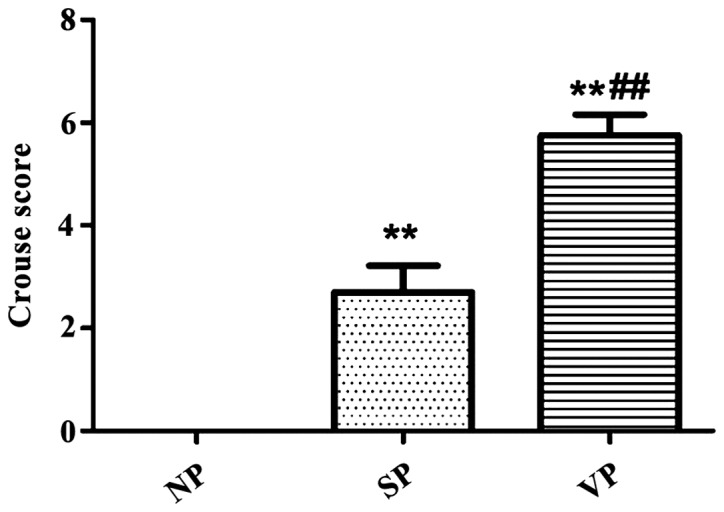
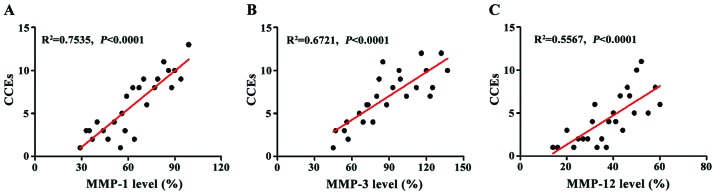
We analyzed the effects of matrix metalloproteinase (MMP)-1, MMP-3, and MMP-12 on the degree of carotid atherosclerosis (CAS) and plaque stability, and investigated their correlations with cardiovascular and cerebrovascular events (CCEs). Two hundred CAS patients were enrolled. Carotid intima-media thickness (IMT) was measured using ultrasonic examination. Patients were divided into the no plaque group (NP group), stable plaque group (SP group), and vulnerable plaque group (VP group). The Crouse method was used for the evaluation of plaque scores. Additionally, 60 healthy subjects were enrolled as the control group. Serum triacylglycerol (TG), total cholesterol (TC), low density lipoprotein cholesterol (LDL-C), and high density lipoprotein cholesterol (HDL-C) were analyzed. The serum protein levels of MMP-1, MMP-3, and MMP-12 were measured by western blotting. The frequency of CCEs within 2 years was recorded, and its correlation with MMP-1, MMP-3, and MMP-12 was analyzed. The CAS plaque scores in the SP and VP groups were significantly increased compared with the NP group, and the difference between the SP and VP groups was significant. The levels of TC, TG, LDL-C, and HDL-C of CAS patients were significantly increased compared with those in the control group, but the differences in these indexes between the patient groups were not significant. Western blotting showed that the levels of MMP-1, MMP-3, and MMP-12 in the patient groups were significantly increased compared with those in the control group, and the protein levels in the VP group were significantly higher than those in the SP and NP groups. Additionally, the levels of MMP-1, MMP-3, and MMP-12 had significantly positive correlations with the occurrence of CCEs in CAS patients. In conclusion, MMP-1, MMP-3, and MMP-12 are positively correlated with CCEs in CAS patients. They can be used as markers for the clinical diagnosis and prognosis of CAS.
我们分析了基质金属蛋白酶(MMP)-1、MMP-3和MMP-12对颈动脉粥样硬化(CAS)程度和斑块稳定性的影响,并研究了它们与心脑血管事件(CCE)的相关性。纳入了200例CAS患者。采用超声检查测量颈动脉内膜中层厚度(IMT)。患者分为无斑块组(NP组)、稳定斑块组(SP组)和易损斑块组(VP组)。采用Crouse法评估斑块评分。此外,纳入60名健康受试者作为对照组。分析血清三酰甘油(TG)、总胆固醇(TC)、低密度脂蛋白胆固醇(LDL-C)和高密度脂蛋白胆固醇(HDL-C)。通过蛋白质免疫印迹法测定MMP-1、MMP-3和MMP-12的血清蛋白水平。记录2年内CCE的发生频率,并分析其与MMP-1、MMP-3和MMP-12的相关性。与NP组相比,SP组和VP组的CAS斑块评分显著升高,且SP组和VP组之间的差异显著。与对照组相比,CAS患者的TC、TG、LDL-C和HDL-C水平显著升高,但这些指标在患者组之间的差异不显著。蛋白质免疫印迹法显示,与对照组相比,患者组中MMP-1、MMP-3和MMP-12的水平显著升高,且VP组中的蛋白水平显著高于SP组和NP组。此外,MMP-1、MMP-3和MMP-12的水平与CAS患者CCE的发生呈显著正相关。总之,MMP-1、MMP-3和MMP-12与CAS患者的CCE呈正相关。它们可作为CAS临床诊断和预后的标志物。