Hu Meng-Bo, Xu Hua, Zhu Wen-Hui, Bai Pei-De, Hu Ji-Meng, Yang Tian, Jiang Hao-Wen, Ding Qiang
Department of Urology, Huashan Hospital, Fudan University, Shanghai 200040, P.R. China.
Oncol Lett. 2018 Feb;15(2):1607-1615. doi: 10.3892/ol.2017.7454. Epub 2017 Nov 21.
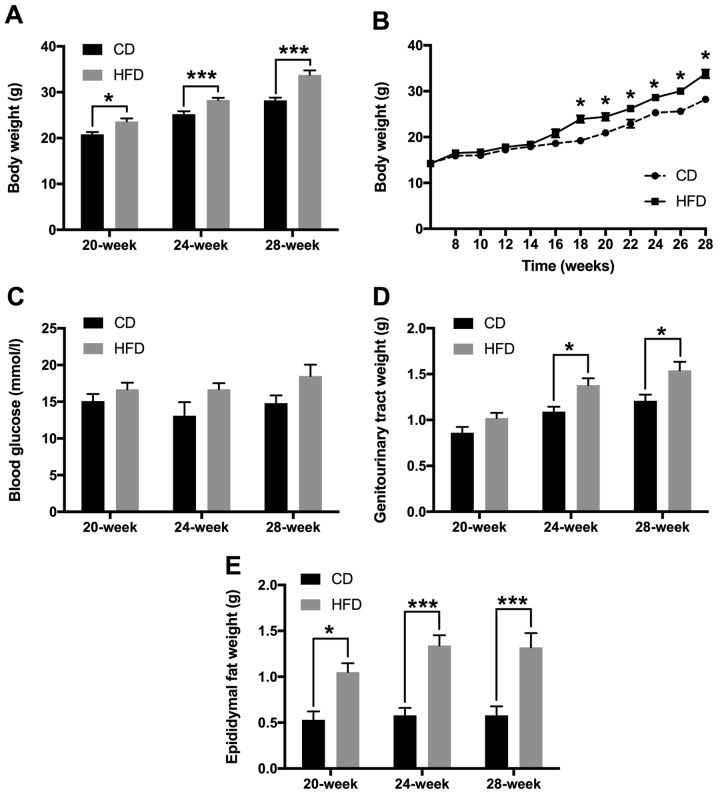
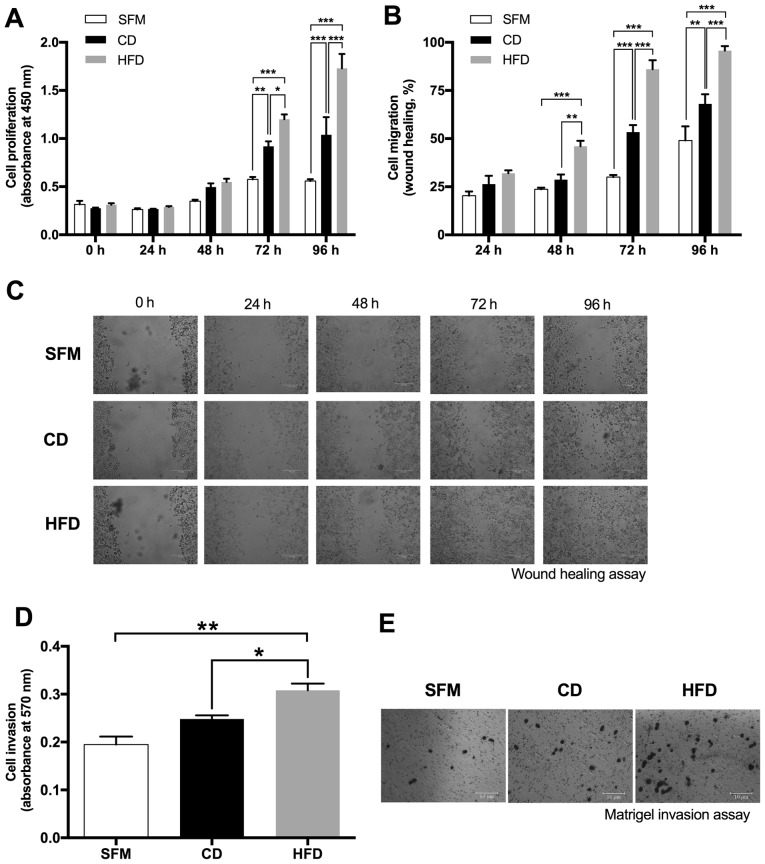
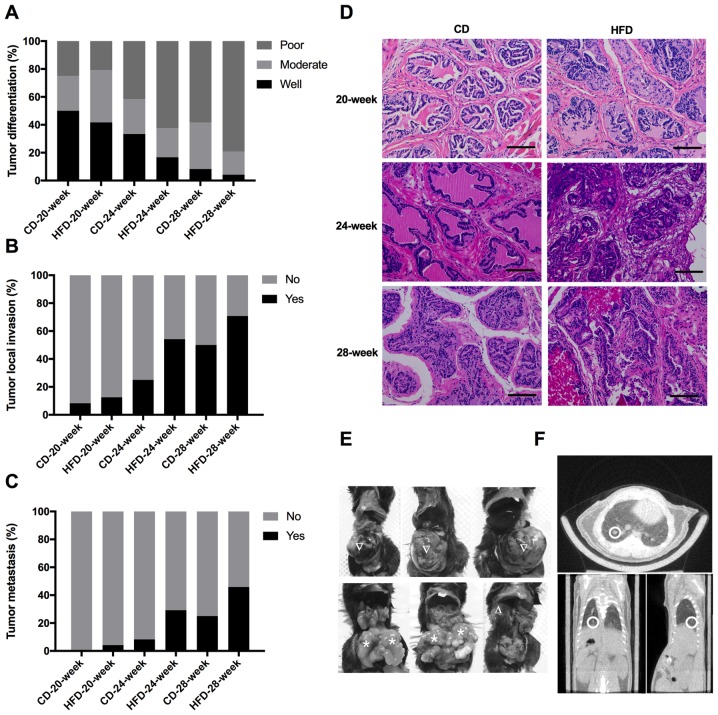
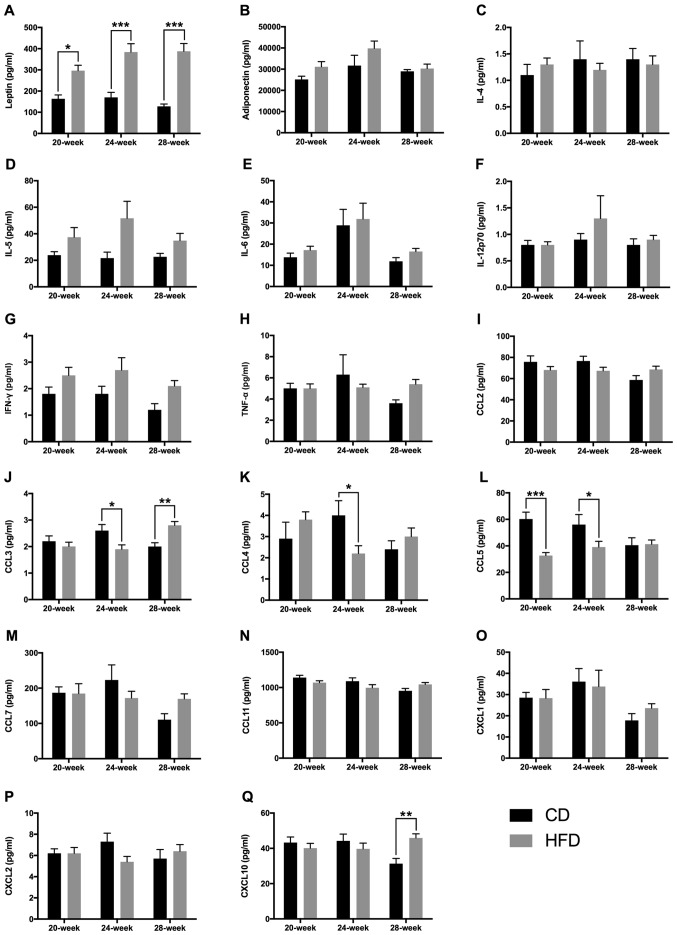
High-fat diet (HFD) -induced obesity is associated with more aggressive and lethal prostate cancer (PCa) in males, although the exact underlying mechanisms remain unclear. In the present study, transgenic adenocarcinoma of mouse prostate (TRAMP) models fed on an HFD (40% fat) or a control diet (CD; 16% fat) were generated, and cancer differentiation, local invasion and metastasis were compared at 20, 24 and 28 weeks. Mouse sera from each group were collected, and adipokines and cytokines were measured using multiplex immunoassays. HFD-sera and CD-sera were additionally processed into conditioned media (2.5% mixed sera), and studies were conducted to determine the proliferation, migration and invasion of cancer cells when conditioned media were used for culture. In TRAMP mice, HFD feeding increased body weight and adipose tissue deposition, and promoted the progression of PCa, specifically with regard to poorer differentiation, increased local invasion and metastasis rate. Sera from HFD-fed TRAMP mice contained increased levels of leptin, and a time-dependent increasing trend in the levels of CC chemokine ligand (CCL)3, CCL4, CCL5 and CXC chemokine ligand (CXCL)10 was observed. However, no alterations were detected in the levels of adiponectin, interleukin (IL)-4, IL-5, IL-6, IL-12p70, interferon-γ, tumor necrosis factor-α, CCL2, CCL7, CCL11, CXCL1 and CXCL2. studies determined that HFD-sera-conditioned medium promoted proliferation, migration and invasion of DU145 cells, as compared with CD-sera-conditioned medium and serum-free medium. In conclusion, the results of the present study suggested that the circulating adipokine and cytokine alterations in response to excess adipose tissue deposition induced by HFD feeding contributed to PCa progression.
高脂饮食(HFD)诱导的肥胖与男性侵袭性更强、更致命的前列腺癌(PCa)相关,尽管确切的潜在机制尚不清楚。在本研究中,构建了以高脂饮食(40%脂肪)或对照饮食(CD;16%脂肪)喂养的转基因小鼠前列腺腺癌(TRAMP)模型,并在20、24和28周时比较癌症分化、局部侵袭和转移情况。收集每组小鼠的血清,使用多重免疫测定法测量脂肪因子和细胞因子。将高脂饮食血清和对照饮食血清进一步处理成条件培养基(2.5%混合血清),并进行研究以确定当使用条件培养基进行培养时癌细胞的增殖、迁移和侵袭情况。在TRAMP小鼠中,高脂饮食喂养增加了体重和脂肪组织沉积,并促进了前列腺癌的进展,特别是在分化较差、局部侵袭增加和转移率方面。高脂饮食喂养的TRAMP小鼠血清中瘦素水平升高,并且观察到CC趋化因子配体(CCL)3、CCL4、CCL5和CXC趋化因子配体(CXCL)10水平呈时间依赖性增加趋势。然而,脂联素、白细胞介素(IL)-4、IL-5、IL-6、IL-12p70、干扰素-γ、肿瘤坏死因子-α、CCL2、CCL7、CCL11、CXCL1和CXCL2的水平未检测到变化。研究确定,与对照饮食血清条件培养基和无血清培养基相比,高脂饮食血清条件培养基促进了DU145细胞的增殖、迁移和侵袭。总之,本研究结果表明,高脂饮食喂养诱导的过量脂肪组织沉积所导致的循环脂肪因子和细胞因子变化促成了前列腺癌的进展。