Ahn Jae-Sook, Kim Hyeoung-Joon, Kim Yeo-Kyeoung, Lee Seung-Shin, Ahn Seo-Yeon, Jung Sung-Hoon, Yang Deok-Hwan, Lee Je-Jung, Park Hee Jeong, Lee Ja-Yeon, Choi Seung Hyun, Jung Chul Won, Jang Jun-Ho, Kim Hee Je, Moon Joon Ho, Sohn Sang Kyun, Lee Yoo Jin, Won Jong-Ho, Kim Sung-Hyun, Zhang Zhaolei, Kim TaeHyung, Kim Dennis Dong Hwan
Hematology-Oncology, Chonnam National University Hwasun Hospital, Jeollanam-do, Korea.
Genomic Research Center for Hematopoietic Diseases, Chonnam National University Hwasun Hospital, Jeollanam-do, Korea.
Oncotarget. 2017 Dec 22;9(4):4961-4968. doi: 10.18632/oncotarget.23575. eCollection 2018 Jan 12.
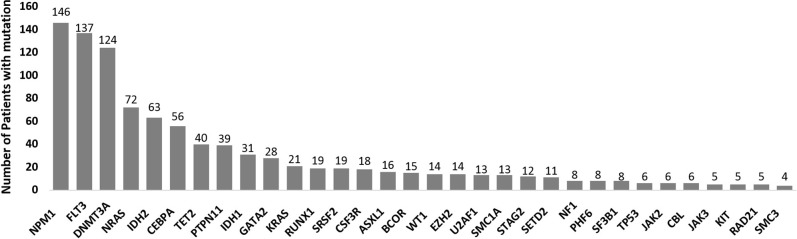
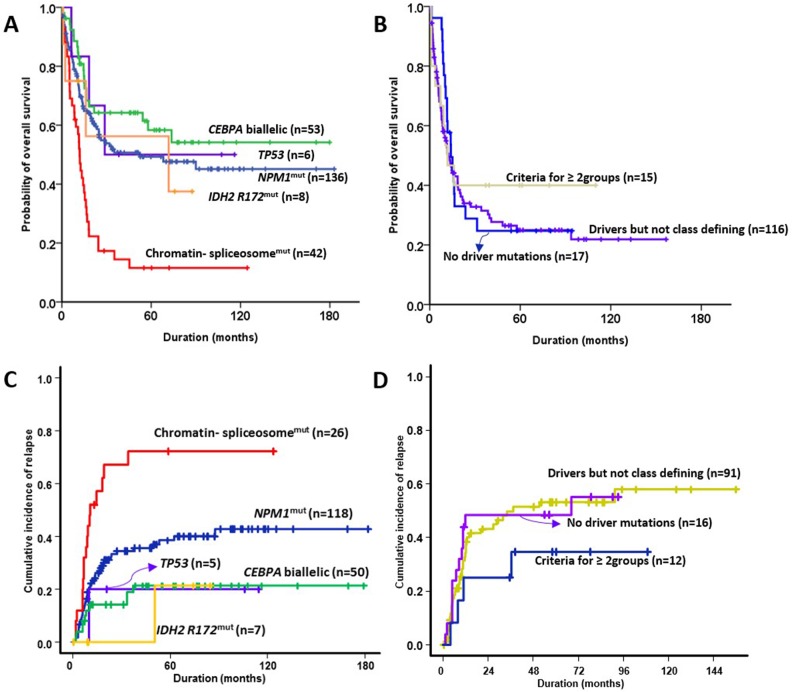
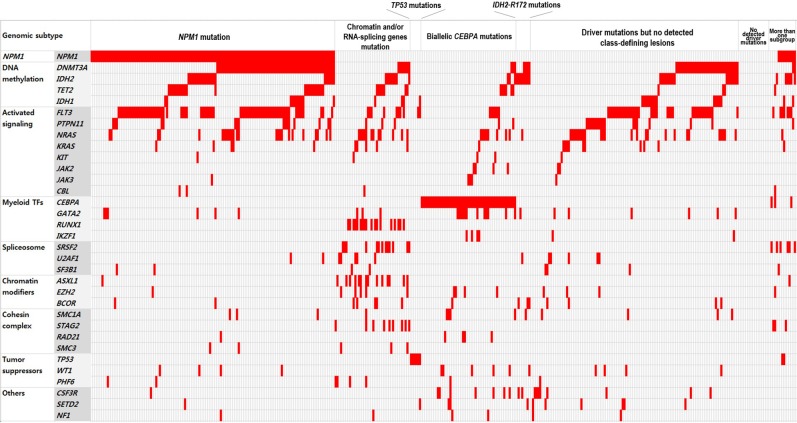
This study was performed to assess if a recently recommended genomic classification is predictive in patients with normal-karyotype (NK) acute myeloid leukemia (AML). A total of 393 patients were included. Analysis of genetic mutations was performed using targeted resequencing with an Illumina Hiseq 2000. We identified driver mutations across 40 genes, with one or more driver mutations identified in 95.7% of patients. The molecular subclassification was as follows: 34.6% patients (n = 136) with AML with the mutation, 10.7% (n = 42) with AML with mutated chromatin or RNA-splicing genes or both, 1.5% (n = 6) with AML with mutations, 13.5% (n = 53) with AML with biallelic mutations, 2.0% (n = 8) with AML with 72 mutations and no other class-defining lesion, 29.5% (n = 116) with AML with driver mutations but no detected class-defining lesion, 4.3% (n = 17) with AML with no detected driver mutation, and 3.8% (n = 15) patients with AML who met the criteria for ≥2 genomic subgroups. The 5-year overall survival and relapse rate of subgroup in AML with mutated chromatin, RNA-splicing genes, or both was 11.6% (95% CI = 1.4-21.8%) and 71.4% (95% CI = 45.7-86.5%), respectively. This study suggests that the recently recommended genomic classification is an appropriate and replicable categorization system in the NK AML population. The subgroup of AML with mutated chromatin, RNA-splicing genes, or both showed extremely poor survival in NK-AML; thus, a novel approach is needed to improve their prognosis.
本研究旨在评估一种最近推荐的基因组分类是否能预测核型正常(NK)的急性髓系白血病(AML)患者的情况。共纳入393例患者。使用Illumina Hiseq 2000进行靶向重测序以分析基因突变。我们在40个基因中鉴定出驱动突变,95.7%的患者中鉴定出一个或多个驱动突变。分子亚分类如下:34.6%的患者(n = 136)为伴有 突变的AML,10.7%(n = 42)为伴有染色质或RNA剪接基因突变或两者均突变的AML,1.5%(n = 6)为伴有 突变的AML,13.5%(n = 53)为伴有双等位基因 突变的AML,2.0%(n = 8)为伴有72个突变且无其他明确分类病变的AML,29.5%(n = 116)为伴有驱动突变但未检测到明确分类病变的AML,4.3%(n = 17)为未检测到驱动突变的AML,以及3.8%(n = 15)符合≥2个基因组亚组标准的AML患者。伴有染色质、RNA剪接基因突变或两者均突变的AML亚组的5年总生存率和复发率分别为11.6%(95%CI = 1.4 - 21.8%)和71.4%(95%CI = 45.7 - 86.5%)。本研究表明,最近推荐的基因组分类是NK AML人群中一种合适且可重复的分类系统。伴有染色质、RNA剪接基因突变或两者均突变的AML亚组在NK-AML中显示出极差的生存率;因此,需要一种新方法来改善其预后。