Shenkin Susan D, Fox Christopher, Godfrey Mary, Siddiqi Najma, Goodacre Steve, Young John, Anand Atul, Gray Alasdair, Smith Joel, Ryan Tracy, Hanley Janet, MacRaild Allan, Steven Jill, Black Polly L, Boyd Julia, Weir Christopher J, MacLullich Alasdair Mj
Geriatric Medicine, University of Edinburgh, Edinburgh, UK.
Old Age Psychiatry, University of East Anglia, Norfolk, UK.
BMJ Open. 2018 Feb 10;8(2):e015572. doi: 10.1136/bmjopen-2016-015572.
Delirium is a severe neuropsychiatric syndrome of rapid onset, commonly precipitated by acute illness. It is common in older people in the emergency department (ED) and acute hospital, but greatly under-recognised in these and other settings. Delirium and other forms of cognitive impairment, particularly dementia, commonly coexist. There is a need for a rapid delirium screening tool that can be administered by a range of professional-level healthcare staff to patients with sensory or functional impairments in a busy clinical environment, which also incorporates general cognitive assessment. We developed the 4 'A's Test (4AT) for this purpose. This study's primary objective is to validate the 4AT against a reference standard. Secondary objectives include (1) comparing the 4AT with another widely used test (the Confusion Assessment Method (CAM)); (2) determining if the 4AT is sensitive to general cognitive impairment; (3) assessing if 4AT scores predict outcomes, including (4) a health economic analysis.
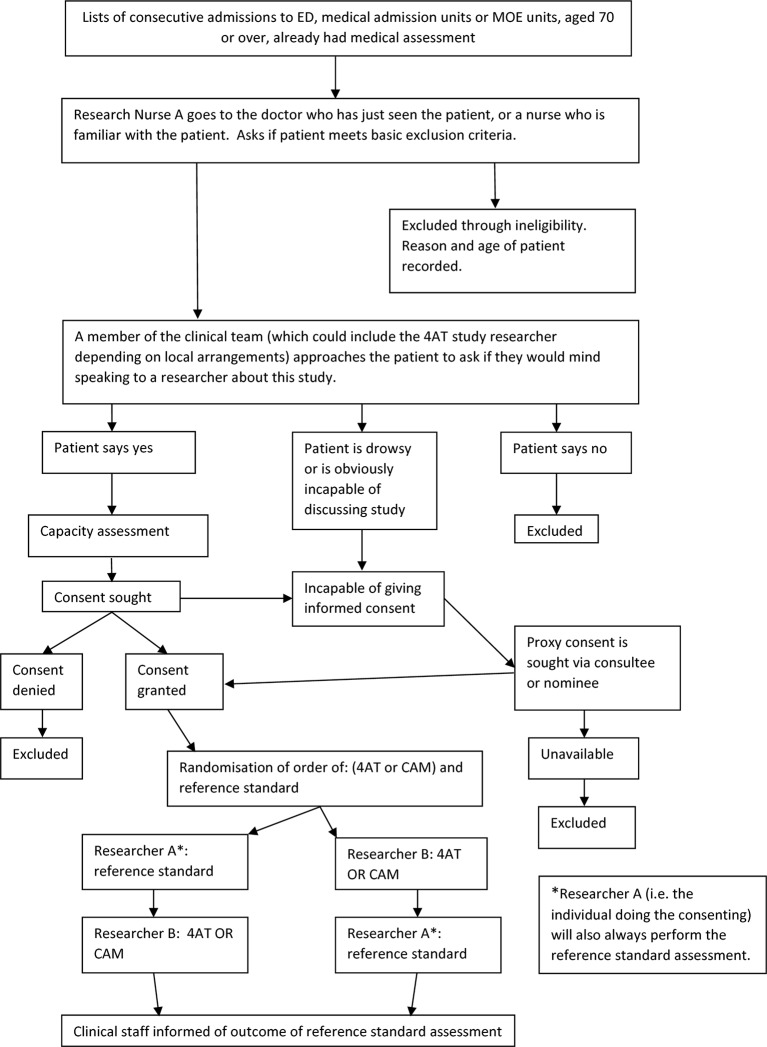
900 patients aged 70 or over in EDs or acute general medical wards will be recruited in three sites (Edinburgh, Bradford and Sheffield) over 18 months. Each patient will undergo a reference standard delirium assessment and will be randomised to assessment with either the 4AT or the CAM. At 12 weeks, outcomes (length of stay, institutionalisation and mortality) and resource utilisation will be collected by a questionnaire and via the electronic patient record.
Ethical approval was granted in Scotland and England. The study involves administering tests commonly used in clinical practice. The main ethical issues are the essential recruitment of people without capacity. Dissemination is planned via publication in high impact journals, presentation at conferences, social media and the website www.the4AT.com.
ISRCTN53388093; Pre-results.
谵妄是一种起病迅速的严重神经精神综合征,通常由急性疾病引发。在急诊科(ED)和急症医院的老年人中很常见,但在这些及其他环境中却常常未得到充分认识。谵妄与其他形式的认知障碍,尤其是痴呆,通常并存。需要一种快速的谵妄筛查工具,可供一系列专业级别的医护人员在繁忙的临床环境中对有感觉或功能障碍的患者进行使用,该工具还应纳入一般认知评估。我们为此开发了4“A”测试(4AT)。本研究的主要目的是对照参考标准验证4AT。次要目的包括:(1)将4AT与另一种广泛使用的测试(混乱评估法(CAM))进行比较;(2)确定4AT对一般认知障碍是否敏感;(3)评估4AT分数是否能预测结果,包括(4)进行健康经济分析。
在18个月内,将在三个地点(爱丁堡、布拉德福德和谢菲尔德)招募900名70岁及以上在急诊科或急性普通内科病房的患者。每位患者将接受参考标准的谵妄评估,并被随机分配接受4AT或CAM评估。在12周时,将通过问卷调查和电子病历收集结果(住院时间、机构化和死亡率)及资源利用情况。
已在苏格兰和英格兰获得伦理批准。该研究涉及使用临床实践中常用的测试。主要伦理问题是必须招募无行为能力的人。计划通过在高影响力期刊上发表、在会议上展示、社交媒体以及网站www.the4AT.com进行传播。
ISRCTN53388093;预结果。