Chemistry Department, Pontifical Catholic University of Equator, Av. 12 de Octubre 1076 y Roca, Quito 170109, Ecuador.
Center for Bioinformatics and Molecular Simulations, Faculty of Engineering, University of Talca, 2 Norte 685, Casilla 721, Talca 3640000, Chile.
Molecules. 2018 Feb 14;23(2):412. doi: 10.3390/molecules23020412.
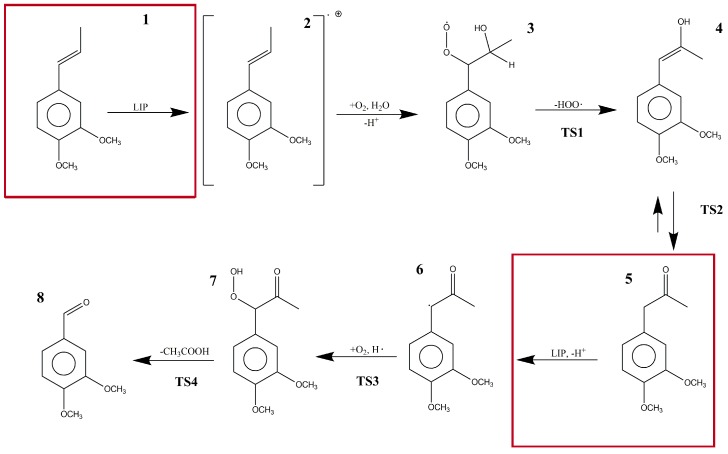
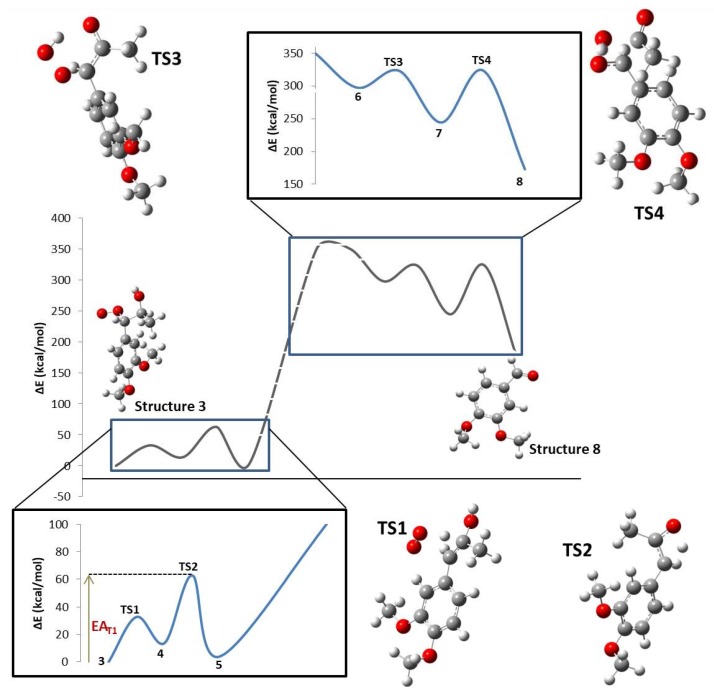
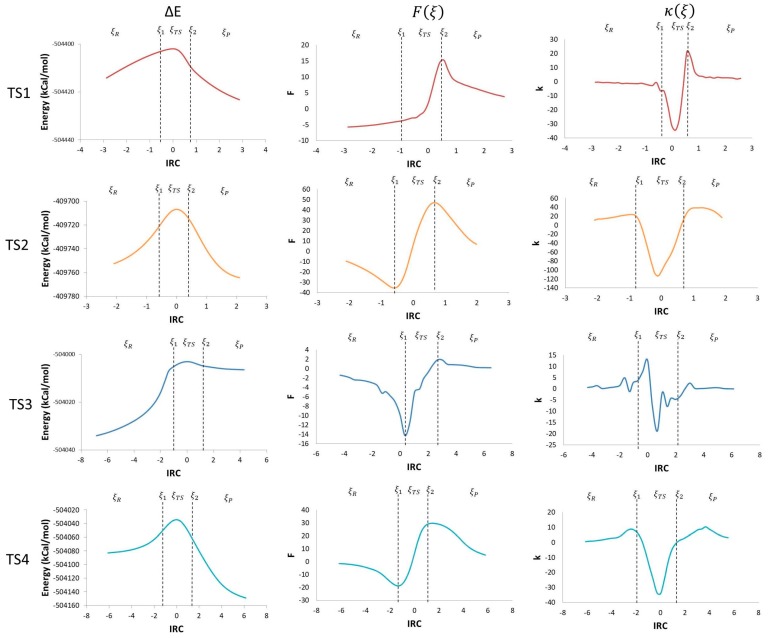
Lignin peroxidase (LiP) is an important enzyme for degrading aromatic hydrocarbons not only in nature but also in industry. In the presence of H₂O₂, this enzyme can easily decompose lignin and analogue compounds under mild conditions. In this reaction mechanism, LiP catalyzes the C-C cleavage of a propenyl side chain, being able to produce veratraldehyde (VAD) from 1-(3',4'-dimethoxyphenyl) propene (DMPP). One of the few and complete proposed mechanisms includes several non-enzymatic reactions. In this study, we performed a computational study to gain insight about the non-enzymatic steps involved in the reaction mechanism of VAD formation from DMPP using LiP as a catalyst. A kinetic characterization of the reaction using the reaction force and the reaction force constant concepts within the density functional theory (DFT) framework is proposed. All theoretical calculations for the reaction pathway were performed using the Minnesota Global Hybrid functional M06-2X and a 6-31++G(d,p) basis set. The complete reaction comprises seven steps (five steps not including LiP as a catalyst), which include radical species formation, bond transformation, water and oxygen addition, atom reordering, and deacetylation. The overall mechanism is an endothermic process with mixed activation energies depending on the four transition states. These results are the first attempt to fully understand the catalytic role of LiP in the degradation of lignin and its aromatic derivative compounds in terms of the electronic structure methods and future hybrid calculation approaches that we have recently been performing.
木质素过氧化物酶(LiP)不仅在自然界中,而且在工业中都是降解芳烃的重要酶。在 H₂O₂存在下,该酶可以在温和条件下轻易地分解木质素和类似物。在这种反应机制中,LiP 催化丙烯侧链的 C-C 裂解,能够将 1-(3',4'-二甲氧基苯基)丙烯(DMPP)转化为藜芦醛(VAD)。少数且完整的提议机制之一包括几个非酶反应。在这项研究中,我们进行了计算研究,以深入了解使用 LiP 作为催化剂从 DMPP 形成 VAD 的反应机制中涉及的非酶步骤。使用反应力和反应力常数概念在密度泛函理论(DFT)框架内对反应进行动力学特征化。使用明尼苏达全局混合泛函 M06-2X 和 6-31++G(d,p)基组对反应途径的所有理论计算。完整的反应包括七个步骤(不包括 LiP 作为催化剂的五个步骤),包括自由基物种形成、键转化、水和氧气添加、原子重排和脱乙酰基。整个机制是一个吸热过程,其激活能取决于四个过渡态。这些结果是我们最近一直在进行的电子结构方法和未来混合计算方法方面,首次尝试全面了解 LiP 在木质素及其芳香衍生物化合物降解中的催化作用。