Department of Radiology, Perelman School of Medicine, University of Pennsylvania, Philadelphia, PA-19104, USA.
Molecular Toxicology Unit, Institute of Environmental Medicine (IMM), Karolinska Institutet, 17177 Stockholm, Sweden.
Int J Environ Res Public Health. 2018 Feb 14;15(2):338. doi: 10.3390/ijerph15020338.
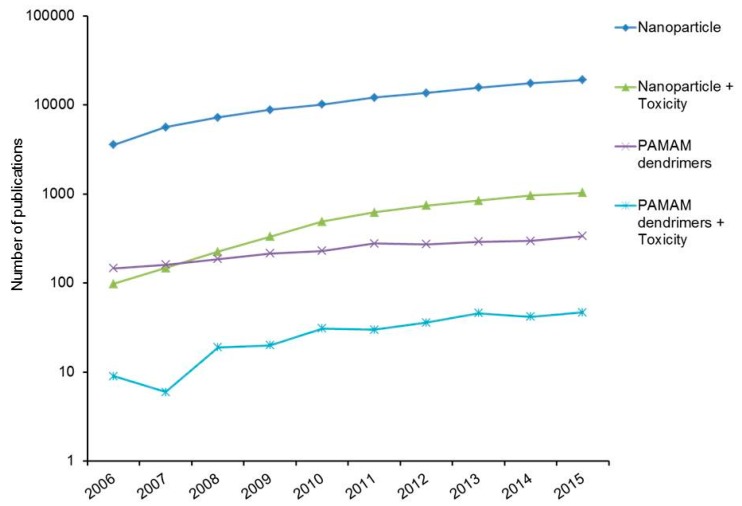
Engineered nanomaterials are increasingly being developed for paints, sunscreens, cosmetics, industrial lubricants, tyres, semiconductor devices, and also for biomedical applications such as in diagnostics, therapeutics, and contrast agents. As a result, nanomaterials are being manufactured, transported, and used in larger and larger quantities, and potential impacts on environmental and human health have been raised. Poly(amidoamine) (PAMAM) dendrimers are specifically suitable for biomedical applications. They are well-defined nanoscale molecules which contain a 2-carbon ethylenediamine core and primary amine groups at the surface. The systematically variable structural architecture and the large internal free volume make these dendrimers an attractive option for drug delivery and other biomedical applications. Due to the wide range of applications, the Organisation for Economic Co-Operation and Development (OECD) have included them in their list of nanoparticles which require toxicological assessment. Thus, the toxicological impact of these PAMAM dendrimers on human health and the environment is a matter of concern. In this review, the potential toxicological impact of PAMAM dendrimers on human health and environment is assessed, highlighting work to date exploring the toxicological effects of PAMAM dendrimers.
工程纳米材料越来越多地被开发用于涂料、防晒霜、化妆品、工业润滑剂、轮胎、半导体器件,也用于诊断、治疗和对比剂等生物医学应用。因此,纳米材料的制造、运输和使用数量越来越大,对环境和人类健康的潜在影响也引起了关注。聚(酰胺-胺)(PAMAM)树枝状大分子特别适合生物医学应用。它们是结构明确的纳米级分子,含有 2-碳乙二胺核心和表面的伯胺基团。系统变化的结构架构和较大的内部自由体积使这些树枝状大分子成为药物输送和其他生物医学应用的有吸引力的选择。由于应用范围广泛,经济合作与发展组织(经合组织)已将其列入需要进行毒理学评估的纳米颗粒清单。因此,这些 PAMAM 树枝状大分子对人类健康和环境的潜在毒理学影响是一个值得关注的问题。在这篇综述中,评估了 PAMAM 树枝状大分子对人类健康和环境的潜在毒理学影响,重点介绍了迄今为止探索 PAMAM 树枝状大分子毒理学效应的工作。