Epithelial Biology Laboratory, The Francis Crick Institute, London, NW1 1AT, UK.
Stem Cell and Cancer Biology Laboratory, The Francis Crick Institute, London, NW1 1AT, UK.
Cell Rep. 2018 Feb 13;22(7):1639-1646. doi: 10.1016/j.celrep.2018.01.060.
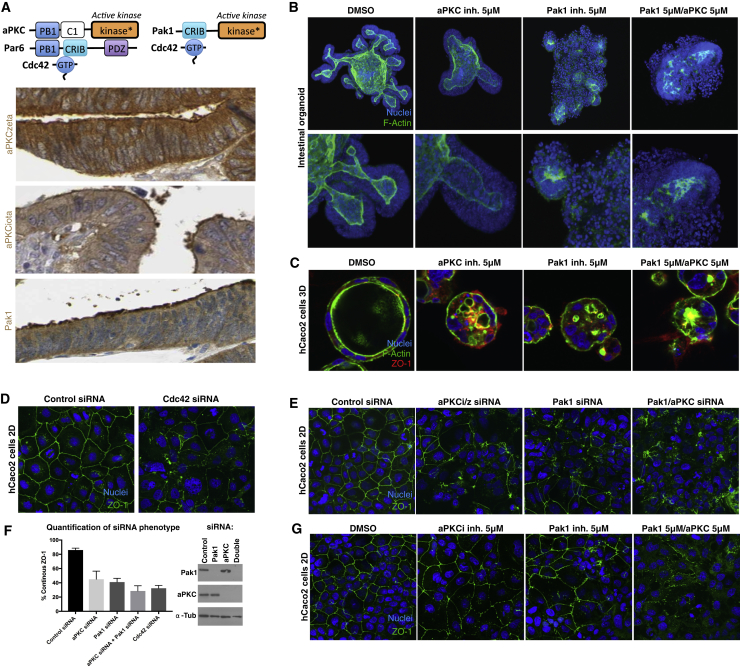
Epithelial cells are polarized along their apical-basal axis by the action of the small GTPase Cdc42, which is known to activate the aPKC kinase at the apical domain. However, loss of aPKC kinase activity was reported to have only mild effects on epithelial cell polarity. Here, we show that Cdc42 also activates a second kinase, Pak1, to specify apical domain identity in Drosophila and mammalian epithelia. aPKC and Pak1 phosphorylate an overlapping set of polarity substrates in kinase assays. Inactivating both aPKC kinase activity and the Pak1 kinase leads to a complete loss of epithelial polarity and morphology, with cells losing markers of apical polarization such as Crumbs, Par3/Bazooka, or ZO-1. This function of Pak1 downstream of Cdc42 is distinct from its role in regulating integrins or E-cadherin. Our results define a conserved dual-kinase mechanism for the control of apical membrane identity in epithelia.
上皮细胞沿其顶端-基底轴被小 GTPase Cdc42 极化,已知 Cdc42 在顶端域激活 aPKC 激酶。然而,报道称 aPKC 激酶活性的丧失对上皮细胞极性只有轻微影响。在这里,我们表明 Cdc42 还激活了第二种激酶 Pak1,以在果蝇和哺乳动物上皮细胞中指定顶端域的身份。在激酶测定中,aPKC 和 Pak1 磷酸化一组重叠的极性底物。失活 aPKC 激酶活性和 Pak1 激酶导致上皮极性和形态完全丧失,细胞失去顶端极化的标志物,如 Crumbs、Par3/Bazooka 或 ZO-1。Cdc42 下游 Pak1 的这一功能与它在调节整合素或 E-钙粘蛋白中的作用不同。我们的结果定义了一个保守的双激酶机制,用于控制上皮细胞中顶端膜的身份。