Burns Michael C, Howes Jennifer E, Sun Qi, Little Andrew J, Camper DeMarco V, Abbott Jason R, Phan Jason, Lee Taekyu, Waterson Alex G, Rossanese Olivia W, Fesik Stephen W
Vanderbilt University School of Medicine, Department of Biochemistry, 2215 Garland Ave., 607 Light Hall, Nashville, TN, 37232-0146, USA.
Vanderbilt University School of Medicine, Department of Biochemistry, 2215 Garland Ave., 607 Light Hall, Nashville, TN, 37232-0146, USA.
Anal Biochem. 2018 May 1;548:44-52. doi: 10.1016/j.ab.2018.01.025. Epub 2018 Feb 11.
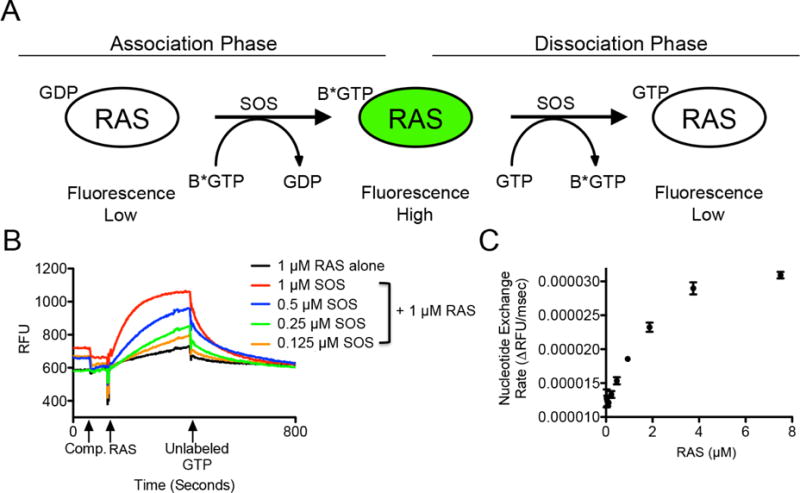
K-RAS is mutated in approximately 30% of human cancers, resulting in increased RAS signaling and tumor growth. Thus, RAS is a highly validated therapeutic target, especially in tumors of the pancreas, lung and colon. Although directly targeting RAS has proven to be challenging, it may be possible to target other proteins involved in RAS signaling, such as the guanine nucleotide exchange factor Son of Sevenless (SOS). We have previously reported on the discovery of small molecules that bind to SOS1, activate SOS-mediated nucleotide exchange on RAS, and paradoxically inhibit ERK phosphorylation (Burns et al., PNAS, 2014). Here, we describe the discovery of additional, structurally diverse small molecules that also bind to SOS1 in the same pocket and elicit similar biological effects. We tested >160,000 compounds in a fluorescence-based assay to assess their effects on SOS-mediated nucleotide exchange. X-Ray structures revealed that these small molecules bind to the CDC25 domain of SOS1. Compounds that elicited high levels of nucleotide exchange activity in vitro increased RAS-GTP levels in cells, and inhibited phospho ERK levels at higher treatment concentrations. The identification of structurally diverse SOS1 binding ligands may assist in the discovery of new molecules designed to target RAS-driven tumors.
在大约30%的人类癌症中,K-RAS发生突变,导致RAS信号传导增强和肿瘤生长。因此,RAS是一个经过高度验证的治疗靶点,尤其是在胰腺、肺和结肠肿瘤中。尽管直接靶向RAS已被证明具有挑战性,但有可能靶向参与RAS信号传导的其他蛋白质,如鸟嘌呤核苷酸交换因子七号无翅之子(SOS)。我们之前曾报道发现了与SOS1结合、激活SOS介导的RAS核苷酸交换并反常抑制ERK磷酸化的小分子(Burns等人,《美国国家科学院院刊》,2014年)。在此,我们描述了另外一些结构多样的小分子的发现,这些小分子也在同一口袋中与SOS1结合并引发类似的生物学效应。我们在基于荧光的检测中测试了超过160,000种化合物,以评估它们对SOS介导的核苷酸交换的影响。X射线结构显示这些小分子与SOS1的CDC25结构域结合。在体外引发高水平核苷酸交换活性的化合物会增加细胞中的RAS-GTP水平,并在较高处理浓度下抑制磷酸化ERK水平。鉴定结构多样的SOS1结合配体可能有助于发现旨在靶向RAS驱动肿瘤的新分子。