Department of Cardiology, Shanghai General Hospital, School of Medicine, Shanghai Jiao Tong University, Shanghai 200080, China.
Mediators Inflamm. 2017;2017:3102737. doi: 10.1155/2017/3102737. Epub 2017 Dec 27.
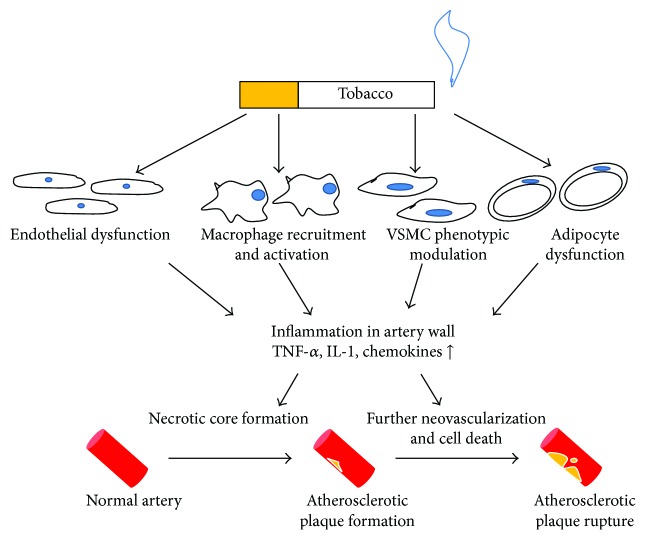
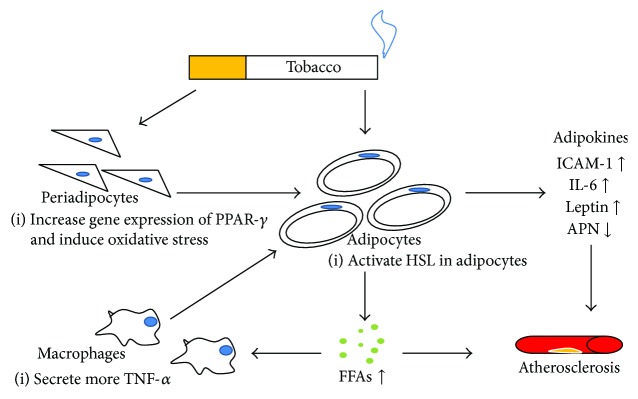
Smoking is an established risk factor for atherosclerosis through several underlying pathways. Moreover, in the development of atherosclerotic plaque formation, obesity, defined as excess fat mass accumulation, also plays a vital role in dyslipidemia and insulin resistance. Substantial evidence shows that cigarette smoking induces multiple pathological effects in adipose tissue, such as differentiation of adipocytes, lipolysis, and secretion properties in adipose tissue. Therefore, there is an emerging speculation in which adipose tissue abnormality induced by smoking or nicotine is likely to accelerate the progression of atherosclerosis. Herein, this review aims to investigate the possible interplay between smoking and adipose tissue dysfunction in the development of atherosclerosis.
吸烟是动脉粥样硬化的既定危险因素,涉及多种潜在途径。此外,在动脉粥样硬化斑块形成的过程中,肥胖(定义为脂肪过度堆积)也在血脂异常和胰岛素抵抗中起着至关重要的作用。大量证据表明,吸烟会在脂肪组织中引起多种病理作用,如脂肪细胞分化、脂肪分解和脂肪组织的分泌特性。因此,有一个新的推测认为,吸烟或尼古丁引起的脂肪组织异常可能会加速动脉粥样硬化的进展。本文旨在探讨吸烟与脂肪组织功能障碍在动脉粥样硬化发展中的可能相互作用。