Division of Pulmonary and Critical Care Medicine, Brigham and Women's Hospital, Boston, MA, United States.
Trans-NIH Center for Human Immunology, Autoimmunity, and Inflammation (CHI), National Institutes of Health, Bethesda, MD, United States.
Front Immunol. 2018 Jan 31;9:76. doi: 10.3389/fimmu.2018.00076. eCollection 2018.
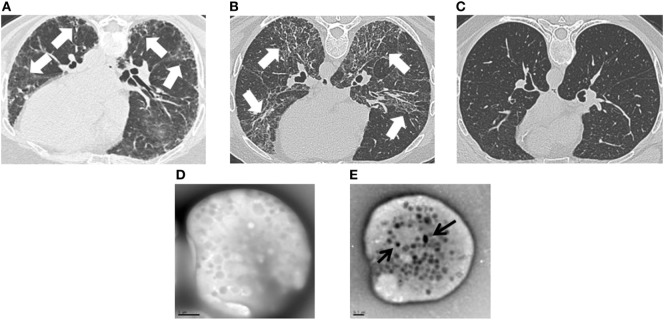
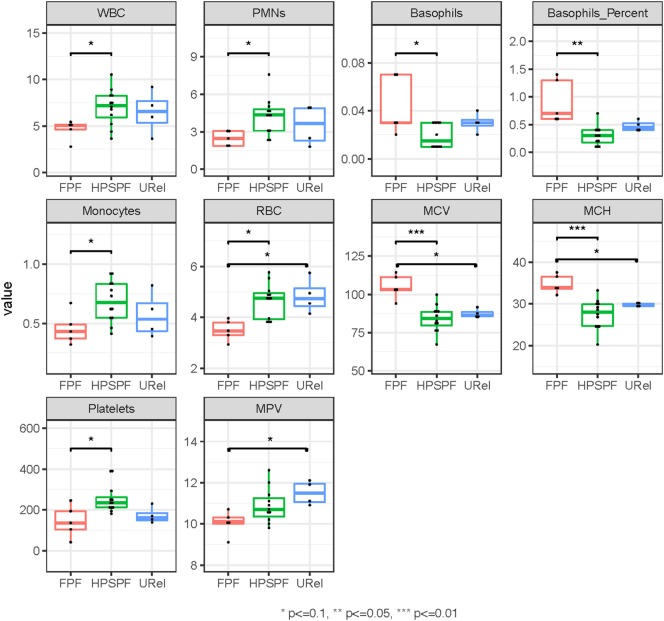
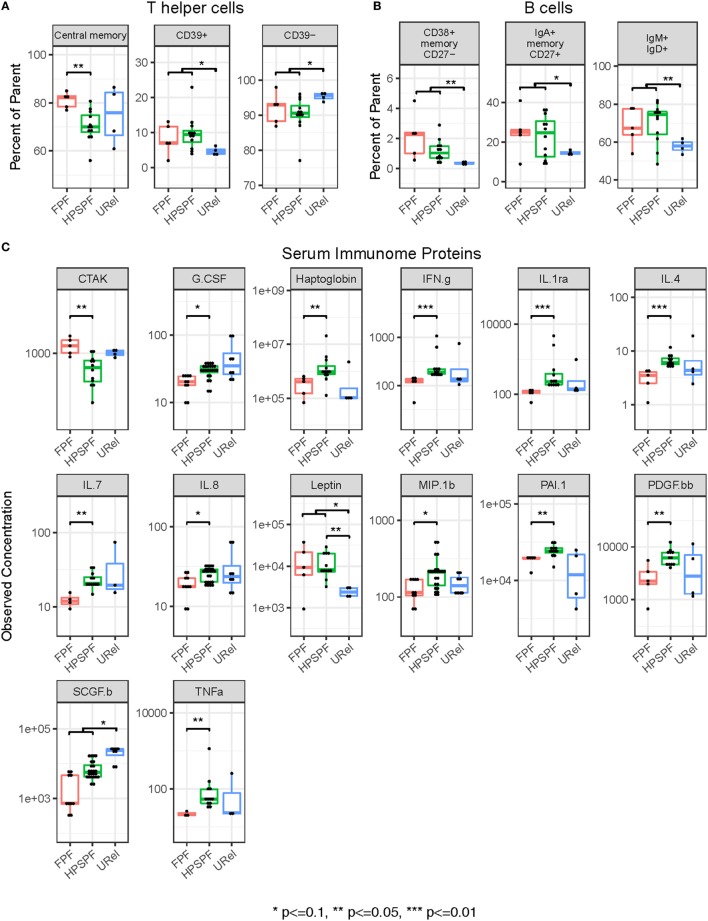
The immunome (immune cell phenotype, gene expression, and serum cytokines profiling) in pulmonary fibrosis is incompletely defined. Studies focusing on inherited forms of pulmonary fibrosis provide insights into mechanisms of fibrotic lung disease in general. To define the cellular and molecular immunologic phenotype in peripheral blood, high-dimensional flow cytometry and large-scale gene expression of peripheral blood mononuclear cells and serum proteomic multiplex analyses were performed and compared in a cohort with familial pulmonary fibrosis (FPF), an autosomal dominant disorder with incomplete penetrance; Hermansky-Pudlak syndrome pulmonary fibrosis (HPSPF), a rare autosomal recessive disorder; and their unaffected relatives. Our results showed high peripheral blood concentrations of activated central memory helper cells in patients with FPF. Proportions of CD38 memory CD27 B-cells, IgA memory CD27 B-cells, IgM and IgD B-cells, and CD39 T helper cells were increased whereas those of CD39 T helper cells were reduced in patients affected with either familial or HPSPF. Gene expression and serum proteomic analyses revealed enrichment of upregulated genes associated with mitosis and cell cycle control in circulating mononuclear cells as well as altered levels of several analytes, including leptin, cytokines, and growth factors. In conclusion, dysregulation of the extra-pulmonary immunome is a phenotypic feature of FPF or HPSPF. Further studies investigating the blood immunome are indicated to determine the role of immune system dysregulation in the pathogenesis of pulmonary fibrosis.
www.ClinicalTrials.gov, identifiers NCT00968084, NCT01200823, NCT00001456, and NCT00084305.
肺纤维化的免疫组(免疫细胞表型、基因表达和血清细胞因子谱)尚未完全定义。专注于遗传性肺纤维化的研究为一般纤维化肺疾病的机制提供了深入了解。为了定义外周血中的细胞和分子免疫学表型,对家族性肺纤维化(FPF)、一种不完全外显的常染色体显性遗传疾病;Hermansky-Pudlak 综合征肺纤维化(HPSPF)、一种罕见的常染色体隐性遗传疾病;及其未受影响的亲属的外周血单个核细胞进行了高维流式细胞术和大规模基因表达以及血清蛋白组学多重分析,并进行了比较。我们的结果表明,FPF 患者外周血中激活的中央记忆辅助细胞浓度较高。CD38 记忆 CD27 B 细胞、IgA 记忆 CD27 B 细胞、IgM 和 IgD B 细胞以及 CD39 T 辅助细胞的比例增加,而家族性或 HPSPF 患者的 CD39 T 辅助细胞比例降低。基因表达和血清蛋白组学分析显示,循环单个核细胞中与有丝分裂和细胞周期控制相关的上调基因以及几种分析物(包括瘦素、细胞因子和生长因子)的水平发生改变。总之,肺外免疫组的失调是 FPF 或 HPSPF 的表型特征。进一步研究血液免疫组学以确定免疫系统失调在肺纤维化发病机制中的作用是必要的。
www.ClinicalTrials.gov,标识符 NCT00968084、NCT01200823、NCT00001456 和 NCT00084305。