Moradi Yousef, Nasehi Mahshid, Asadi-Lari Mohsen, Khamseh Mohamad Ebrahim, Baradaran Hamid Reza
Department of Epidemiology, School of Public Health, Iran University of Medical Sciences, Tehran, Iran.
Endocrine Research Center, Institute of Endocrinology and Metabolism, Iran University of Medical Sciences, Tehran, Iran.
Med J Islam Repub Iran. 2017 Mar 14;31:21. doi: 10.18869/mjiri.31.21. eCollection 2017.
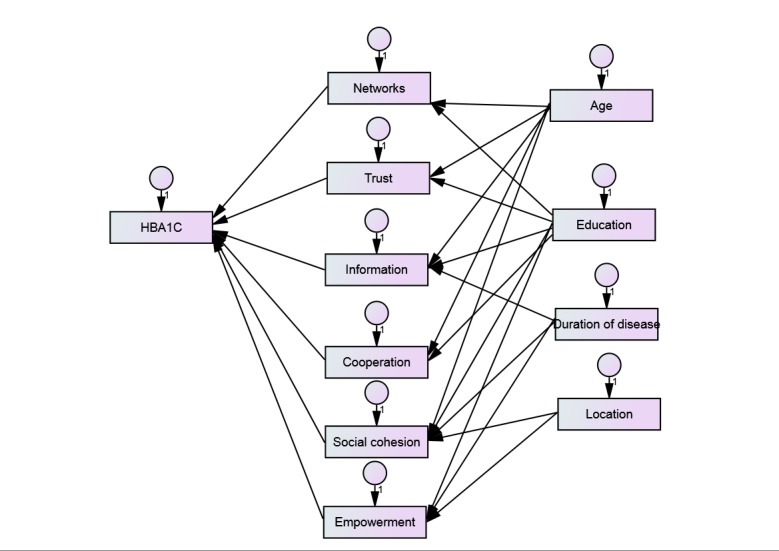
Social capital is an important interpersonal organizational resource that may affect health behaviors and seems to be an important factor in chronic diseases. Considering the lack of evidence on this topic, in the present study, we aimed at investigating the association between components of social capital, socioeconomic condition, and controlling Type 2 diabetes mellitus in Iran. This study was conducted on 300 patients with Type 2 diabetes in Tehran, Iran. In this study, simple random sampling method was used for data collection. Path analysis model was used to examine the potential association between social capital components and to determine the factors that control Type 2 diabetes. In the present study, most of the participants were female (70.7%) and married (78.7%). Path coefficients were calculated by a series of multiple regression analyses based on the conceptual model. The final model had a proper fit with Chi-square = 2.08 (DF = 1, P = 0.049), GFI = 0.542, AGFI = 0.915, NFI = 0.228, RFI = 0.284, IFI = 0.299, TLI = 0.292, CFI = 0.219, and RMSEA = 0.033. The Groups and networks (network) (β = 0.051, p = 0.036) and trust and solidarity (β = -0.018, p = 0.028) had a direct positive and negative effect on HbA1C, respectively. The results also revealed that education levels had a direct positive effect on groups and networks (network) (β = 0.118, p = 0.036), trust and solidarity (β = 0.082, p = 0.007), information and communication (β = 0.037, p = 0.027), and contribution in team works and public activities (β = 0.064, p = 0.003). In addition, education levels had an indirect positive effect on HbA1C through their effect on groups and networks (network), trust and solidarity, and information and communication. Social capital has a significant relationship with diabetes. Although it was not specified clearly which components of social capital were associated with diabetes, trust and solidarity showed a negative direct effect on HbA1C, respectively. Therefore, developing and implementing local and collective programs to build trust and increase the standards of social trust in patients with diabetes can be effective in controlling HbA1C.
社会资本是一种重要的人际组织资源,可能影响健康行为,并且似乎是慢性病的一个重要因素。鉴于关于这一主题的证据不足,在本研究中,我们旨在调查伊朗社会资本各组成部分、社会经济状况与2型糖尿病控制之间的关联。本研究针对伊朗德黑兰的300名2型糖尿病患者开展。在本研究中,采用简单随机抽样方法收集数据。路径分析模型用于检验社会资本各组成部分之间的潜在关联,并确定控制2型糖尿病的因素。在本研究中,大多数参与者为女性(70.7%)且已婚(78.7%)。基于概念模型,通过一系列多元回归分析计算路径系数。最终模型拟合良好,卡方值=2.08(自由度=1,P=0.049),GFI=0.542,AGFI=0.915,NFI=0.228,RFI=0.284,IFI=0.299,TLI=0.292,CFI=0.219,RMSEA=0.033。群体与网络(网络)(β=0.051,p=0.036)以及信任与团结(β=-0.018,p=0.028)分别对糖化血红蛋白(HbA1C)有直接的正向和负向影响。结果还显示,教育水平对群体与网络(网络)(β=0.118,p=0.036)、信任与团结(β=0.082,p=0.007)、信息与沟通(β=0.037,p=0.027)以及团队合作和公共活动中的贡献(β=0.064,p=0.003)有直接的正向影响。此外,教育水平通过对群体与网络(网络)、信任与团结以及信息与沟通的影响,对糖化血红蛋白(HbA1C)有间接的正向影响。社会资本与糖尿病存在显著关系。尽管未明确指出社会资本的哪些组成部分与糖尿病相关,但信任与团结分别对糖化血红蛋白(HbA1C)显示出负向直接影响。因此,制定和实施地方及集体项目以建立信任并提高糖尿病患者的社会信任水平,可能对控制糖化血红蛋白(HbA1C)有效。