• 文献检索
  • 文档翻译
  • 深度研究
  • 学术资讯
  • Suppr Zotero 插件Zotero 插件
  • 邀请有礼
  • 套餐&价格
  • 历史记录
应用&插件
Suppr Zotero 插件Zotero 插件浏览器插件Mac 客户端Windows 客户端微信小程序
定价
高级版会员购买积分包购买API积分包
服务
文献检索文档翻译深度研究API 文档MCP 服务
关于我们
关于 Suppr公司介绍联系我们用户协议隐私条款
关注我们

Suppr 超能文献

核心技术专利:CN118964589B侵权必究
粤ICP备2023148730 号-1Suppr @ 2026

文献检索

告别复杂PubMed语法,用中文像聊天一样搜索,搜遍4000万医学文献。AI智能推荐,让科研检索更轻松。

立即免费搜索

文件翻译

保留排版,准确专业,支持PDF/Word/PPT等文件格式,支持 12+语言互译。

免费翻译文档

深度研究

AI帮你快速写综述,25分钟生成高质量综述,智能提取关键信息,辅助科研写作。

立即免费体验

从安全数据中筛选:使用机器学习在社交数字媒体中识别个体病例安全报告。

Sorting Through the Safety Data Haystack: Using Machine Learning to Identify Individual Case Safety Reports in Social-Digital Media.

机构信息

Genentech, A Member of the Roche Group, Roche, South San Francisco, CA, USA.

IBM Watson Health, Cambridge, MA, USA.

出版信息

Drug Saf. 2018 Jun;41(6):579-590. doi: 10.1007/s40264-018-0641-7.

DOI:10.1007/s40264-018-0641-7
PMID:29446035
原文链接:https://pmc.ncbi.nlm.nih.gov/articles/PMC5966485/
Abstract

INTRODUCTION

There is increasing interest in social digital media (SDM) as a data source for pharmacovigilance activities; however, SDM is considered a low information content data source for safety data. Given that pharmacovigilance itself operates in a high-noise, lower-validity environment without objective 'gold standards' beyond process definitions, the introduction of large volumes of SDM into the pharmacovigilance workflow has the potential to exacerbate issues with limited manual resources to perform adverse event identification and processing. Recent advances in medical informatics have resulted in methods for developing programs which can assist human experts in the detection of valid individual case safety reports (ICSRs) within SDM.

OBJECTIVE

In this study, we developed rule-based and machine learning (ML) models for classifying ICSRs from SDM and compared their performance with that of human pharmacovigilance experts.

METHODS

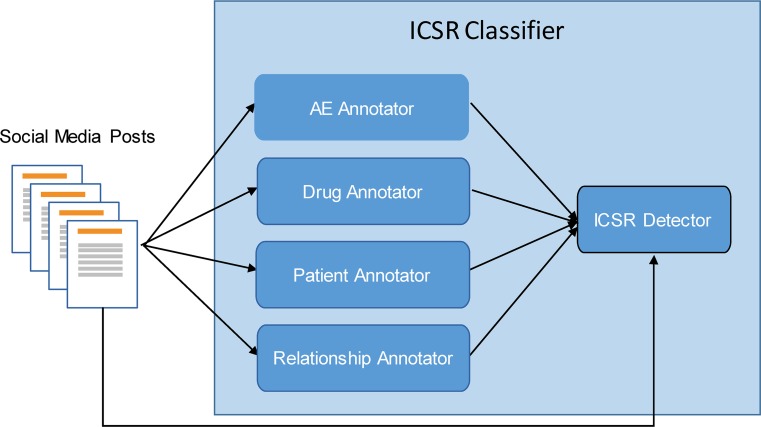
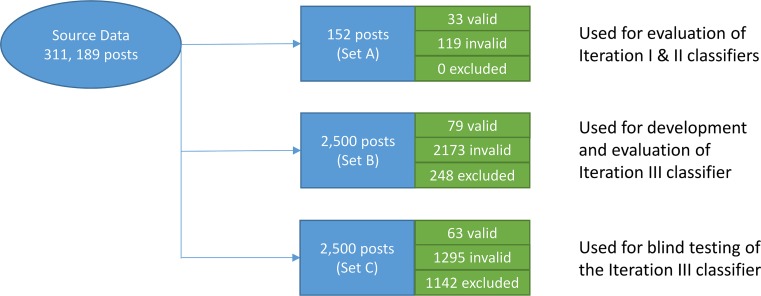
We used a random sampling from a collection of 311,189 SDM posts that mentioned Roche products and brands in combination with common medical and scientific terms sourced from Twitter, Tumblr, Facebook, and a spectrum of news media blogs to develop and evaluate three iterations of an automated ICSR classifier. The ICSR classifier models consisted of sub-components to annotate the relevant ICSR elements and a component to make the final decision on the validity of the ICSR. Agreement with human pharmacovigilance experts was chosen as the preferred performance metric and was evaluated by calculating the Gwet AC1 statistic (gKappa). The best performing model was tested against the Roche global pharmacovigilance expert using a blind dataset and put through a time test of the full 311,189-post dataset.

RESULTS

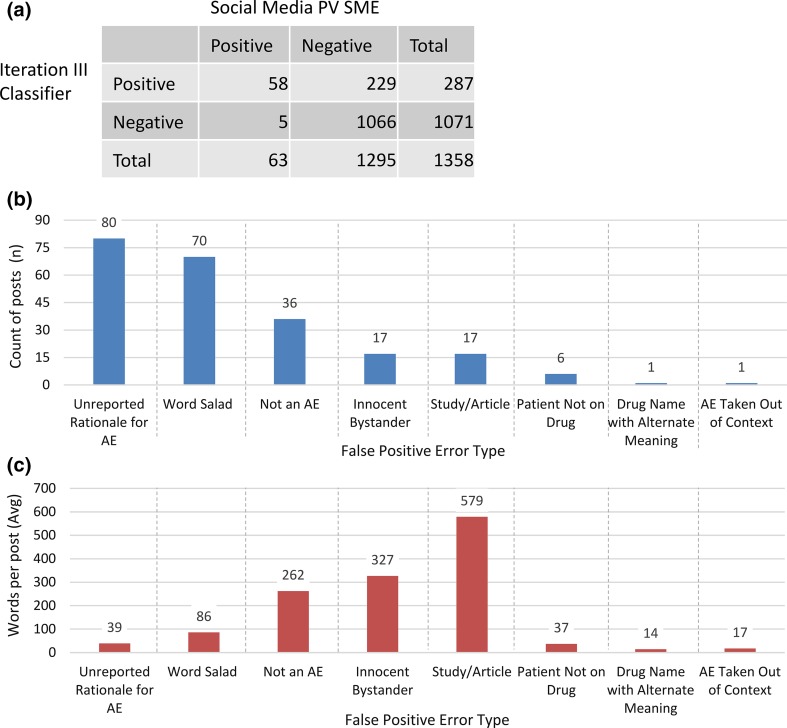
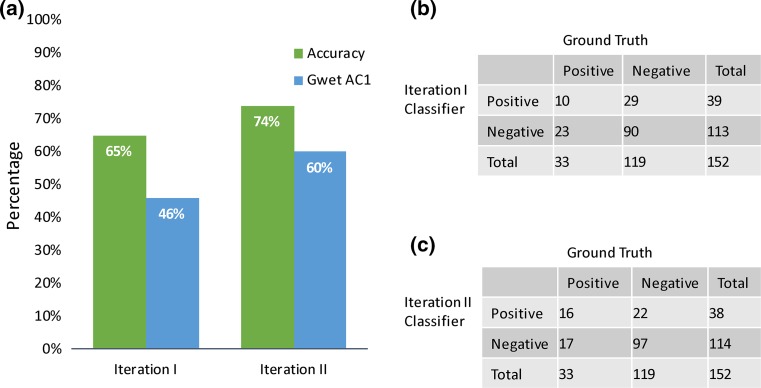
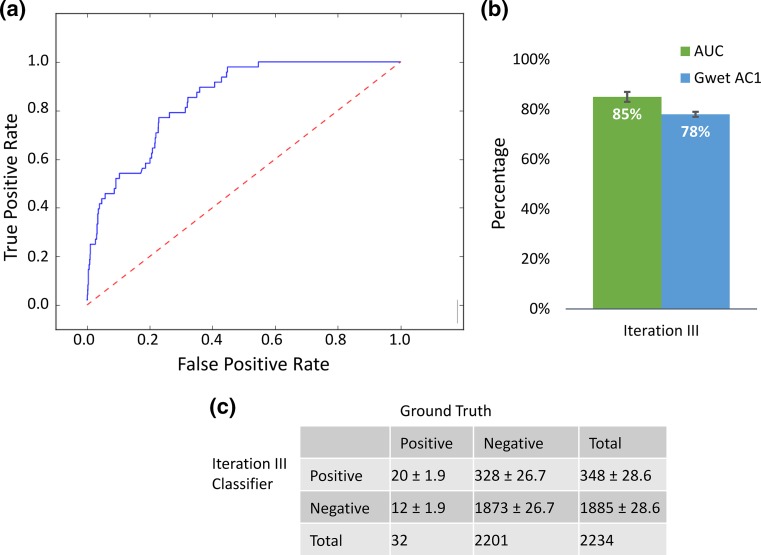
During this effort, the initial strict rule-based approach to ICSR classification resulted in a model with an accuracy of 65% and a gKappa of 46%. Adding an ML-based adverse event annotator improved the accuracy to 74% and gKappa to 60%. This was further improved by the addition of an additional ML ICSR detector. On a blind test set of 2500 posts, the final model demonstrated a gKappa of 78% and an accuracy of 83%. In the time test, it took the final model 48 h to complete a task that would have taken an estimated 44,000 h for human experts to perform.

CONCLUSION

The results of this study indicate that an effective and scalable solution to the challenge of ICSR detection in SDM includes a workflow using an automated ML classifier to identify likely ICSRs for further human SME review.

摘要

简介

社交数字媒体(SDM)作为药物警戒活动的数据来源,其重要性日益凸显;然而,SDM 被认为是安全性数据的低信息含量数据源。鉴于药物警戒本身在缺乏客观“黄金标准”的情况下运作,其定义仅限于流程,因此将大量 SDM 引入药物警戒工作流程可能会加剧由于手动资源有限而导致的识别和处理不良事件的问题。最近医学信息学的发展导致了开发程序的方法,这些方法可以帮助人类专家在 SDM 中检测有效的个体病例安全报告(ICSR)。

目的

在这项研究中,我们开发了基于规则和机器学习(ML)的模型,用于对 SDM 中的 ICSR 进行分类,并将其性能与人类药物警戒专家的性能进行了比较。

方法

我们使用来自 Roche 产品和品牌的 311189 个 SDM 帖子的随机抽样,以及来自 Twitter、Tumblr、Facebook 和一系列新闻媒体博客的常见医学和科学术语,开发并评估了三个迭代的自动化 ICSR 分类器。ICSR 分类器模型由子组件组成,用于注释相关的 ICSR 元素,以及组件用于对 ICSR 的有效性做出最终决定。选择与人类药物警戒专家的一致性作为首选性能指标,并通过计算 Gwet AC1 统计量(gKappa)进行评估。对表现最好的模型进行了盲测,使用 Roche 全球药物警戒专家对其进行了测试,并对整个 311189 个帖子数据集进行了时间测试。

结果

在这项研究中,最初严格的基于规则的 ICSR 分类方法导致模型的准确率为 65%,gKappa 为 46%。添加基于 ML 的不良事件注释器将准确率提高到 74%,gKappa 提高到 60%。通过添加另一个 ML ICSR 检测器进一步提高了性能。在一个 2500 个帖子的盲测集上,最终模型的 gKappa 为 78%,准确率为 83%。在时间测试中,最终模型完成任务耗时 48 小时,而人类专家完成这项任务的估计时间为 44000 小时。

结论

这项研究的结果表明,一种有效的、可扩展的解决方案,可以应对 SDM 中 ICSR 检测的挑战,该方案包括使用自动化 ML 分类器来识别可能的 ICSR,以供进一步的人类 SME 审查。
https://cdn.ncbi.nlm.nih.gov/pmc/blobs/ed9d/5966485/0b2453a75b99/40264_2018_641_Fig5_HTML.jpg
https://cdn.ncbi.nlm.nih.gov/pmc/blobs/ed9d/5966485/716afb22512c/40264_2018_641_Fig1_HTML.jpg
https://cdn.ncbi.nlm.nih.gov/pmc/blobs/ed9d/5966485/ecfbaa6fc237/40264_2018_641_Fig2_HTML.jpg
https://cdn.ncbi.nlm.nih.gov/pmc/blobs/ed9d/5966485/efb82f9fd8a8/40264_2018_641_Fig3_HTML.jpg
https://cdn.ncbi.nlm.nih.gov/pmc/blobs/ed9d/5966485/dae6e3a20eaf/40264_2018_641_Fig4_HTML.jpg
https://cdn.ncbi.nlm.nih.gov/pmc/blobs/ed9d/5966485/0b2453a75b99/40264_2018_641_Fig5_HTML.jpg
https://cdn.ncbi.nlm.nih.gov/pmc/blobs/ed9d/5966485/716afb22512c/40264_2018_641_Fig1_HTML.jpg
https://cdn.ncbi.nlm.nih.gov/pmc/blobs/ed9d/5966485/ecfbaa6fc237/40264_2018_641_Fig2_HTML.jpg
https://cdn.ncbi.nlm.nih.gov/pmc/blobs/ed9d/5966485/efb82f9fd8a8/40264_2018_641_Fig3_HTML.jpg
https://cdn.ncbi.nlm.nih.gov/pmc/blobs/ed9d/5966485/dae6e3a20eaf/40264_2018_641_Fig4_HTML.jpg
https://cdn.ncbi.nlm.nih.gov/pmc/blobs/ed9d/5966485/0b2453a75b99/40264_2018_641_Fig5_HTML.jpg

相似文献

1
Sorting Through the Safety Data Haystack: Using Machine Learning to Identify Individual Case Safety Reports in Social-Digital Media.从安全数据中筛选:使用机器学习在社交数字媒体中识别个体病例安全报告。
Drug Saf. 2018 Jun;41(6):579-590. doi: 10.1007/s40264-018-0641-7.
2
Towards Automating Adverse Event Review: A Prediction Model for Case Report Utility.迈向不良事件审查自动化:病例报告效用预测模型
Drug Saf. 2020 Apr;43(4):329-338. doi: 10.1007/s40264-019-00897-0.
3
Development of a multivariate prediction model to identify individual case safety reports which require clinical review.开发一种多变量预测模型,以识别需要临床审查的个体病例安全报告。
Pharmacoepidemiol Drug Saf. 2022 Dec;31(12):1300-1307. doi: 10.1002/pds.5553. Epub 2022 Oct 21.
4
Leveraging Machine Learning to Facilitate Individual Case Causality Assessment of Adverse Drug Reactions.利用机器学习促进药物不良反应个体病例因果关系评估。
Drug Saf. 2022 May;45(5):571-582. doi: 10.1007/s40264-022-01163-6. Epub 2022 May 17.
5
Adverse Drug Reaction Case Safety Practices in Large Biopharmaceutical Organizations from 2007 to 2017: An Industry Survey.2007年至2017年大型生物制药组织中的药品不良反应案例安全实践:一项行业调查
Pharmaceut Med. 2019 Dec;33(6):499-510. doi: 10.1007/s40290-019-00307-x.
6
Training Augmented Intelligent Capabilities for Pharmacovigilance: Applying Deep-learning Approaches to Individual Case Safety Report Processing.培养用于药物警戒的增强智能能力:将深度学习方法应用于个体病例安全报告处理
Pharmaceut Med. 2018;32(6):391-401. doi: 10.1007/s40290-018-0251-9. Epub 2018 Oct 13.
7
Individual Case Safety Report Replication: An Analysis of Case Reporting Transmission Networks.个体病例安全报告复制:病例报告传播网络分析。
Drug Saf. 2023 Jan;46(1):39-52. doi: 10.1007/s40264-022-01251-7. Epub 2022 Dec 24.
8
Automation Opportunities in Pharmacovigilance: An Industry Survey.药物警戒中的自动化机遇:一项行业调查
Pharmaceut Med. 2020 Feb;34(1):7-18. doi: 10.1007/s40290-019-00320-0.
9
Identification of Substandard Medicines via Disproportionality Analysis of Individual Case Safety Reports.通过个体病例安全报告的不成比例分析识别不合格药品。
Drug Saf. 2017 Apr;40(4):293-303. doi: 10.1007/s40264-016-0499-5.
10
Evaluation of Facebook and Twitter Monitoring to Detect Safety Signals for Medical Products: An Analysis of Recent FDA Safety Alerts.评估脸书和推特监测以检测医疗产品安全信号:对美国食品药品监督管理局近期安全警报的分析
Drug Saf. 2017 Apr;40(4):317-331. doi: 10.1007/s40264-016-0491-0.

引用本文的文献

1
Pharmacovigilance in the digital age: gaining insight from social media data.数字时代的药物警戒:从社交媒体数据中获取见解
Exp Biol Med (Maywood). 2025 May 27;250:10555. doi: 10.3389/ebm.2025.10555. eCollection 2025.
2
Artificial intelligence integration in the drug lifecycle and in regulatory science: policy implications, challenges and opportunities.人工智能在药物生命周期和监管科学中的整合:政策影响、挑战与机遇。
Front Pharmacol. 2024 Aug 2;15:1437167. doi: 10.3389/fphar.2024.1437167. eCollection 2024.
3
Using Healthcare Resources Wisely: A Predictive Support System Regarding the Severity of Patient Falls.

本文引用的文献

1
Social Media Monitoring and Adverse Drug Reaction Reporting in Pharmacovigilance: An Overview of the Regulatory Landscape.药物警戒中的社交媒体监测与药品不良反应报告:监管格局概述
Ther Innov Regul Sci. 2017 Jan;51(1):125-131. doi: 10.1177/2168479016663264. Epub 2016 Sep 27.
2
Deep learning for pharmacovigilance: recurrent neural network architectures for labeling adverse drug reactions in Twitter posts.用于药物警戒的深度学习:用于标记推特帖子中药物不良反应的循环神经网络架构
J Am Med Inform Assoc. 2017 Jul 1;24(4):813-821. doi: 10.1093/jamia/ocw180.
3
Using Social Listening Data to Monitor Misuse and Nonmedical Use of Bupropion: A Content Analysis.
明智利用医疗资源:一个关于患者跌倒严重程度的预测支持系统。
J Healthc Eng. 2022 Aug 1;2022:3100618. doi: 10.1155/2022/3100618. eCollection 2022.
4
The Use of Artificial Intelligence in Pharmacovigilance: A Systematic Review of the Literature.人工智能在药物警戒中的应用:文献系统评价。
Pharmaceut Med. 2022 Oct;36(5):295-306. doi: 10.1007/s40290-022-00441-z. Epub 2022 Jul 29.
5
Supervised Machine Learning-Based Decision Support for Signal Validation Classification.基于监督机器学习的信号验证分类决策支持。
Drug Saf. 2022 May;45(5):583-596. doi: 10.1007/s40264-022-01159-2. Epub 2022 May 17.
6
Machine Learning in Causal Inference: Application in Pharmacovigilance.机器学习在因果推断中的应用:在药物警戒中的应用。
Drug Saf. 2022 May;45(5):459-476. doi: 10.1007/s40264-022-01155-6. Epub 2022 May 17.
7
Artificial Intelligence, Real-World Automation and the Safety of Medicines.人工智能、真实世界自动化与药品安全。
Drug Saf. 2021 Feb;44(2):125-132. doi: 10.1007/s40264-020-01001-7. Epub 2020 Oct 7.
8
Using Item Response Theory for Explainable Machine Learning in Predicting Mortality in the Intensive Care Unit: Case-Based Approach.应用项目反应理论进行可解释机器学习预测重症监护病房死亡率:基于案例的方法。
J Med Internet Res. 2020 Sep 25;22(9):e20268. doi: 10.2196/20268.
9
Utilizing Advanced Technologies to Augment Pharmacovigilance Systems: Challenges and Opportunities.利用先进技术增强药物警戒系统:挑战与机遇。
Ther Innov Regul Sci. 2020 Jul;54(4):888-899. doi: 10.1007/s43441-019-00023-3. Epub 2019 Dec 28.
10
Adverse Events Due to Insomnia Drugs Reported in a Regulatory Database and Online Patient Reviews: Comparative Study.监管数据库和在线患者评论中报告的失眠药物不良事件:比较研究
J Med Internet Res. 2019 Nov 8;21(11):e13371. doi: 10.2196/13371.
利用社交倾听数据监测安非他酮的滥用和非医疗用途:一项内容分析。
JMIR Public Health Surveill. 2017 Feb 1;3(1):e6. doi: 10.2196/publichealth.6174.
4
Evaluation of Facebook and Twitter Monitoring to Detect Safety Signals for Medical Products: An Analysis of Recent FDA Safety Alerts.评估脸书和推特监测以检测医疗产品安全信号:对美国食品药品监督管理局近期安全警报的分析
Drug Saf. 2017 Apr;40(4):317-331. doi: 10.1007/s40264-016-0491-0.
5
Can social media data lead to earlier detection of drug-related adverse events?社交媒体数据能否促成药物相关不良事件的更早发现?
Pharmacoepidemiol Drug Saf. 2016 Dec;25(12):1425-1433. doi: 10.1002/pds.4090. Epub 2016 Sep 7.
6
Pharmacovigilance from social media: mining adverse drug reaction mentions using sequence labeling with word embedding cluster features.社交媒体中的药物警戒:使用带有词嵌入聚类特征的序列标注挖掘药物不良反应提及信息。
J Am Med Inform Assoc. 2015 May;22(3):671-81. doi: 10.1093/jamia/ocu041. Epub 2015 Mar 9.
7
Utilizing social media data for pharmacovigilance: A review.利用社交媒体数据进行药物警戒:综述
J Biomed Inform. 2015 Apr;54:202-12. doi: 10.1016/j.jbi.2015.02.004. Epub 2015 Feb 23.
8
A new dimension of health care: systematic review of the uses, benefits, and limitations of social media for health communication.医疗保健的一个新维度:社交媒体用于健康传播的用途、益处及局限性的系统综述
J Med Internet Res. 2013 Apr 23;15(4):e85. doi: 10.2196/jmir.1933.
9
Standardized assessment of reading performance: the New International Reading Speed Texts IReST.阅读表现的标准化评估:新国际阅读速度文本 IReST。
Invest Ophthalmol Vis Sci. 2012 Aug 13;53(9):5452-61. doi: 10.1167/iovs.11-8284.
10
Online social networking by patients with diabetes: a qualitative evaluation of communication with Facebook.糖尿病患者的在线社交网络:对 Facebook 交流的定性评估。
J Gen Intern Med. 2011 Mar;26(3):287-92. doi: 10.1007/s11606-010-1526-3. Epub 2010 Oct 13.