Zhang Shulan, Luo Jing, Wu Ziyan, Roggenbuck Dirk, Schierack Peter, Reinhold Dirk, Li Ji, Zeng Xiaofeng, Zhang Fengchun, Qian Jiaming, Li Yongzhe
Department of Rheumatology and Clinical Immunology, Peking Union Medical College Hospital, Chinese Academy of Medical Sciences & Peking Union Medical College, Key Laboratory of Rheumatology and Clinical Immunology, Ministry of Education, Beijing, China.
Division of Rheumatology, Department of Medicine, The Second Hospital of Shanxi Medical University, Shanxi, China.
Clin Transl Gastroenterol. 2018 Feb 15;9(2):e133. doi: 10.1038/ctg.2018.1.
There is an increasing need to identify reliable biomarkers for distinguishing Crohn's disease (CD) from other gastrointestinal disorders sharing similar clinical and pathological features. This study aimed at evaluating the diagnostic potential of antibodies to zymogen granule glycoprotein GP2 (aGP2) in a large, well-defined Chinese cohort with a special focus on their role in discriminating CD from intestinal Behçet's disease (BD) and intestinal tubercolosis (ITB).
A total of 577 subjects were prospectively enrolled, including 171 patients with CD, 208 patients with ulcerative colitis (UC), 71 with BD, 57 with ITB and 70 healthy controls (HC). aGP2 and anti-Saccharomyces cerevisiae antibodies (ASCA) were determined by ELISA. Perinuclear antineutrophil cytoplasmic antibodies were tested by indirect immunofluorescent assay.
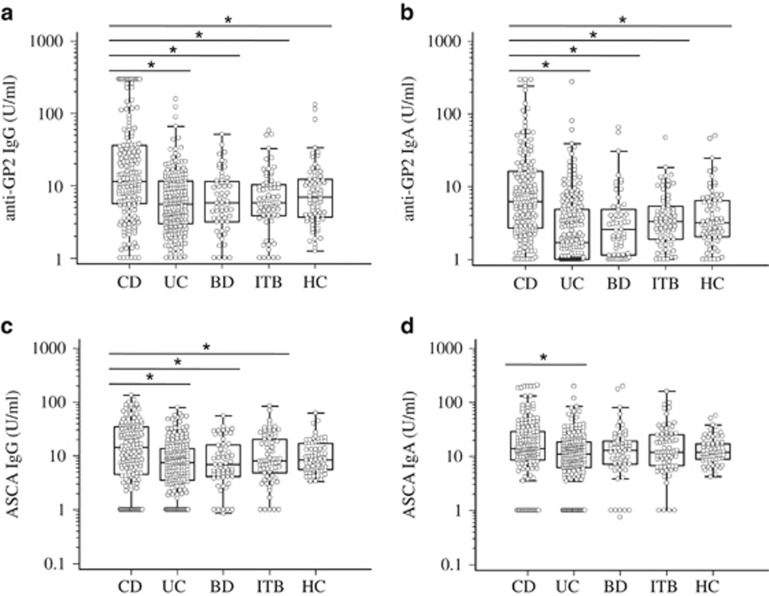
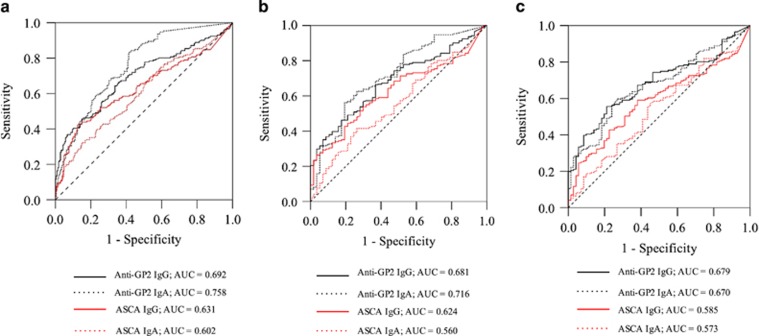
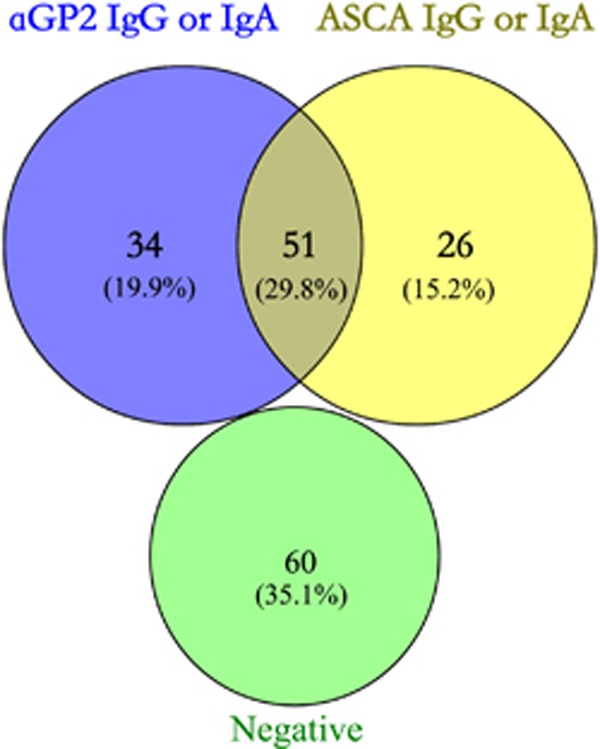
aGP2 IgG and IgA levels were significantly elevated in patients with CD compared with those in patients with UC, intestinal BD, and ITB and HC. Conversely, ASCA IgG levels were not different between CD and intestinal BD patients, whereas ASCA IgA levels did not discriminate CD from intestinal BD and ITB patients. aGP2 IgA and IgG displayed a better assay performance (larger areas under the curve) over ASCA IgA and IgG in differentiating CD from disease controls (P<0.05). ASCA IgA did not discriminate CD from disease controls. aGP2 IgA and/or IgG was significantly associated with penetrating disease (B3) and ileal CD (L1) (P<0.05), whereas ASCA IgA and/or IgG was not.
In comparison with ASCA, aGP2 distinguishes CD from intestinal BD or ITB as disease controls more efficiently, aiding in the differential diagnosis of IBD.
越来越需要识别可靠的生物标志物,以将克罗恩病(CD)与具有相似临床和病理特征的其他胃肠道疾病区分开来。本研究旨在评估在中国一个大规模、明确界定的队列中,针对酶原颗粒糖蛋白GP2的抗体(aGP2)的诊断潜力,特别关注其在鉴别CD与肠道白塞病(BD)和肠结核(ITB)中的作用。
前瞻性纳入577名受试者,包括171例CD患者、208例溃疡性结肠炎(UC)患者、71例BD患者、57例ITB患者和70名健康对照(HC)。采用酶联免疫吸附测定(ELISA)法检测aGP2和抗酿酒酵母抗体(ASCA)。采用间接免疫荧光法检测核周抗中性粒细胞胞浆抗体。
与UC、肠道BD、ITB患者及HC相比,CD患者的aGP2 IgG和IgA水平显著升高。相反,CD患者与肠道BD患者的ASCA IgG水平无差异,而ASCA IgA水平无法区分CD患者与肠道BD和ITB患者。在区分CD与疾病对照方面,aGP2 IgA和IgG的检测性能(曲线下面积更大)优于ASCA IgA和IgG(P<0.05)。ASCA IgA无法区分CD与疾病对照。aGP2 IgA和/或IgG与穿透性疾病(B3)和回肠CD(L1)显著相关(P<0.05),而ASCA IgA和/或IgG则无此相关性。
与ASCA相比,aGP2能更有效地将CD与作为疾病对照的肠道BD或ITB区分开来,有助于炎症性肠病的鉴别诊断。