Center for Liver Research, School of Digestive and Liver Diseases, Institute of Post Graduate Medical Education and Research, 244, Acharya Jagadish Chandra Bose Road, Kolkata, West Bengal, 700020, India.
Department of Human Genetics, Indian Statistical Institute, Kolkata, India.
Sci Rep. 2021 Dec 2;11(1):23303. doi: 10.1038/s41598-021-02383-z.
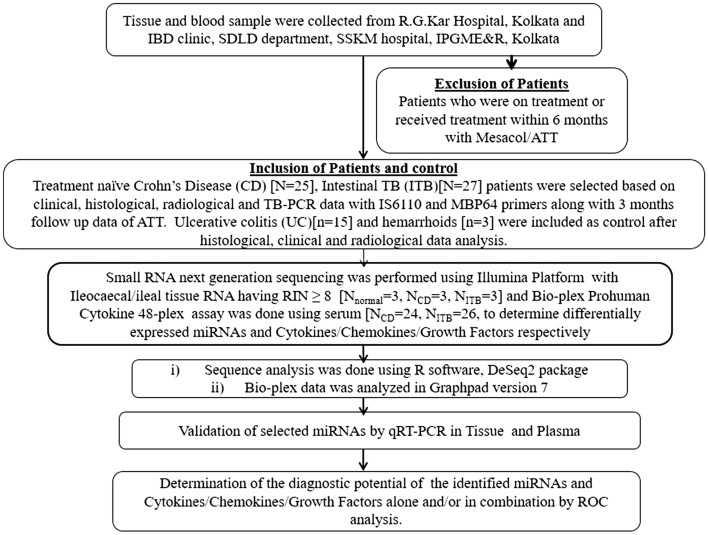
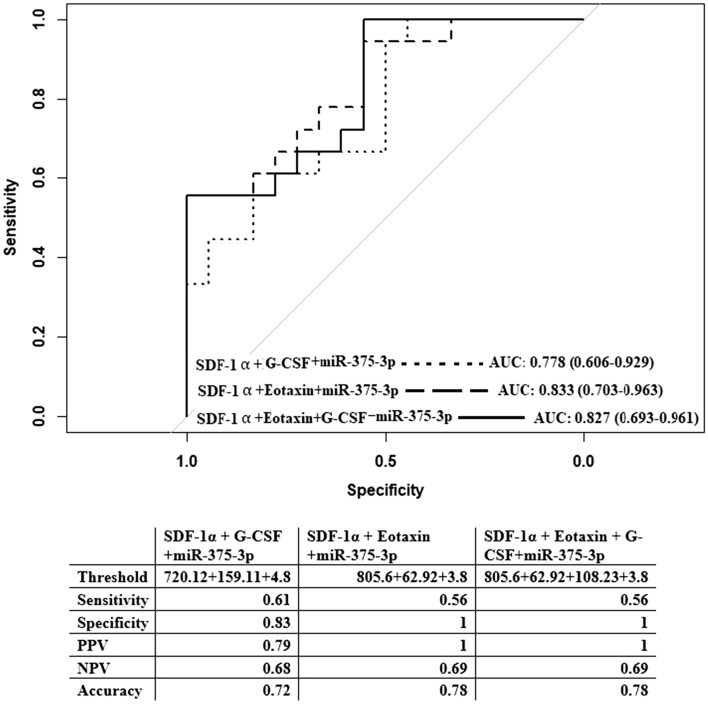
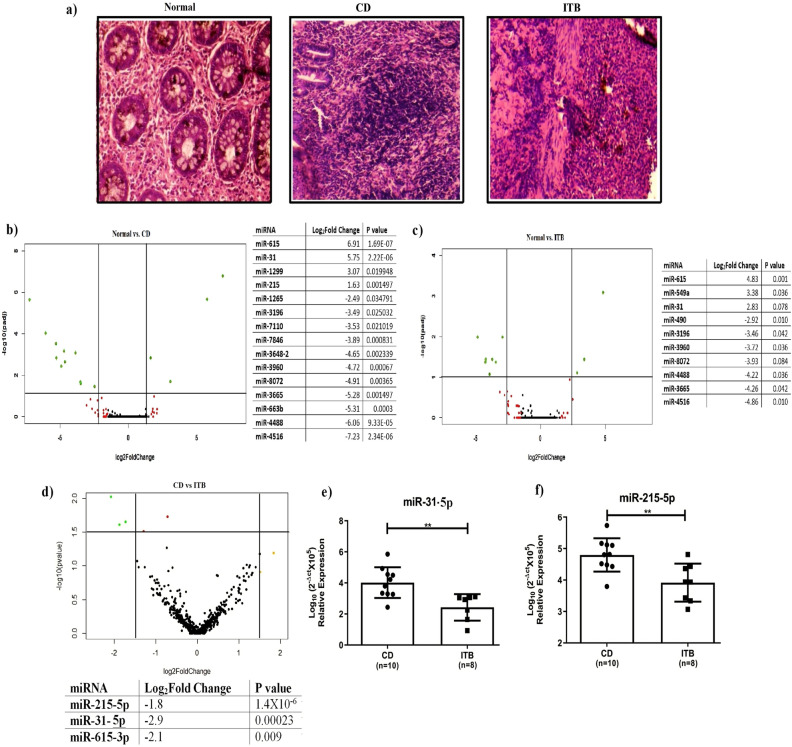
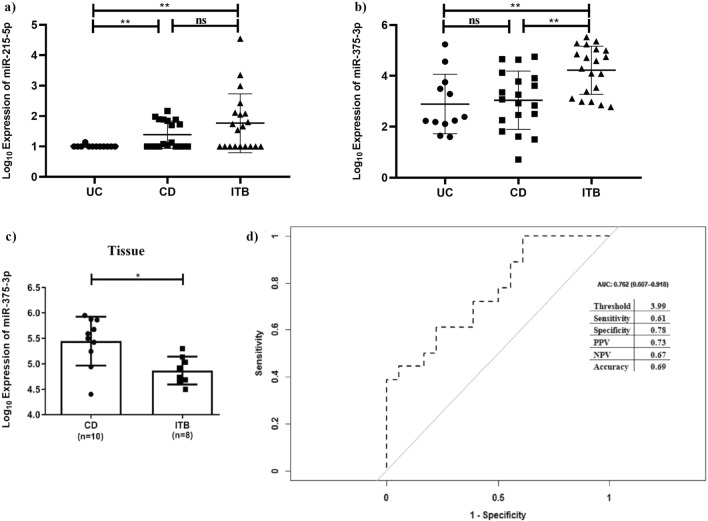
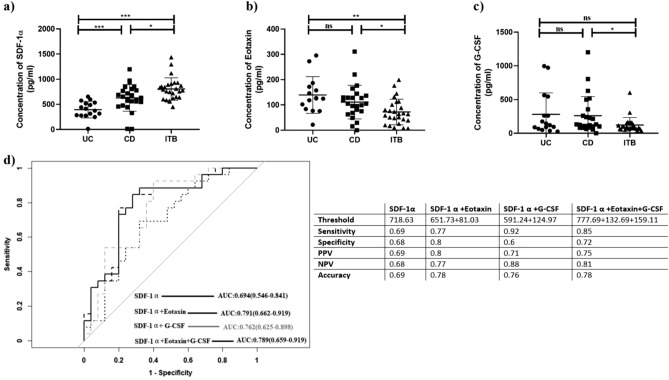
Differentiation of Crohn's disease (CD) from intestinal tuberculosis (ITB) is a big challenge to gastroenterologists because of their indistinguishable features and insensitive diagnostic tools. A non-invasive biomarker is urgently required to distinguish ITB/CD patients particularly in India, a TB endemic region, where CD frequency is increasing rapidly due to urbanization. Among the three differentially expressed miRNAs obtained from small RNA transcriptomic profiling of ileocaecal/terminal ileal tissue of ITB/CD patients (n = 3), only two down-regulated miRNAs, miR-31-5p, and miR-215-5p showed comparable data in qRT-PCR. Out of which, only miR-215-5p was detectable in the patient's plasma, but there was no significant difference in expression between ITB/CD. On the other hand, miR-375-3p, the pulmonary TB specific marker was found in higher amount in the plasma of ITB patients than CD while reverse expression was observed in the ileocaecal/terminal ileal tissues of the same patients. Next, using Bioplex pro-human cytokine 48-plex screening panel, only three chemokines, Eotaxin-1/CCL11, SDF-1α/CXCL12, and G-CSF have noted significantly different levels in the serum of ITB/CD patients. ROC analysis has revealed that compared to a single molecule, a combination of miR-375-3p + Eotaxin-1/CCL11 + SDF-1α /CXCL12 + G-CSF showed a better AUC of 0.83, 95% CI (0.69-0.96) with 100% specificity and positive predictive value while sensitivity, negative predictive value, and accuracy were 56%, 69%, and 78% respectively in distinguishing ITB from CD. This study suggests that a combination of plasma markers shows better potential in differentiating ITB from CD than a single marker and this panel of markers may be used for clinical management of ITB/CD patients.
鉴别克罗恩病(CD)与肠结核(ITB)是对胃肠病学家的一大挑战,因为这两种疾病的特征难以区分,且诊断工具不够敏感。由于城市化导致 CD 发病率迅速上升,印度是结核病流行地区,因此急需一种非侵入性生物标志物来区分 ITB/CD 患者。在 ITB/CD 患者回肠末端/末端回肠组织的小 RNA 转录组谱分析中获得的三个差异表达 miRNA 中,只有两个下调的 miRNA(miR-31-5p 和 miR-215-5p)在 qRT-PCR 中得到了类似的数据。其中,只有 miR-215-5p 可在患者的血浆中检测到,但在 ITB/CD 患者中表达无显著差异。另一方面,miR-375-3p 是肺结核的特异性标志物,在 ITB 患者的血浆中含量高于 CD,而在同一患者的回肠末端/末端回肠组织中则呈相反的表达。接着,使用 Bioplex pro 人类细胞因子 48 plex 筛选试剂盒,仅在 ITB/CD 患者的血清中发现三种趋化因子,即嗜酸性粒细胞趋化因子-1/CCL11、基质细胞衍生因子-1α/CXCL12 和粒细胞集落刺激因子的水平有显著差异。ROC 分析显示,与单个分子相比,miR-375-3p+嗜酸性粒细胞趋化因子-1/CCL11+基质细胞衍生因子-1α/CXCL12+粒细胞集落刺激因子的组合具有更好的 AUC(0.83,95%CI:0.69-0.96),其特异性和阳性预测值为 100%,而敏感性、阴性预测值和准确性分别为 56%、69%和 78%,可用于鉴别 ITB 与 CD。该研究表明,与单个标志物相比,血浆标志物的组合在鉴别 ITB 与 CD 方面具有更好的潜力,该标志物组合可能用于 ITB/CD 患者的临床管理。