Lee Sihyoung, You Chang-Youn, Kim Joonghee, Jo You Hwan, Ro Young Sun, Kang Si-Hyuck, Lee Heeyoung
Department of Emergency Medicine, Seoul National University Bundang Hospital, Bundang-gu, Seongnam-si, Gyeonggi-do, Republic of Korea.
Laboratory of Emergency Medical Services, Seoul National University Hospital Biomedical Research Institute, Jongno-gu, Seoul, Republic of Korea.
PLoS One. 2018 Feb 15;13(2):e0191738. doi: 10.1371/journal.pone.0191738. eCollection 2018.
Hypertension-related visits to the emergency department (ED) are increasing every year. Thus, ED could play a significant role in detecting hypertension and providing necessary interventions. However, it is not known whether a hypertensive event observed in the ED is an independent risk factor for future major adverse cardiovascular events (MACE).
A population-based observational study was conducted using a nationally representative cohort that contained the claim data of 1 million individuals from 2002 to 2013. We included non-critical ED visits without any history of MACE, and compared the new occurrences of MACE according to the presence of hypertensive events using extended Cox regression model. The disease-modifying effect of a follow-up visit was assessed by analyzing the interaction between hypertensive event and follow-up visit.
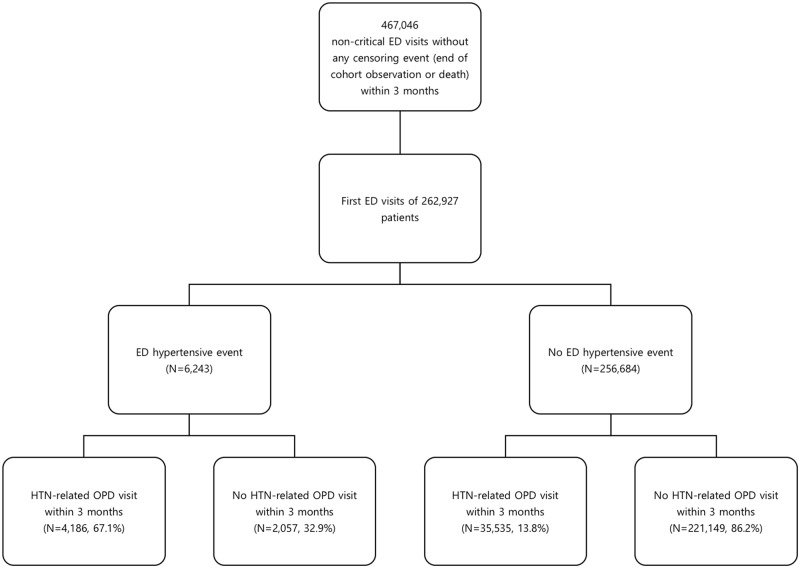
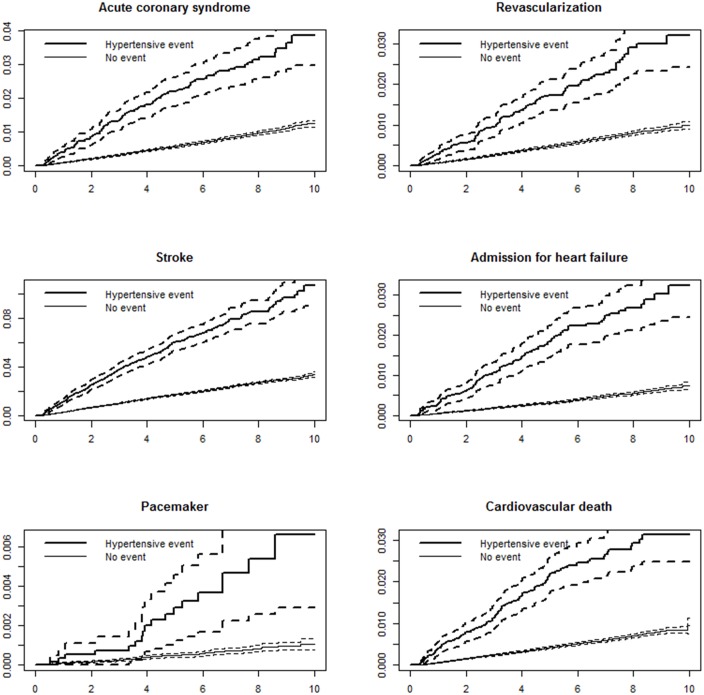
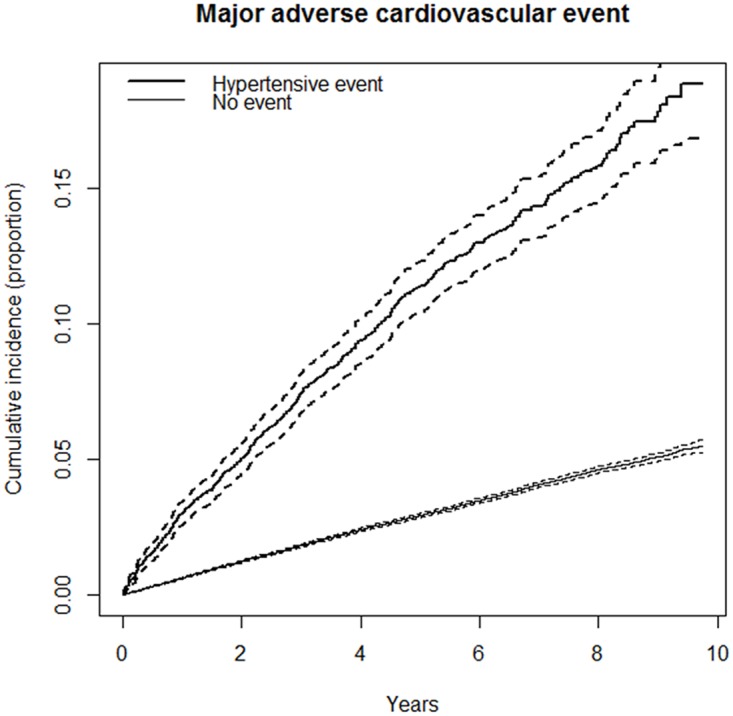
Among 262,927 first non-critical ED visits during the study period (from 2004 to 2013), 6,243 (2.4%) visits were accompanied by a hypertensive event. The hypertensive event group had a higher risk of having a first MACE at 3 pre-specified intervals: 0-3 years (HR, 4.25; 95% CI, 3.83-4.71; P<0.001), 4-6 years (HR, 3.65; 95% CI, 3.14-4.24; P<0.001), and 7-10 years (HR, 3.20; 95% CI, 2.50-4.11; P<0.001). Follow-up visits showed significant disease-modifying effect at 2 intervals: 0-3 years (HR 0.65, 95% CI, 0.50-0.83) and 4-7 years (HR 0.68, 95% CI, 0.48-0.95).
A hypertensive event in the ED is an independent risk factor for MACE, and follow-up visits after the event can significantly modify the risk.
每年因高血压前往急诊科(ED)就诊的人数都在增加。因此,急诊科在检测高血压和提供必要干预措施方面可以发挥重要作用。然而,尚不清楚在急诊科观察到的高血压事件是否是未来主要不良心血管事件(MACE)的独立危险因素。
使用一个具有全国代表性的队列进行了一项基于人群的观察性研究,该队列包含了2002年至2013年100万人的索赔数据。我们纳入了没有任何MACE病史的非危急急诊科就诊病例,并使用扩展Cox回归模型根据是否存在高血压事件比较MACE的新发病例。通过分析高血压事件与随访就诊之间的相互作用来评估随访就诊的疾病改善效果。
在研究期间(2004年至2013年)的262,927例首次非危急急诊科就诊病例中,6,243例(2.4%)就诊伴有高血压事件。高血压事件组在3个预先设定的时间段内首次发生MACE的风险更高:0至3年(风险比[HR],4.25;95%置信区间[CI],3.83至4.71;P<0.001),4至6年(HR,3.65;95%CI,3.14至4.24;P<0.001),以及7至10年(HR,3.20;95%CI,2.50至4.11;P<0.001)。随访就诊在2个时间段显示出显著的疾病改善效果:0至3年(HR 0.65,95%CI,0.50至0.83)和4至7年(HR 0.68,95%CI,0.48至0.95)。
急诊科的高血压事件是MACE的独立危险因素,事件后的随访就诊可以显著改变风险。