Chen Katherine Y H, Messina Nicole, Germano Susie, Bonnici Rhian, Freyne Bridget, Cheung Michael, Goldsmith Greta, Kollmann Tobias R, Levin Michael, Burgner David, Curtis Nigel
Murdoch Children's Research Institute, The Royal Children's Hospital, Melbourne, Vic, Australia.
Department of Paediatrics, The University of Melbourne, Melbourne, Vic, Australia.
PLoS One. 2018 Feb 15;13(2):e0191830. doi: 10.1371/journal.pone.0191830. eCollection 2018.
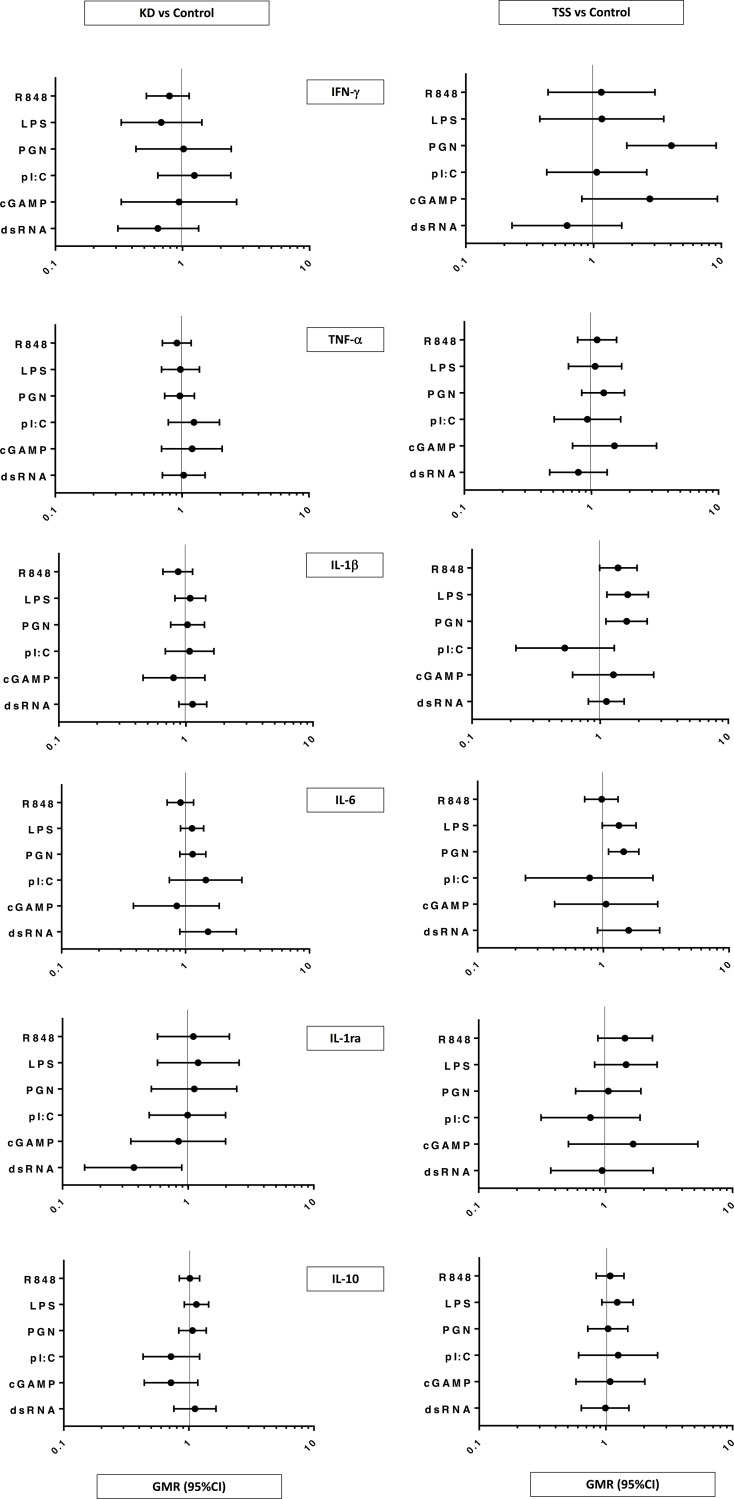
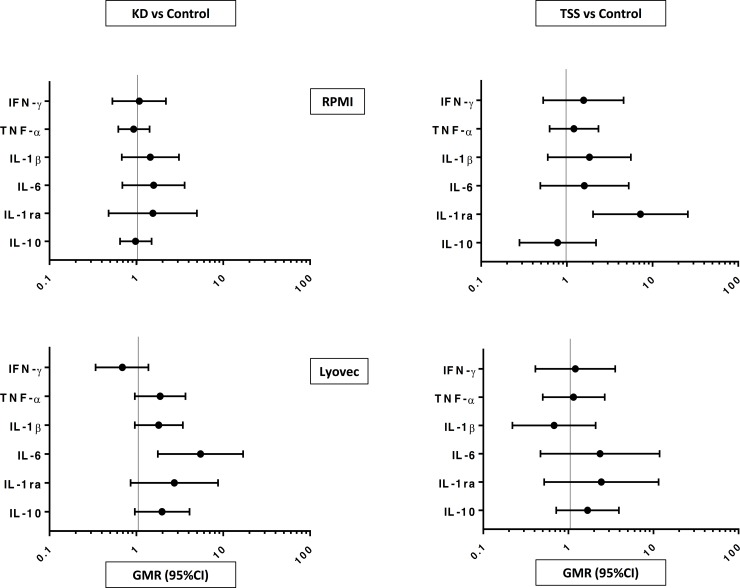
The pathogenesis of Kawasaki disease (KD) remains unknown and there is accumulating evidence for the importance of the innate immune system in initiating and mediating the host inflammatory response. We compared innate immune responses in KD and toxic shock syndrome (TSS) participants more than two years after their acute illness with control participants to investigate differences in their immune phenotype. Toxic shock syndrome shares many clinical features with KD; by including both disease groups we endeavoured to explore changes in innate immune responses following acute inflammatory illnesses more broadly. We measured the in vitro production of interferon (IFN)-γ, tumour necrosis factor (TNF)-α, interleukin (IL)-1β, IL-6, IL-1 receptor antagonist (IL-1ra), and IL-10 following whole blood stimulation with toll-like receptor and inflammasome ligands in 52 KD, 20 TSS, and 53 control participants in a case-control study. Analyses were adjusted for age, sex, and unstimulated cytokine concentrations. Compared to controls, KD participants have reduced IL-1ra production in response to stimulation with double stranded RNA (geometric mean ratio (GMR) 0.37, 95% CI 0.15, 0.89, p = 0.03) and increased IL-6 production in response to incubation with Lyovec™ (GMR 5.48, 95% CI 1.77, 16.98, p = 0.004). Compared to controls, TSS participants have increased IFN-γ production in response to peptidoglycan (GMR 4.07, 95% CI 1.82, 9.11, p = 0.001), increased IL-1β production to lipopolysaccharide (GMR 1.64, 95% CI 1.13, 2.38, p = 0.01) and peptidoglycan (GMR 1.61, 95% CI 1.11, 2.33, p = 0.01), and increased IL-6 production to peptidoglycan (GMR 1.45, 95% CI 1.10, 1.92, p = 0.01). Years following the acute illness, individuals with previous KD or TSS exhibit a pro-inflammatory innate immune phenotype suggesting a possible underlying immunological susceptibility or innate immune memory.
川崎病(KD)的发病机制尚不清楚,越来越多的证据表明先天性免疫系统在启动和介导宿主炎症反应中具有重要作用。我们比较了KD和中毒性休克综合征(TSS)患者在急性疾病发生两年多后的先天性免疫反应与对照参与者,以研究他们免疫表型的差异。中毒性休克综合征与KD有许多共同的临床特征;通过纳入这两个疾病组,我们试图更广泛地探索急性炎症性疾病后先天性免疫反应的变化。在一项病例对照研究中,我们测量了52名KD患者、20名TSS患者和53名对照参与者在用Toll样受体和炎性小体配体刺激全血后体外产生的干扰素(IFN)-γ、肿瘤坏死因子(TNF)-α、白细胞介素(IL)-1β、IL-6、IL-1受体拮抗剂(IL-ira)和IL-10。分析对年龄、性别和未刺激的细胞因子浓度进行了校正。与对照组相比,KD患者对双链RNA刺激的IL-ira产生减少(几何平均比(GMR)0.37,95%可信区间0.15,0.89,p = 0.03),对Lyovec™孵育的IL-6产生增加(GMR 5.48,95%可信区间1.77,16.98,p = 0.004)。与对照组相比,TSS患者对肽聚糖的IFN-γ产生增加(GMR 4.07,95%可信区间1.82,9.11,p = 0.001),对脂多糖的IL-1β产生增加(GMR 1.64,95%可信区间1.13,2.38,p = 0.01)和对肽聚糖的IL-1β产生增加(GMR 1.61,95%可信区间1.11,2.33,p = 0.01),对肽聚糖的IL-6产生增加(GMR 1.45,95%可信区间1.10,1.92,p = 0.01)。在急性疾病发生数年之后,既往患有KD或TSS的个体表现出促炎的先天性免疫表型,提示可能存在潜在的免疫易感性或先天性免疫记忆。