Casas-Aparicio Gustavo Alejandro, León-Rodríguez Isabel, Hernández-Zenteno Rafael de Jesús, Castillejos-López Manuel, Alvarado-de la Barrera Claudia, Ormsby Christopher E, Reyes-Terán Gustavo
Centro de Investigación en Enfermedades Infecciosas, Instituto Nacional de Enfermedades Respiratorias Ismael Cosío Villegas, Ciudad de México, México.
Servicio Clínico 5, Instituto Nacional de Enfermedades Respiratorias Ismael Cosío Villegas, Ciudad de México, México.
PLoS One. 2018 Feb 15;13(2):e0192592. doi: 10.1371/journal.pone.0192592. eCollection 2018.
Fluid accumulation is associated with adverse outcomes such as acute kidney injury (AKI) in critically ill patients. This study aimed to describe the factors associated with AKI in individuals with influenza A H1N1 severe pneumonia, and explore the relation of fluid accumulation with AKI and mortality.
We reviewed medical records of individuals with influenza A H1N1 severe pneumonia and no history of chronic kidney disease, attending a national referral center for respiratory diseases between November 2014 and May 2015. Demographic information, risk factors for AKI, physiologic and laboratory data, outcomes and information on fluid intake and output were recorded. Categorical variables were compared using the chi-square test. Quantitative variables were compared using the Mann-Whitney test. Factors associated with AKI and mortality were identified by binary logistic regression. Linear models of fluid accumulation rates for individuals and groups were estimated using segmented linear regression.
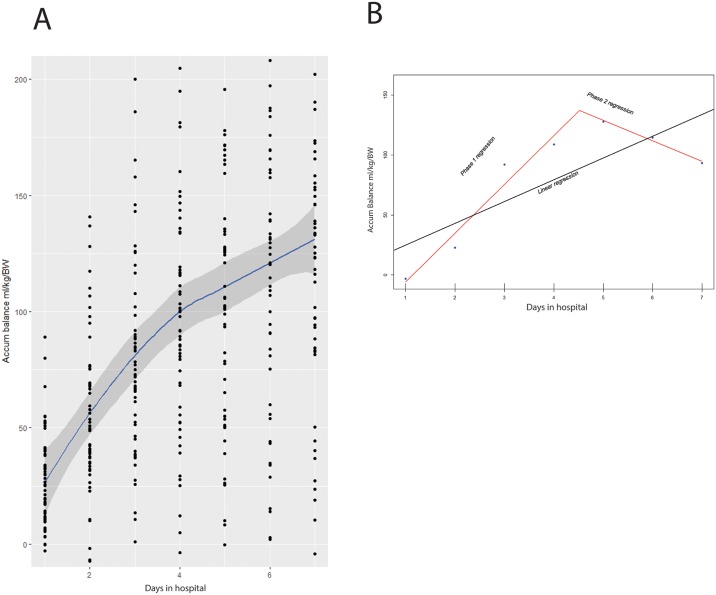
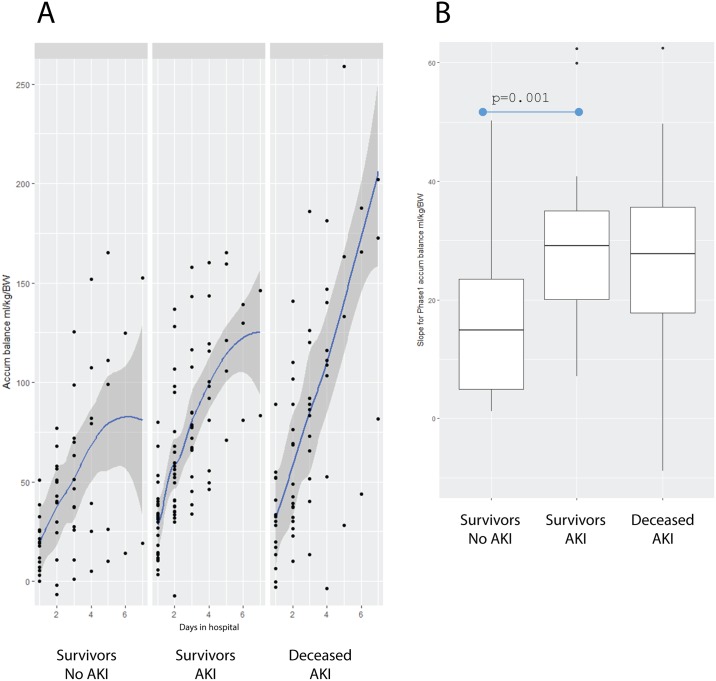
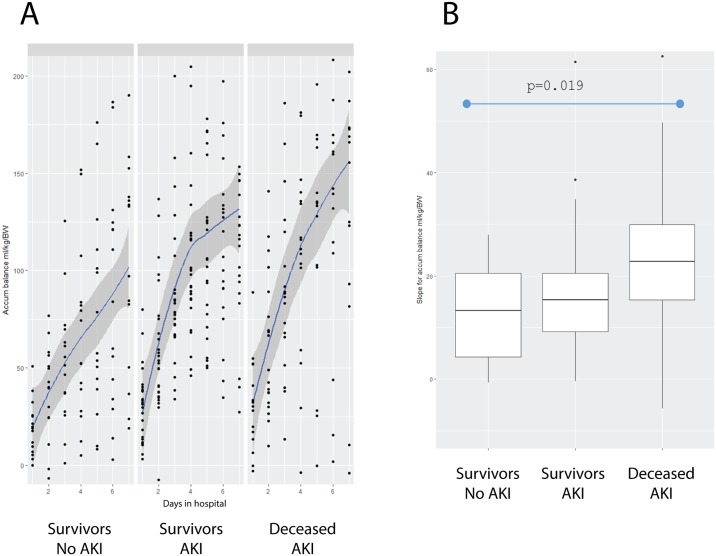
Of 60 patients studied, 43 developed AKI (71.6%). Male gender was protective for AKI (p = 0.019). AKI was associated with nephrotoxic drugs (p = 0.016); PEEP>10 cm H2O on admission (p = 0.031); mortality (p = 0.037); and fluid accumulation ≥10% (fluid overload) at day 7 of hospitalization (p = 0.00026). Mortality was associated with older age (p = 0.009); nephrotoxic drugs (p = 0.034); and higher Pneumonia Severity Index score (112 vs. 76, p = 0.008) on admission. The Deceased-AKI group had a higher rate of fluid accumulation (expressed as ml/kg/body weight) than the Survivors-No AKI group during the study period of 7 days (Survivors-No AKI = 13.31 vs. Deceased-AKI = 22.76, p = 0.019). During the highest phase of fluid accumulation, the Survivors-No AKI group had a slower rate of fluid accumulation than the Survivors-AKI group (14.91 vs. 28.49, p = 0.001).
A high rate of fluid accumulation was associated with AKI and mortality. We support the approach of resuscitation in acute illness, with an early transition to neutral and then negative fluid balances.
在重症患者中,液体潴留与诸如急性肾损伤(AKI)等不良结局相关。本研究旨在描述甲型H1N1流感重症肺炎患者中与AKI相关的因素,并探讨液体潴留与AKI及死亡率之间的关系。
我们回顾了2014年11月至2015年5月期间在一家全国性呼吸系统疾病转诊中心就诊的无慢性肾脏病病史的甲型H1N1流感重症肺炎患者的病历。记录人口统计学信息、AKI的危险因素、生理和实验室数据、结局以及液体出入量信息。分类变量采用卡方检验进行比较。定量变量采用曼-惠特尼检验进行比较。通过二元逻辑回归确定与AKI和死亡率相关的因素。使用分段线性回归估计个体和组的液体潴留率的线性模型。
在研究的60例患者中,43例发生了AKI(71.6%)。男性对AKI有保护作用(p = 0.019)。AKI与肾毒性药物(p = 0.016)、入院时呼气末正压(PEEP)>10 cm H₂O(p = 0.031)、死亡率(p = 0.037)以及住院第7天液体潴留≥10%(液体超负荷)(p = 0.00026)相关。死亡率与年龄较大(p = 0.009)、肾毒性药物(p = 0.034)以及入院时较高的肺炎严重程度指数评分(112对76,p = 0.008)相关。在7天的研究期间,死亡-AKI组的液体潴留率(以ml/kg体重表示)高于存活-无AKI组(存活-无AKI = 13.31对死亡-AKI = 22.76,p = 0.019)。在液体潴留的最高阶段,存活-无AKI组的液体潴留率低于存活-AKI组(14.91对28.49,p = 0.001)。
高液体潴留率与AKI和死亡率相关。我们支持在急性疾病中进行复苏的方法,早期过渡到中性然后负液体平衡。