Deakin University, Geelong, Australia, Institute for Physical Activity and Nutrition (IPAN), School of Exercise and Nutrition Science, Geelong, Victoria, Australia.
School of Science and Health, Western Sydney University, Penrith, New South Wales, Australia.
Br J Sports Med. 2018 Mar;52(5):314-321. doi: 10.1136/bjsports-2016-096634. Epub 2016 Oct 6.
To evaluate the effectiveness of behavioural interventions that report sedentary behaviour outcomes during early childhood.
Systematic review and meta-analysis.
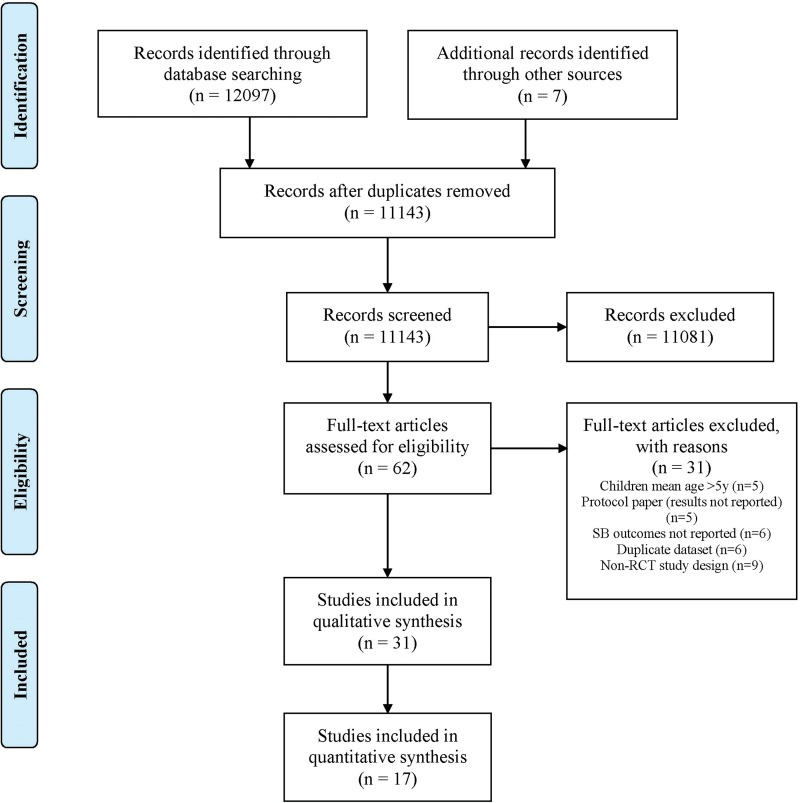
Academic Search Complete, CINAHL Complete, Global Health, MEDLINE Complete, PsycINFO, SPORTDiscus with Full Text and EMBASE electronic databases were searched in March 2016.
Inclusion criteria were: (1) published in a peer-reviewed English language journal; (2) sedentary behaviour outcomes reported; (3) randomised controlled trial (RCT) study design; and (4) participants were children with a mean age of ≤5.9 years and not yet attending primary/elementary school at postintervention.
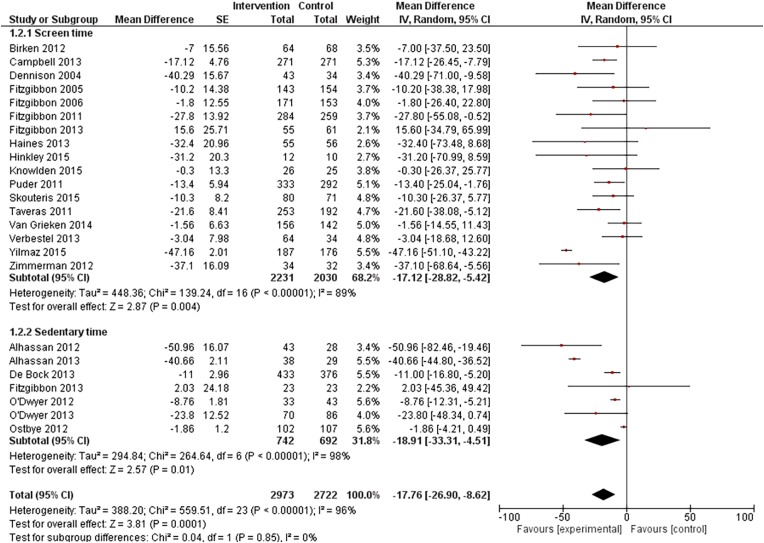
31 studies were included in the systematic review and 17 studies in the meta-analysis. The overall mean difference in screen time outcomes between groups was -17.12 (95% CI -28.82 to -5.42) min/day with a significant overall intervention effect (Z=2.87, p=0.004). The overall mean difference in sedentary time between groups was -18.91 (95% CI -33.31 to -4.51) min/day with a significant overall intervention effect (Z=2.57, p=0.01). Subgroup analyses suggest that for screen time, interventions of ≥6 months duration and those conducted in a community-based setting are most effective. For sedentary time, interventions targeting physical activity (and reporting changes in sedentary time) are more effective than those directly targeting sedentary time.
SUMMARY/CONCLUSIONS: Despite heterogeneity in study methods and results, overall interventions to reduce sedentary behaviour in early childhood show significant reductions, suggesting that this may be an opportune time to intervene.
CRD42015017090.
评估在儿童早期报告久坐行为结果的行为干预措施的有效性。
系统评价和荟萃分析。
2016 年 3 月,在 Academic Search Complete、CINAHL Complete、Global Health、MEDLINE Complete、PsycINFO、SPORTDiscus with Full Text 和 EMBASE 电子数据库中进行了检索。
(1)发表在同行评议的英文期刊上;(2)报告久坐行为结果;(3)随机对照试验(RCT)设计;(4)参与者为平均年龄≤5.9 岁的儿童,且干预后尚未入读小学/小学。
系统评价纳入 31 项研究,荟萃分析纳入 17 项研究。组间屏幕时间结果的总体平均差异为-17.12(95%CI-28.82 至-5.42)min/天,干预效果具有统计学意义(Z=2.87,p=0.004)。组间久坐时间的总体平均差异为-18.91(95%CI-33.31 至-4.51)min/天,干预效果具有统计学意义(Z=2.57,p=0.01)。亚组分析表明,对于屏幕时间,持续时间≥6 个月的干预措施和在社区环境中进行的干预措施最有效。对于久坐时间,针对身体活动的干预措施(并报告久坐时间的变化)比直接针对久坐时间的干预措施更有效。
尽管研究方法和结果存在异质性,但总体而言,减少儿童早期久坐行为的干预措施显示出显著的减少,这表明现在可能是干预的合适时机。
CRD42015017090。