Institute of Aging Research, Dongguan Scientific Research Center, Guangdong Medical University, Dongguan, 523808, China.
Guangdong Provincial Key Laboratory of Medical Molecular Diagnostics, Guangdong Medical University, Dongguan, 523808, China.
Cell Death Dis. 2018 Feb 15;9(3):260. doi: 10.1038/s41419-018-0303-9.
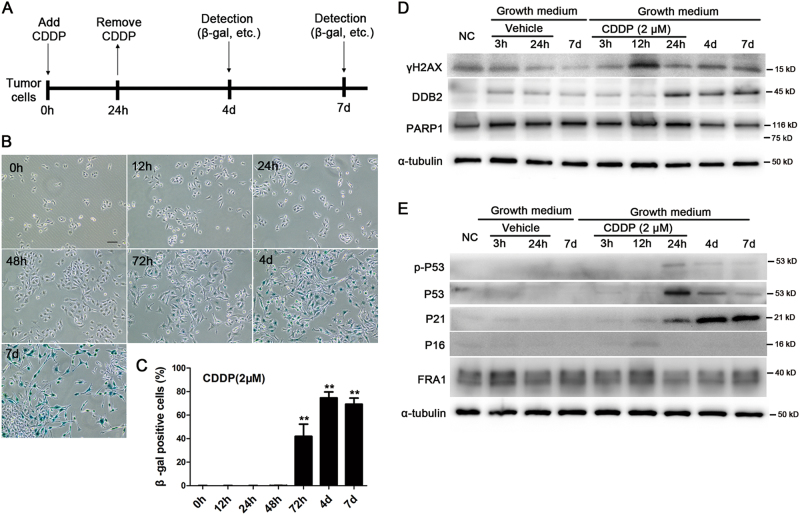
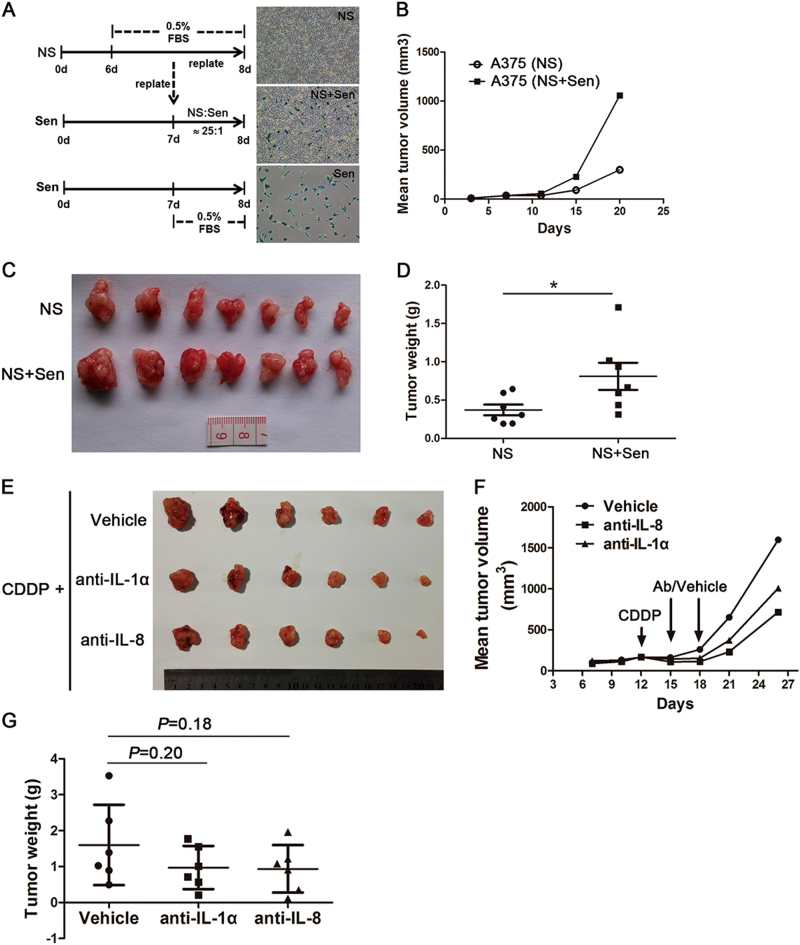
Although targeted therapy and immunotherapy greatly improve the outcome of melanoma, drug resistance and low response rates still maintain the unsubstitutability of traditional chemotherapy. Cisplatin (CDDP) is widely used in different types of tumours with high response rates, but it generally has low efficiency in melanoma. The mechanisms underpinning the phenomena are not sufficiently understood. Here we demonstrated that various melanoma cell lines adopted senescence phenotype after CDDP treatment in contrast to the other types of tumour cells. CDDP treatment induced melanoma A375 cells into senescence through the sequential activation of the DNA damage response and the P53/P21 pathway. All the senescent melanoma cells induced by CDDP alone or the combination of CDDP and dacarbazine developed robust senescence-associated secretory phenotype (SASP), that is, the secretion of multiple cytokines. IL-1α was an early component and an upstream regulator of SASP. Similarly, CDDP either alone or combined with dacarbazine could induce melanoma cell senescence and SASP in either A375 or B16F10 melanoma xenograft mice. The supernatant of senescent A375 cells promoted the growth of normal non-senescent A375 cells and enhanced their expression and secretion of IL-8 through the activation of the ERK1/2-RSK1 pathway. The transplantation of non-senescent and senescent A375 cells together into nude mice showed accelerated tumour growth compared with transplanting non-senescent cells alone; no tumours developed when transplanting senescent cells alone. Following CDDP administration in A375-bearing mice, the intratumour injection of neutralisation antibodies targeting the SASP factors IL-1α or IL-8 evidently delayed tumour growth. The results suggest that the CDDP-induced senescent melanoma cells promote non-senescent cells proliferation through the activation of ERK1/2-RSK1 pathway by the SASP factors. Cell senescence and concomitant SASP may be the particular mechanisms for melanoma to resist chemotherapeutics.
尽管靶向治疗和免疫疗法极大地改善了黑色素瘤的预后,但耐药性和低反应率仍然使传统化疗不可或缺。顺铂(CDDP)广泛用于各种高反应率的肿瘤类型,但在黑色素瘤中通常效率较低。其背后的机制尚不完全清楚。在这里,我们证明了与其他类型的肿瘤细胞相比,各种黑色素瘤细胞系在用 CDDP 处理后采用衰老表型。CDDP 处理通过 DNA 损伤反应和 P53/P21 途径的顺序激活诱导黑色素瘤 A375 细胞衰老。单独用 CDDP 或 CDDP 与达卡巴嗪联合处理诱导的所有衰老黑色素瘤细胞均表现出强大的衰老相关分泌表型(SASP),即多种细胞因子的分泌。IL-1α 是 SASP 的早期组成部分和上游调节剂。同样,单独用 CDDP 或与达卡巴嗪联合使用均可诱导 A375 或 B16F10 黑色素瘤异种移植小鼠中的黑色素瘤细胞衰老和 SASP。衰老的 A375 细胞的上清液通过激活 ERK1/2-RSK1 途径促进正常非衰老的 A375 细胞的生长,并增强其 IL-8 的表达和分泌。将非衰老和衰老的 A375 细胞一起移植到裸鼠中,与单独移植非衰老细胞相比,肿瘤生长明显加快;单独移植衰老细胞时则不会形成肿瘤。在携带 A375 的小鼠中给予 CDDP 后,用针对 SASP 因子 IL-1α 或 IL-8 的中和抗体对肿瘤内进行注射,明显延迟了肿瘤的生长。结果表明,CDDP 诱导的衰老黑色素瘤细胞通过 SASP 因子激活 ERK1/2-RSK1 途径促进非衰老细胞增殖。细胞衰老和伴随的 SASP 可能是黑色素瘤抵抗化疗的特殊机制。