Department of Anatomy, Histology and Embryology, Institute of Neuroscience, Changsha Medical University, Changsha, 410219, China.
Department of Physiology, Faculty of Medicine, University of Toronto, Toronto, ON, Canada.
Cell Death Dis. 2018 Feb 15;9(3):281. doi: 10.1038/s41419-018-0282-x.
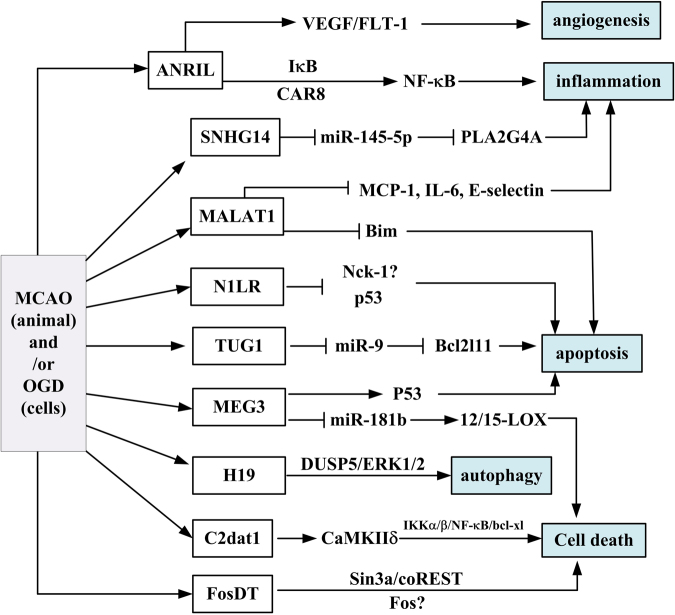
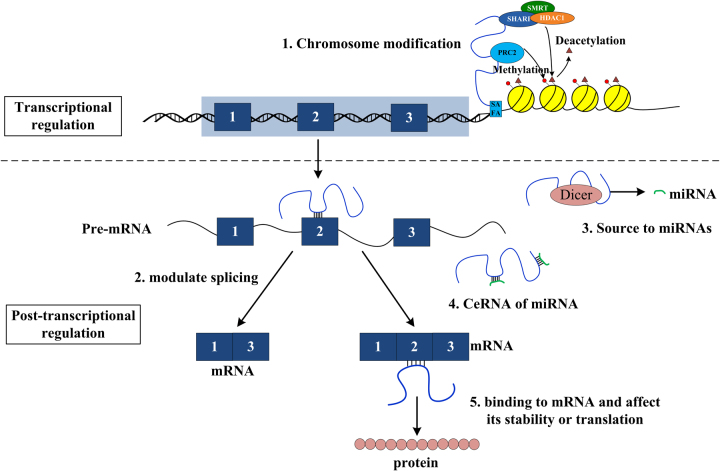
Stroke is one of the leading causes of mortality and disability worldwide. Uncovering the cellular and molecular pathophysiological processes in stroke have been a top priority. Long non-coding (lnc) RNAs play critical roles in different kinds of diseases. In recent years, a bulk of aberrantly expressed lncRNAs have been screened out in ischemic stroke patients or ischemia insulted animals using new technologies such as RNA-seq, deep sequencing, and microarrays. Nine specific lncRNAs, antisense non-coding RNA in the INK4 locus (ANRIL), metastasis-associate lung adenocarcinoma transcript 1 (MALAT1), N1LR, maternally expressed gene 3 (MEG3), H19, CaMK2D-associated transcript 1 (C2dat1), Fos downstream transcript (FosDT), small nucleolar RNA host gene 14 (SNHG14), and taurine-upregulated gene 1 (TUG1), were found increased in cerebral ischemic animals and/or oxygen-glucose deprived (OGD) cells. These lncRNAs were suggested to promote cell apoptosis, angiogenesis, inflammation, and cell death. Our Gene Ontology (GO) enrichment analysis predicted that MEG3, H19, and MALAT1 might also be related to functions such as neurogenesis, angiogenesis, and inflammation through mechanisms of gene regulation (DNA transcription, RNA folding, methylation, and gene imprinting). This knowledge may provide a better understanding of the functions and mechanisms of lncRNAs in ischemic stroke. Further elucidating the functions and mechanisms of these lncRNAs in biological systems under normal and pathological conditions may lead to opportunities for identifying biomarkers and novel therapeutic targets of ischemic stroke.
中风是全球范围内导致死亡和残疾的主要原因之一。揭示中风的细胞和分子病理生理过程一直是重中之重。长链非编码 (lnc) RNA 在各种疾病中发挥着关键作用。近年来,使用 RNA-seq、深度测序和微阵列等新技术,已经从缺血性中风患者或缺血性损伤动物中筛选出大量异常表达的 lncRNA。九个特定的 lncRNA,INK4 基因座的反义非编码 RNA(ANRIL)、转移相关肺腺癌转录本 1(MALAT1)、N1LR、母系表达基因 3(MEG3)、H19、钙调蛋白激酶 2D 相关转录本 1(C2dat1)、Fos 下游转录本(FosDT)、小核仁 RNA 宿主基因 14(SNHG14)和牛磺酸上调基因 1(TUG1),在脑缺血动物和/或氧葡萄糖剥夺(OGD)细胞中表达增加。这些 lncRNA 被认为促进细胞凋亡、血管生成、炎症和细胞死亡。我们的基因本体 (GO) 富集分析预测,MEG3、H19 和 MALAT1 也可能通过基因调控(DNA 转录、RNA 折叠、甲基化和基因印记)等机制与神经发生、血管生成和炎症等功能有关。这些知识可能有助于更好地理解 lncRNA 在缺血性中风中的功能和机制。进一步阐明这些 lncRNA 在正常和病理生理条件下生物系统中的功能和机制,可能为缺血性中风的生物标志物和新的治疗靶点的识别提供机会。