Langenhof M Rohaa, Komdeur Jan
Behavioural Physiology and Ecology Group, Groningen Institute for Evolutionary Life Sciences, University of Groningen, Groningen, Netherlands.
Behav Ecol Sociobiol. 2018;72(3):34. doi: 10.1007/s00265-018-2452-3. Epub 2018 Feb 9.
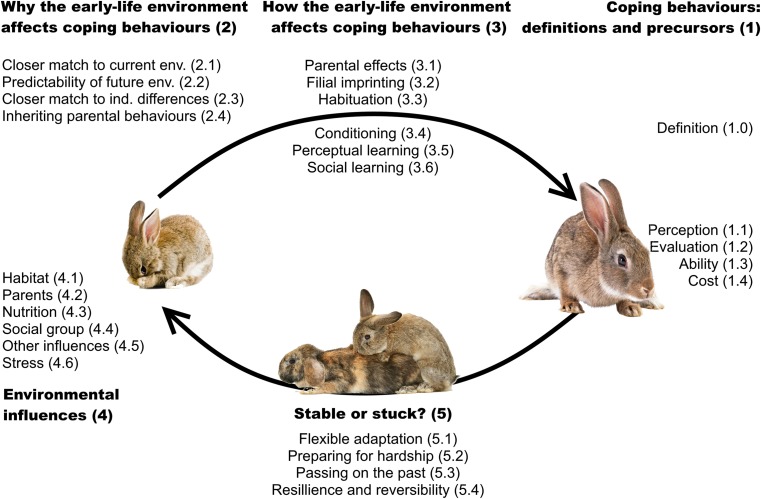
Understanding the ways in which individuals cope with threats, respond to challenges, make use of opportunities and mediate the harmful effects of their surroundings is important for predicting their ability to function in a rapidly changing world. Perhaps one of the most essential drivers of coping behaviour of adults is the environment experienced during their early-life development. Although the study of coping, defined as behaviours displayed in response to environmental challenges, has a long and rich research history in biology, recent literature has repeatedly pointed out that the processes through which coping behaviours develop in individuals are still largely unknown. In this review, we make a move towards integrating ultimate and proximate lines of coping behaviour research. After broadly defining coping behaviours (1), we review why, from an evolutionary perspective, the development of coping has become tightly linked to the early-life environment (2), which relevant developmental processes are most important in creating coping behaviours adjusted to the early-life environment (3), which influences have been shown to impact those developmental processes (4) and what the adaptive significance of intergenerational transmission of coping behaviours is, in the context of behavioural adaptations to a fast changing world (5). Important concepts such as effects of parents, habitat, nutrition, social group and stress are discussed using examples from empirical studies on mammals, fish, birds and other animals. In the discussion, we address important problems that arise when studying the development of coping behaviours and suggest solutions.
了解个体应对威胁、应对挑战、利用机会以及调节周围环境有害影响的方式,对于预测他们在快速变化的世界中发挥功能的能力至关重要。成年人应对行为的最重要驱动因素之一可能是他们早年发育过程中所经历的环境。尽管对应对(定义为个体应对环境挑战时所表现出的行为)的研究在生物学领域有着悠久而丰富的研究历史,但最近的文献反复指出,个体应对行为的发展过程在很大程度上仍然未知。在这篇综述中,我们朝着整合应对行为研究的终极和近端线索迈出了一步。在宽泛地定义应对行为之后(1),我们回顾从进化角度来看,为什么应对行为的发展与早年环境紧密相连(2),在塑造适应早年环境的应对行为方面,哪些相关的发育过程最为重要(3),哪些影响已被证明会对这些发育过程产生作用(4),以及在行为适应快速变化的世界的背景下,应对行为的代际传递的适应性意义是什么(5)。我们将通过对哺乳动物、鱼类、鸟类和其他动物的实证研究实例,讨论诸如父母、栖息地、营养、社会群体和压力等重要概念。在讨论中,我们将探讨研究应对行为发展时出现的重要问题并提出解决方案。