Avitabile Valerio, Camia Andrea
European Commission, Joint Research Centre, Via E. Fermi 2749, 21027 Ispra, Italy.
For Ecol Manage. 2018 Feb 1;409:489-498. doi: 10.1016/j.foreco.2017.11.047.
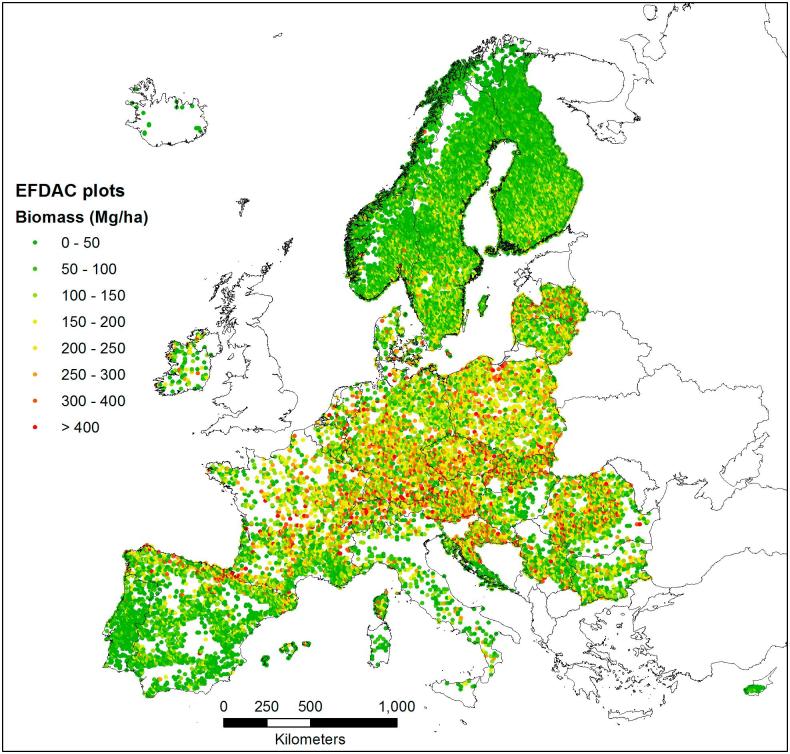
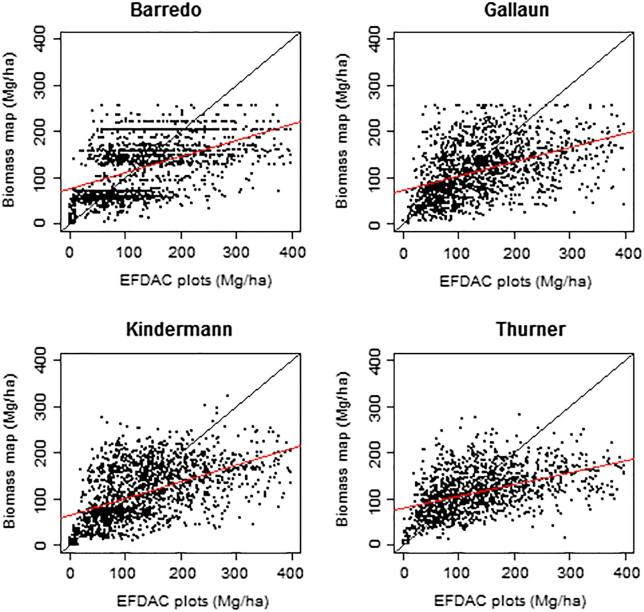
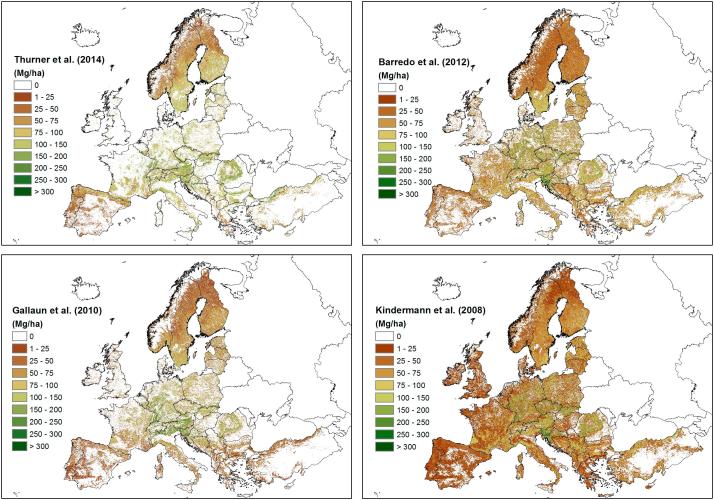
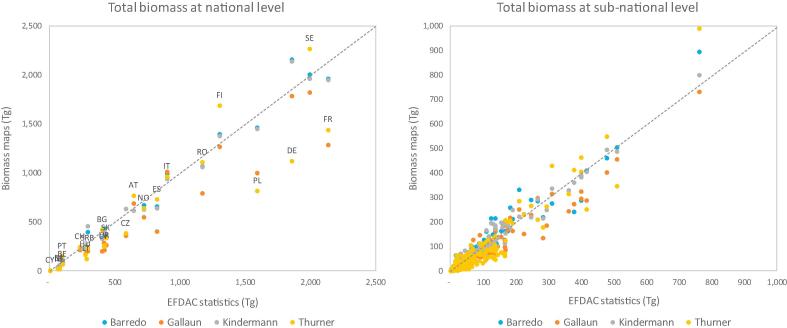
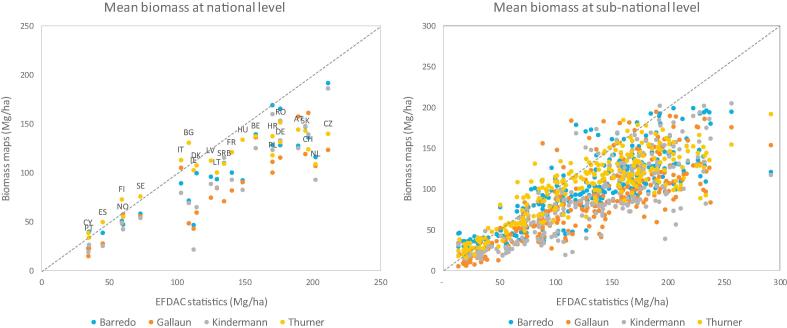
Maps of aboveground forest biomass based on different input data and modelling approaches have been recently produced for Europe, opening up the possibility for several applications and products not obtainable by summary statistics. However, the accuracy assessment of the existing maps is limited by the lack of reference data consistent over the study region and representative of the maps cells. Here, we used harmonized forest biomass data for 26 European countries derived by National Forest Inventories using a common biomass definition and estimator to assess four biomass maps. The assessment was performed at regional, national and sub-national scales using harmonized statistics derived from almost half million ground plot measurements, and at pixel level using a subset of 22,166 plots covering most European forest types. The field plots were temporally aligned with the maps using growth rates and further screened using an innovative approach based on tree cover variability to remove the plots not representative of the map cells. The harmonized reference data showed that all maps tended to overestimate at low biomass (<100 Mg ha) and underestimate at medium - high biomass (>100 Mg ha), resulting in an overall negative bias (23-43 Mg ha at national level) relative to the harmonized estimates. The maps relative errors ranged from 29% to 40% at national level and increased at higher resolutions, reaching 58-67% at pixel level. We also assessed the effect of the harmonization of the national statistics and report that the harmonized biomass values present significant differences compared to the national estimates for 14 countries, and provide a slightly higher stock (+3.8%) at European scale. We show that harmonized and representative reference data are essential to properly assess the accuracy of biomass maps, and we further identify the factors affecting the maps performance and provide indications for their improvements.
近期基于不同输入数据和建模方法制作了欧洲的地上森林生物量地图,为一些无法通过汇总统计获得的应用和产品开辟了可能性。然而,现有地图的精度评估受到研究区域内缺乏一致且能代表地图单元的参考数据的限制。在此,我们使用了由国家森林清查得出的26个欧洲国家的统一森林生物量数据,这些数据采用了共同的生物量定义和估算器来评估四张生物量地图。评估在区域、国家和次国家尺度上进行,使用了源自近50万个地面样地测量数据的统一统计数据,并在像素级别使用了涵盖大多数欧洲森林类型的22,166个样地的子集。利用生长率使实地样地在时间上与地图对齐,并基于树木覆盖变异性采用创新方法进一步筛选,以去除不能代表地图单元的样地。统一的参考数据表明,所有地图在低生物量(<100 Mg ha)时往往高估,在中高生物量(>100 Mg ha)时往往低估,相对于统一估算值,总体呈现负偏差(国家层面为23 - 43 Mg ha)。地图的相对误差在国家层面为29%至40%,在更高分辨率下会增加,在像素级别达到58 - 67%。我们还评估了国家统计数据统一的影响,并报告称,统一的生物量值与14个国家的国家估算值相比存在显著差异,在欧洲尺度上提供了略高的储量(+3.8%)。我们表明,统一且具有代表性的参考数据对于正确评估生物量地图的精度至关重要,并且我们进一步识别了影响地图性能的因素并为其改进提供了指示。