Kirner Sabrina V, Arteaga Danny, Henkel Christian, Margraf Johannes T, Alegret Nuria, Ohkubo Kei, Insuasty Braulio, Ortiz Alejandro, Martín Nazario, Echegoyen Luis, Fukuzumi Shunichi, Clark Timothy, Guldi Dirk M
Department of Chemistry and Pharmacy and Interdisciplinary Center for Molecular Materials , Friedrich-Alexander-Universität Erlangen-Nürnberg , Egerlandstrasse 3 , 91058 Erlangen , Germany.
Departamento de Química , Facultad de Ciencias Naturales , Universidad del Valle , A.A. 25360 Cali , Colombia.
Chem Sci. 2015 Oct 1;6(10):5994-6007. doi: 10.1039/c5sc02051d. Epub 2015 Jul 9.
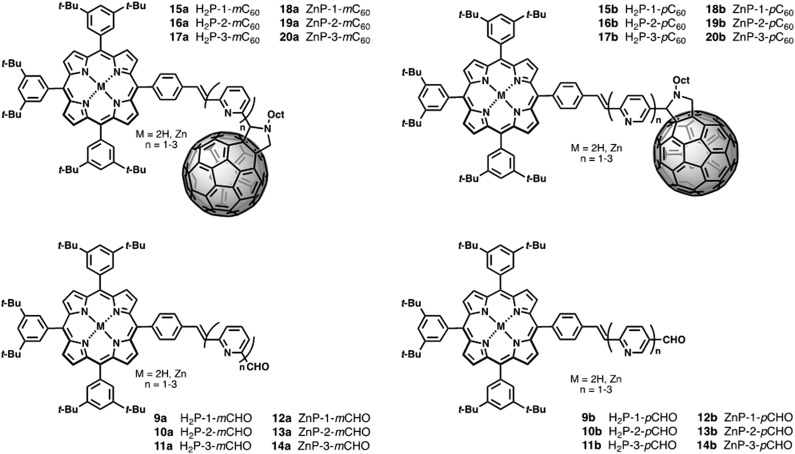
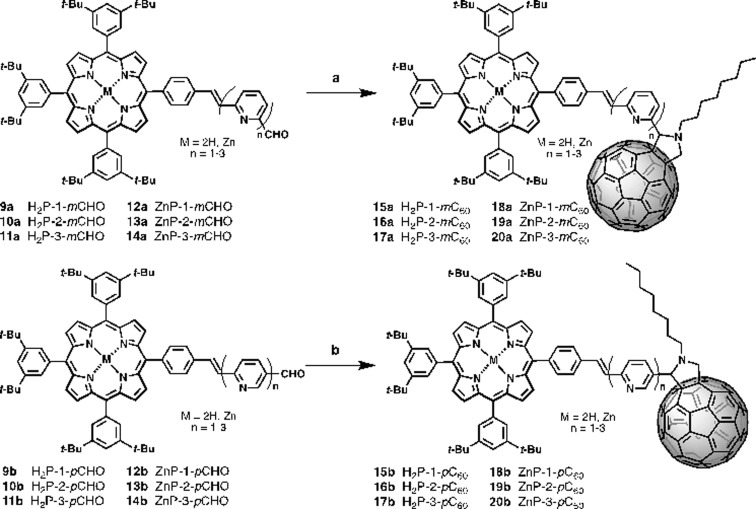
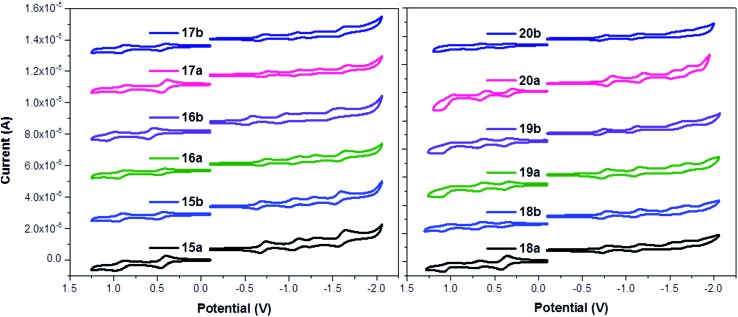
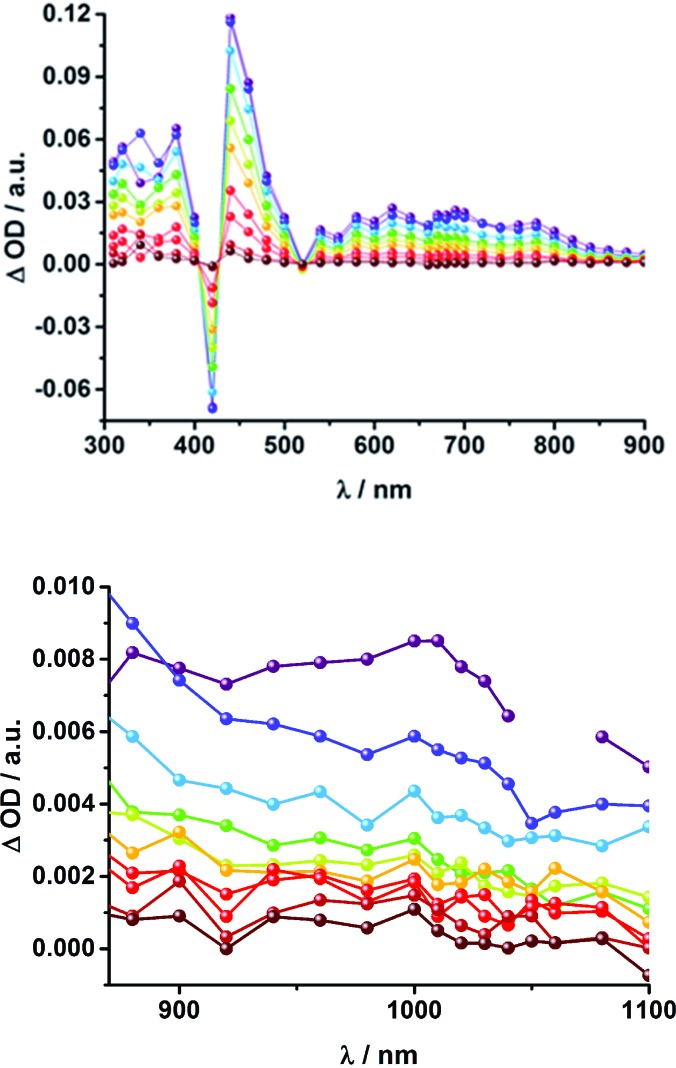
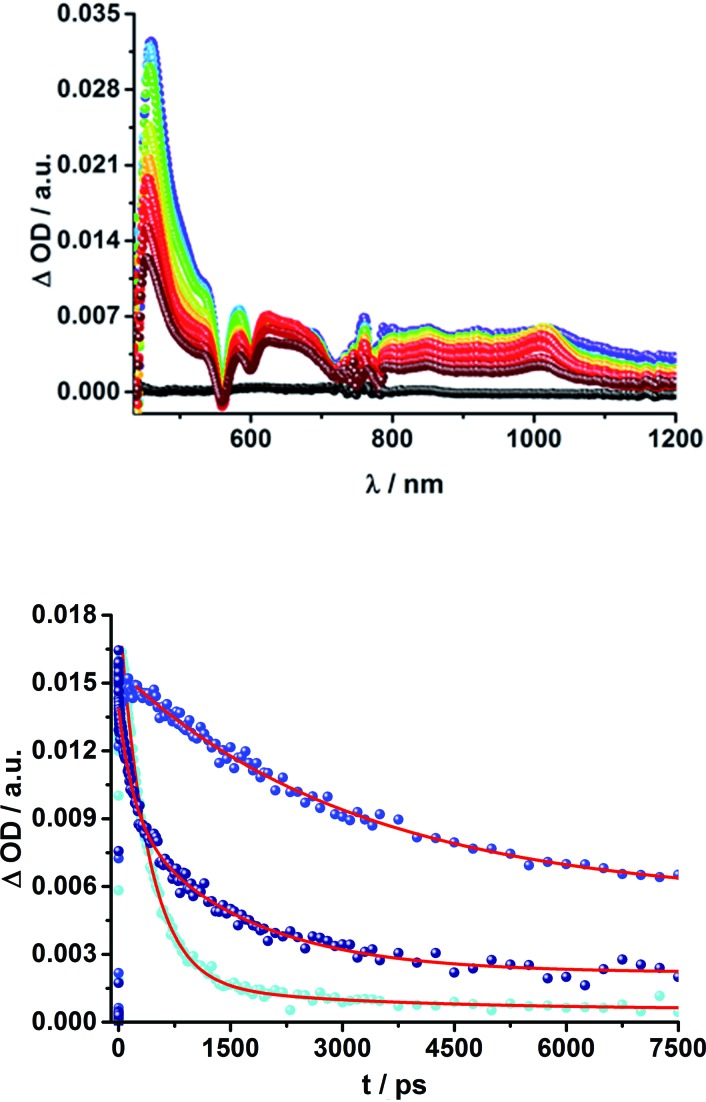
The design, synthesis, and electronic properties of a new series of D-π-A conjugates consisting of free base (HP) and zinc porphyrins (ZnP) as electron donors and a fullerene (C) as electron acceptor, in which the two electroactive entities are covalently linked through pyridine-vinylene spacers of different lengths, are described. Electronic interactions in the ground state were characterized by electrochemical and absorption measurements, which were further supported with theoretical calculations. Most importantly, charge-transfer bands were observed in the absorption spectra, indicating a strong - behavior. In the excited states, electronic interactions were detected by selective photoexcitation under steady-state conditions, by time-resolved fluorescence investigations, and by pump probe experiments on the femto-, pico-, and nanosecond time scales. Porphyrin fluorescence is quenched for the different D-π-A conjugates, from which we conclude that the deactivation mechanisms of the excited singlet states are based on photoinduced energy- and/or electron transfer processes between HP/ZnP and C, mediated through the molecular spacers. The fluorescence intensity decreases and the fluorescence lifetimes shorten as the spacer length decreases and as the spacer substitution changes. With the help of transient absorption spectroscopy, the formation of charge-separated states involving oxidized HP/ZnP and reduced C was confirmed. Lifetimes of the corresponding charge-separated states, which ranged from ∼400 picoseconds to 165 nanoseconds, depend on the spacer length, the spacer substitution, and the solvent polarity. Interestingly, D-π-A conjugates containing the longest linkers did not necessarily exhibit the longest charge-separated state lifetimes. The distances between the electron donors and the acceptors were calculated by molecular modelling. The longest charge-separated state lifetime corresponded to the D-π-A conjugate with the longest electron donor-acceptor distance. Likewise, EPR measurements in frozen media revealed charge separated states in all the D-π-A conjugates investigated. A sharp peak with values ∼2.000 was assigned to reduced C, while a broader, less intense signal ( ∼ 2.003) was assigned to oxidized HP/ZnP. On-off switching of the formation and decay of the charge-separated states was detected by EPR at 77 K by repeatedly turning the irradiation source on and off.
描述了一系列新型D-π-A共轭物的设计、合成及电子性质,该共轭物由游离碱(HP)和锌卟啉(ZnP)作为电子供体以及富勒烯(C)作为电子受体组成,其中两个电活性实体通过不同长度的吡啶-亚乙烯基间隔基共价连接。基态中的电子相互作用通过电化学和吸收测量进行表征,并得到理论计算的进一步支持。最重要的是,在吸收光谱中观察到电荷转移带,表明存在强 - 行为。在激发态下,通过稳态条件下的选择性光激发、时间分辨荧光研究以及在飞秒、皮秒和纳秒时间尺度上的泵浦探测实验检测电子相互作用。不同的D-π-A共轭物使卟啉荧光猝灭,由此我们得出结论,激发单重态的失活机制基于HP/ZnP与C之间通过分子间隔基介导的光诱导能量和/或电子转移过程。随着间隔基长度的减小和间隔基取代的变化,荧光强度降低且荧光寿命缩短。借助瞬态吸收光谱,证实了涉及氧化的HP/ZnP和还原的C的电荷分离态的形成。相应电荷分离态的寿命范围为约400皮秒至165纳秒,取决于间隔基长度、间隔基取代和溶剂极性。有趣的是,含有最长连接基的D-π-A共轭物不一定表现出最长的电荷分离态寿命。通过分子建模计算了电子供体与受体之间的距离。最长的电荷分离态寿命对应于电子供体 - 受体距离最长的D-π-A共轭物。同样,在冷冻介质中的电子顺磁共振(EPR)测量揭示了所有研究的D-π-A共轭物中的电荷分离态。值约为2.000的尖锐峰归属于还原的C,而较宽、强度较低的信号(约2.003)归属于氧化的HP/ZnP。通过在77 K下反复打开和关闭辐照源,EPR检测到电荷分离态形成和衰减的开 - 关切换。