Department of Oral and Maxillofacial Surgery, University of Groningen, University Medical Center Groningen, PO Box 30.001, NL-9700 RB, Groningen, The Netherlands.
Department of Oral and Maxillofacial Surgery, and Department of Fixed and Removable Prosthodontics, Dental School, University of Groningen, University Medical Center Groningen, Groningen, The Netherlands.
Clin Oral Investig. 2018 Sep;22(7):2615-2622. doi: 10.1007/s00784-018-2360-y. Epub 2018 Feb 15.
To assess oral health, health, and quality of life (QoL) of care-dependent community-living older people with and without remaining teeth who recently received formal home care.
For this cross-sectional observational study, community-living older people (≥ 65 years), who recently (< 6 months) received formal home care, were interviewed with validated questionnaires and underwent an oral examination. Oral health, general health, medicines usage, frailty (Groningen Frailty Indicator), cognition (Minimal Mental State Examination), QoL (RAND 36), and oral health-related QoL (Oral Health Impact Profile-14) were assessed.
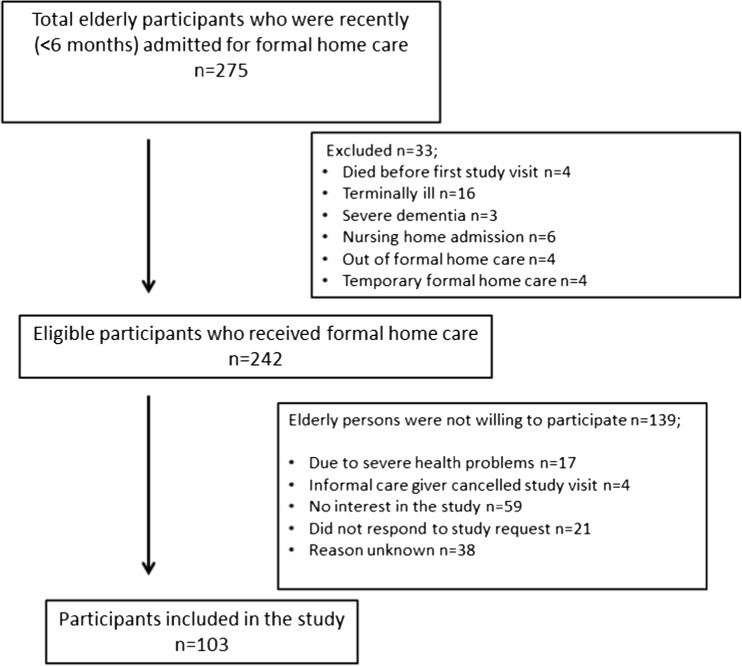
One hundred three out of 275 consecutive eligible older people (median age 79 [IQR (Inter Quartile Range) 72-85 years] participated in the study. Thirty-nine patients had remaining teeth and 64 were edentulous. Compared with edentulous older people, older people with remaining teeth scored significantly better on frailty, QoL, physical functioning, and general health. No significant differences were seen in cognition. Dental and periodontal problems were seen in more than half of the patients with remaining teeth. Two third of the edentulous patients did not visit their dentist regularly or at all.
Care-dependent home-dwelling older people with remaining teeth generally were less frail, scored better on physical functioning and general health and had better QoL than edentulous older people. Dental and periodontal problems were seen in approximately 50% of the elderly.
Notwithstanding their common dental problems, frailty, health, and QoL are better in home-dwelling older people with remaining teeth. To maintain this status, we advise not only dentists, but also health care workers and governments, to encourage people to maintain good oral health.
评估近期接受正规家庭护理的、有/无余留牙的依赖护理的社区居住老年人群的口腔健康、健康状况和生活质量(QoL)。
本横断面观察性研究纳入了最近(<6 个月)接受正规家庭护理的社区居住老年人(≥65 岁),并使用经过验证的问卷对其进行访谈和口腔检查。评估了口腔健康、一般健康状况、用药情况、虚弱程度(格罗宁根虚弱指数)、认知能力(简易精神状态检查)、生活质量(RAND 36 健康调查量表)和口腔健康相关生活质量(口腔健康影响程度量表-14)。
275 名符合条件的连续老年人中,有 103 名(中位数年龄 79 [IQR(四分位间距)72-85 岁])参与了研究。39 名患者有余留牙,64 名患者无牙。与无牙的老年患者相比,有余留牙的老年患者在虚弱程度、生活质量、身体机能和一般健康方面的评分显著更好。认知能力方面未见显著差异。余留牙患者中有一半以上存在牙和牙周问题。64 名无牙患者中有三分之二没有定期或根本不去看牙医。
有余留牙的依赖护理的居家老年人群总体上虚弱程度较轻,身体机能和一般健康状况更好,生活质量更高。约有 50%的老年人存在牙和牙周问题。
尽管存在常见的口腔问题,但有余留牙的居家老年人群的虚弱程度、健康状况和生活质量仍更好。为了保持这种状态,我们建议不仅牙医,还包括卫生保健工作者和政府,鼓励人们保持良好的口腔健康。