Luth Madeline R, Gupta Purva, Ottilie Sabine, Winzeler Elizabeth A
Division of Host Pathogen Systems and Therapeutics, Department of Pediatrics , University of California San Diego , 9500 Gilman Drive , La Jolla , California 92093 , United States.
Skaggs School of Pharmaceutical Sciences , University of California San Diego , 9500 Gilman Drive , La Jolla , California 92093 , United States.
ACS Infect Dis. 2018 Mar 9;4(3):301-314. doi: 10.1021/acsinfecdis.7b00276. Epub 2018 Feb 21.
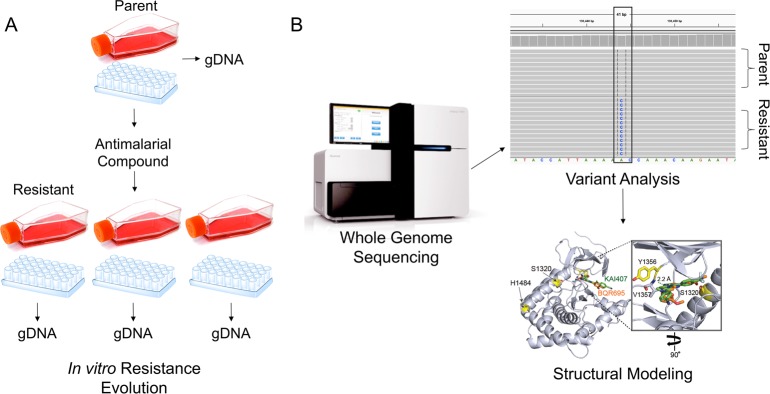
Although many new anti-infectives have been discovered and developed solely using phenotypic cellular screening and assay optimization, most researchers recognize that structure-guided drug design is more practical and less costly. In addition, a greater chemical space can be interrogated with structure-guided drug design. The practicality of structure-guided drug design has launched a search for the targets of compounds discovered in phenotypic screens. One method that has been used extensively in malaria parasites for target discovery and chemical validation is in vitro evolution and whole genome analysis (IVIEWGA). Here, small molecules from phenotypic screens with demonstrated antiparasitic activity are used in genome-based target discovery methods. In this Review, we discuss the newest, most promising druggable targets discovered or further validated by evolution-based methods, as well as some exceptions.
尽管许多新型抗感染药物是仅通过表型细胞筛选和检测优化发现和开发的,但大多数研究人员认识到,基于结构的药物设计更具实用性且成本更低。此外,基于结构的药物设计可以探索更大的化学空间。基于结构的药物设计的实用性引发了对表型筛选中发现的化合物靶点的探索。在疟原虫中广泛用于靶点发现和化学验证的一种方法是体外进化和全基因组分析(IVIEWGA)。在这里,具有已证实抗寄生虫活性的表型筛选中的小分子被用于基于基因组的靶点发现方法。在本综述中,我们讨论了通过基于进化的方法发现或进一步验证的最新、最有前景的可成药靶点,以及一些例外情况。