Aix Marseille Univ, IRD, AP-HM, SSA, VITROME, IHU-Méditerranée Infection. 19-21 Boulevard Jean Moulin, Marseille, France.
Unité de Parasitologie et entomologie, Département des maladies infectieuses, Institut de Recherche Biomédicale des Armées, IHU Méditerranée Infection, Marseille, France.
PLoS Negl Trop Dis. 2018 Feb 16;12(2):e0006189. doi: 10.1371/journal.pntd.0006189. eCollection 2018 Feb.
Matrix-Assisted Laser Desorption/Ionization Time-of-Flight Mass Spectrometry (MALDI-TOF MS) has recently emerged in the field of entomology as a promising method for the identification of arthropods and the detection of associated pathogens.
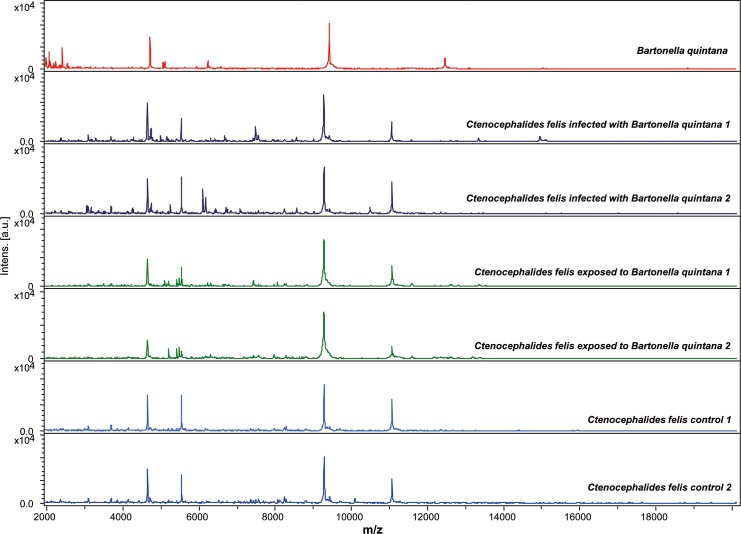
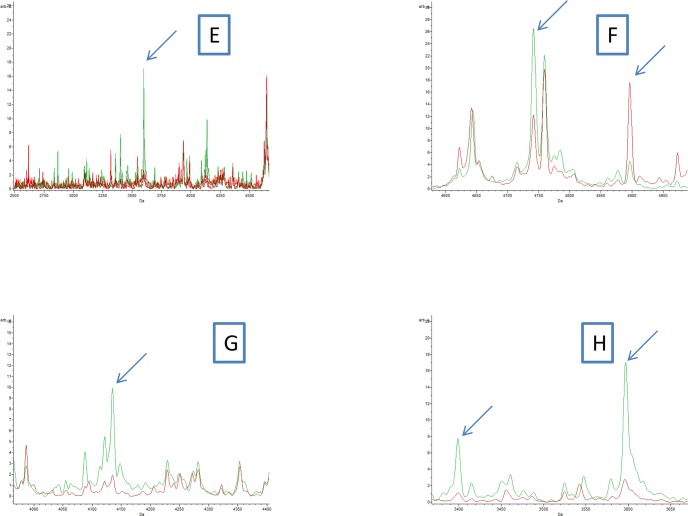
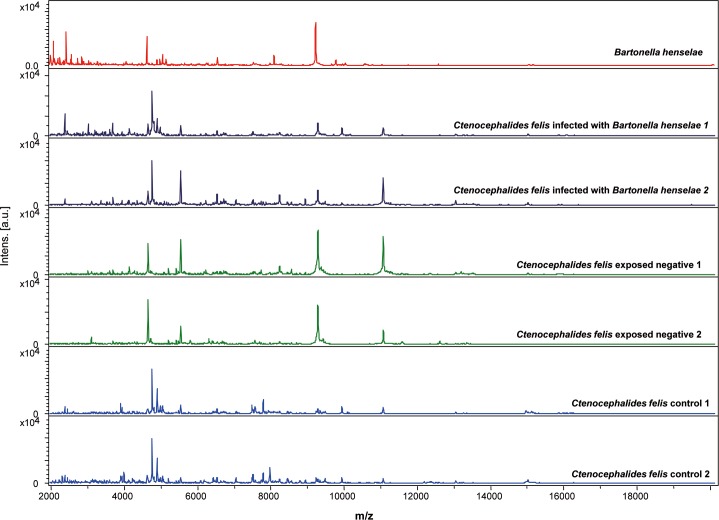
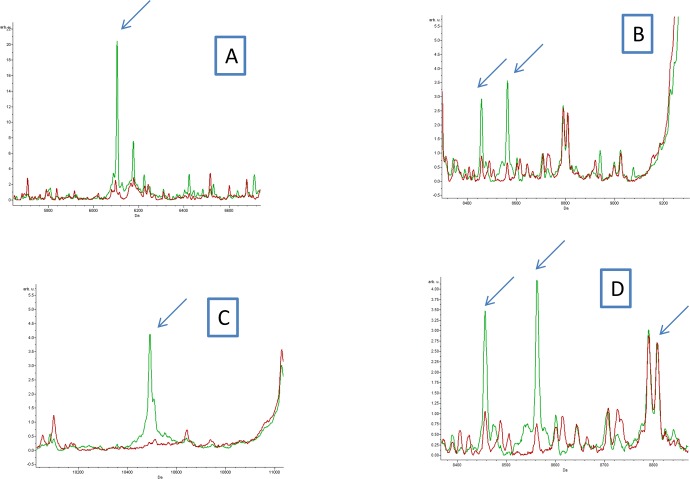
METHODOLOGY/PRINCIPAL FINDINGS: An experimental model of Ctenocephalides felis (cat fleas) infected with Bartonella quintana and Bartonella henselae was developed to evaluate the efficacy of MALDI-TOF MS in distinguishing infected from uninfected fleas, and its ability to distinguish fleas infected with Bartonella quintana from fleas infected with Bartonella henselae. For B. quintana, two groups of fleas received three successive blood meals, infected or not. A total of 140 fleas (100 exposed fleas and 40 control fleas) were engorged on human blood, infected or uninfected with B. quintana. Regarding the second pathogen, two groups of fleas (200 exposed fleas and 40 control fleas) were fed in the same manner with human blood, infected or not with Bartonella henselae. Fleas were dissected longitudinally; one-half was used for assessment of B. quintana and B. henselae infectious status by real-time PCR, and the second half was subjected to MALDI-TOF MS analysis. Comparison of MS spectra from infected fleas and uninfected fleas revealed distinct MS profiles. Blind queries against our MALDI-TOF MS arthropod database, upgraded with reference spectra from B. quintana and B. henselae infected fleas but also non-infected fleas, provided the correct classification for 100% of the different categories of specimens tested on the first model of flea infection with Bartonella quintana. As for Bartonella henselae, 81% of exposed qPCR-positive fleas, 96% of exposed qPCR-negative fleas and 100% of control fleas were correctly identified on the second model of flea infection. MALDI-TOF MS successfully differentiated Bartonella spp.-infected and uninfected fleas and was also able to correctly differentiate fleas infected with Bartonella quintana and fleas infected with Bartonella henselae. MALDI-TOF MS correctly identified flea species as well as their infectious status, consistent with the results of real-time PCR.
CONCLUSIONS/SIGNIFICANCE: MALDI-TOF is a promising tool for identification of the infection status of fleas infected with Bartonella spp., which allows new possibilities for fast and accurate diagnosis in medical entomology and vector surveillance.
基质辅助激光解吸电离飞行时间质谱(MALDI-TOF MS)最近在昆虫学领域崭露头角,成为鉴定节肢动物和检测相关病原体的一种很有前途的方法。
方法/主要发现:本研究建立了感染巴尔通体 quintana 和巴尔通体 henselae 的猫蚤(Ctenocephalides felis)实验模型,以评估 MALDI-TOF MS 区分感染和未感染跳蚤的有效性,以及区分感染巴尔通体 quintana 的跳蚤和感染巴尔通体 henselae 的跳蚤的能力。对于巴尔通体 quintana,两组跳蚤分别接受了三次连续的血餐,感染或未感染。共采集了 140 只跳蚤(100 只暴露跳蚤和 40 只对照跳蚤),吸食了感染或未感染巴尔通体 quintana 的人类血液。对于第二种病原体,两组跳蚤(200 只暴露跳蚤和 40 只对照跳蚤)以相同的方式用感染或未感染巴尔通体 henselae 的人类血液喂养。将跳蚤纵向解剖;一半用于通过实时 PCR 评估巴尔通体 quintana 和巴尔通体 henselae 的感染状态,另一半用于 MALDI-TOF MS 分析。比较感染跳蚤和未感染跳蚤的 MS 图谱,发现 MS 图谱明显不同。对我们的 MALDI-TOF MS 节肢动物数据库进行盲查,该数据库使用来自感染巴尔通体 quintana 和巴尔通体 henselae 的跳蚤以及非感染跳蚤的参考图谱进行了升级,对第一个巴尔通体 quintana 感染跳蚤模型中测试的不同类别的标本进行分类,准确率达到 100%。对于巴尔通体 henselae,81%的暴露 qPCR 阳性跳蚤、96%的暴露 qPCR 阴性跳蚤和 100%的对照跳蚤在第二个跳蚤感染模型中得到了正确识别。MALDI-TOF MS 成功区分了巴尔通体 spp. 感染和未感染的跳蚤,也能够正确区分感染巴尔通体 quintana 的跳蚤和感染巴尔通体 henselae 的跳蚤。MALDI-TOF MS 能够正确识别跳蚤种类及其感染状态,与实时 PCR 的结果一致。
结论/意义:MALDI-TOF 是鉴定感染巴尔通体 spp. 的跳蚤感染状态的一种很有前途的工具,为医学昆虫学和媒介监测中的快速准确诊断提供了新的可能。