Ha My Kieu, Trinh Tung Xuan, Choi Jang Sik, Maulina Desy, Byun Hyung Gi, Yoon Tae Hyun
Department of Chemistry, College of Natural Sciences, Hanyang University, Seoul, 04763, Republic of Korea.
Division of Electronics, Information and Communication Engineering, Kangwon National University, Samcheok, Kangwon-do, 24341, Republic of Korea.
Sci Rep. 2018 Feb 16;8(1):3141. doi: 10.1038/s41598-018-21431-9.
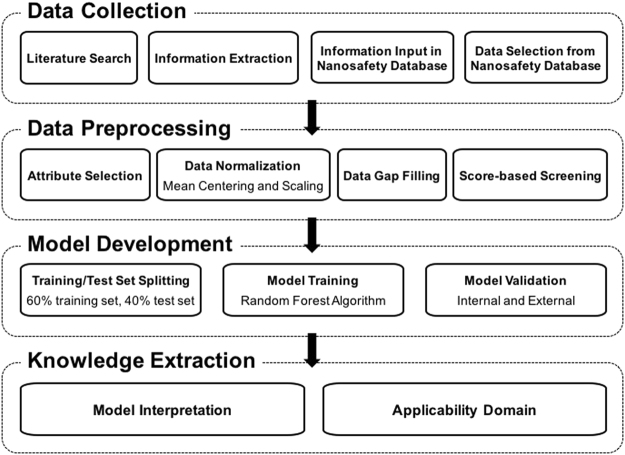
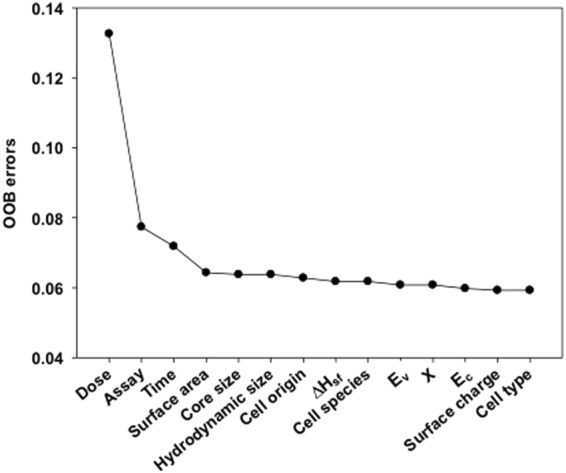
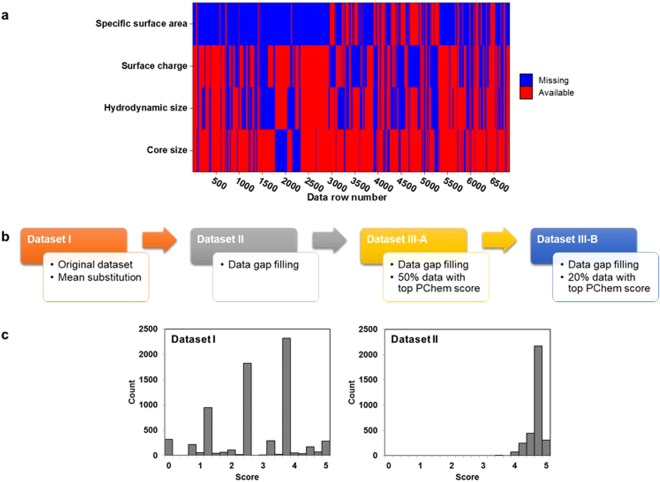
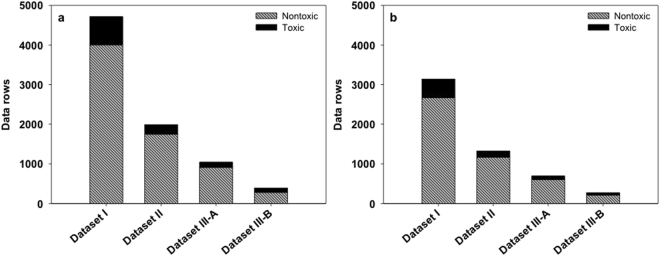
Development of nanotoxicity prediction models is becoming increasingly important in the risk assessment of engineered nanomaterials. However, it has significant obstacles caused by the wide heterogeneities of published literature in terms of data completeness and quality. Here, we performed a meta-analysis of 216 published articles on oxide nanoparticles using 14 attributes of physicochemical, toxicological and quantum-mechanical properties. Particularly, to improve completeness and quality of the extracted dataset, we adapted two preprocessing approaches: data gap-filling and physicochemical property based scoring. Performances of nano-SAR classification models revealed that the dataset with the highest score value resulted in the best predictivity with compromise in its applicability domain. The combination of physicochemical and toxicological attributes was proved to be more relevant to toxicity classification than quantum-mechanical attributes. Overall, by adapting these two preprocessing methods, we demonstrated that meta-analysis of nanotoxicity literatures could provide an effective alternative for the risk assessment of engineered nanomaterials.
纳米毒性预测模型的开发在工程纳米材料的风险评估中变得越来越重要。然而,由于已发表文献在数据完整性和质量方面存在广泛的异质性,这一过程面临重大障碍。在此,我们使用物理化学、毒理学和量子力学性质的14个属性,对216篇关于氧化物纳米颗粒的已发表文章进行了荟萃分析。特别是,为了提高提取数据集的完整性和质量,我们采用了两种预处理方法:数据填补和基于物理化学性质的评分。纳米结构活性关系(nano-SAR)分类模型的性能表明,得分最高的数据集在其适用范围上有所妥协的情况下具有最佳的预测能力。事实证明,物理化学属性和毒理学属性的组合比量子力学属性与毒性分类更相关。总体而言,通过采用这两种预处理方法,我们证明了纳米毒性文献的荟萃分析可以为工程纳米材料的风险评估提供一种有效的替代方法。