Laboratory of Clinical Bacteriology, Parasitology, Zoonoses and Geographical Medicine, School of Medicine, University of Crete, Vassilika Vouton, P.O. Box 2208, GR-71003, Heraklion, Greece.
Biology Department, School of Sciences and Engineering, University of Crete, Vassilika Vouton, P.O. Box 2208, GR-70013, Heraklion, Crete, Greece.
Parasit Vectors. 2018 Feb 17;11(1):94. doi: 10.1186/s13071-018-2676-0.
Phlebotomine sand flies (Diptera: Psychodidae) are vectors of Leishmania spp., protozoan parasites responsible for a group of neglected diseases called leishmaniases. Two sand fly genera, Phlebotomus and Sergentomyia, contain species that are present in the Mediterranean islands of Crete and Cyprus where the visceral (VL), cutaneous (CL) and canine (CanLei) leishmaniases are a public health concern. The risk of transmission of different Leishmania species can be studied in an area by monitoring their vectors. Sand fly species are traditionally identified using morphological characteristics but minute differences between individuals or populations could be overlooked leading to wrong epidemiological predictions. Molecular identification of these important vectors has become, therefore, an essential tool for research tasks concerning their geographical distribution which directly relates to leishmaniasis control efforts. DNA barcoding is a widely used molecular identification method for cataloguing animal species by sequencing a fragment of the mitochondrial gene encoding cytochrome oxidase I.
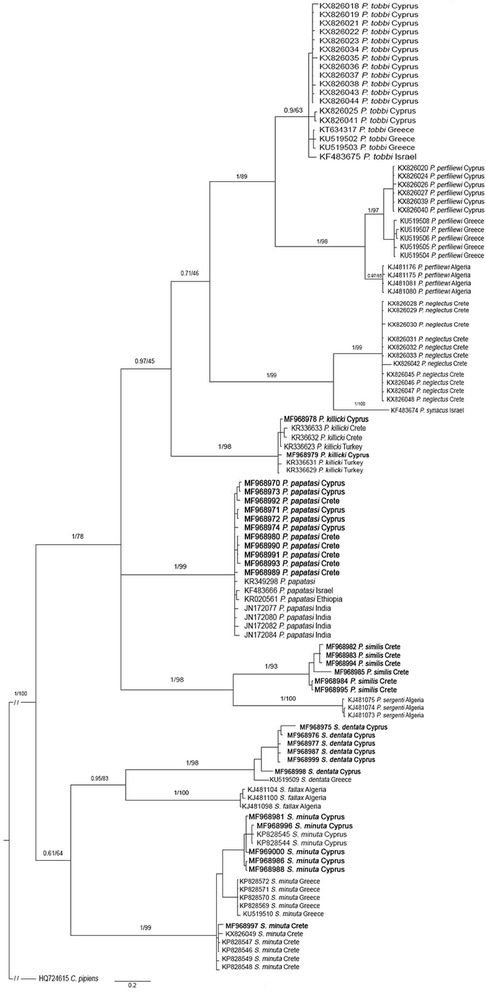
DNA barcoding was used to identify individuals of five sand fly species (Phlebotomus papatasi, P. similis, P. killicki, Sergentomyia minuta, S. dentata) circulating in the islands of Crete and Cyprus during the years 2011-2014. Phlebotomus papatasi is a known vector of zoonotic CL in the Middle East and it is found in both islands. Phlebotomus similis is the suspected vector of Leishmania tropica in Greece causing anthroponotic CL. Phlebotomus killicki was collected in Cyprus for the first time. Sergentomyia minuta, found to present intraspecific diversity, is discussed for its potential as a Leishmania vector. Molecular identification was consistent with the morphological identification. It successfully identified males and females, which is difficult when using only morphological characters. A phylogenetic tree was constructed based on the barcodes acquired, representing their genetic relationships along with other species from the area studied. All individuals identified were clustered according to their species and subgenus.
Molecular identification of sand flies via DNA barcoding can accurately identify these medically important insects assisting traditional morphological tools, thus helping to assess their implication in Leishmania transmission.
白蛉(双翅目:长角亚目)是利什曼原虫(原生动物寄生虫)的传播媒介,这些寄生虫是一组被称为利什曼病的被忽视疾病的病原体。在包含物种的白蛉属和塞氏属中,有一些存在于克里特岛和塞浦路斯这两个地中海岛屿上,那里的内脏利什曼病(VL)、皮肤利什曼病(CL)和犬利什曼病(CanLei)是公共卫生关注的问题。通过监测其传播媒介,可以在一个地区研究不同利什曼原虫物种的传播风险。传统上,通过形态特征来识别白蛉种类,但个体或种群之间的微小差异可能会被忽视,从而导致错误的流行病学预测。因此,对这些重要媒介物进行分子鉴定已成为研究其地理分布的必要工具,而地理分布与控制利什曼病的努力直接相关。DNA 条形码是一种广泛使用的分子鉴定方法,通过对线粒体基因编码细胞色素氧化酶 I 的片段进行测序来对动物物种进行编目。
DNA 条形码用于鉴定 2011-2014 年间在克里特岛和塞浦路斯群岛循环的五种白蛉(埃及伊蚊、皮氏伊蚊、基氏白蛉、米氏白蛉、齿缘白蛉)的个体。埃及伊蚊是中东已知的动物内脏利什曼病的传播媒介,在两个岛屿都有发现。皮氏伊蚊是希腊利什曼原虫热带病的疑似传播媒介,引起人间皮肤利什曼病。塞氏白蛉首次在塞浦路斯被采集到。米氏白蛉存在种内多样性,被认为有作为利什曼原虫传播媒介的潜力,正在讨论中。分子鉴定与形态鉴定一致。它成功地鉴定了雄性和雌性,这是仅使用形态特征难以做到的。根据获得的条形码构建了一个系统发育树,代表了它们与该地区研究的其他物种的遗传关系。根据其物种和亚属对所有鉴定的个体进行聚类。
通过 DNA 条形码对白蛉进行分子鉴定,可以准确识别这些具有医学重要性的昆虫,辅助传统的形态学工具,从而有助于评估它们在利什曼原虫传播中的作用。