Yared Solomon, Gebresilassie Araya, Akililu Essayas, Deribe Kebede, Balkew Meshesha, Warburg Alon, Hailu Asrat, Gebre-Michael Teshome
Department of Biology, College of Natural and Computational Science, Jigjiga University, Jigjiga, Ethiopia.
Department of Biology, Mada Walabu University, Bale-Robe, Ethiopia.
Acta Trop. 2017 Dec;176:1-10. doi: 10.1016/j.actatropica.2017.07.008. Epub 2017 Jul 13.
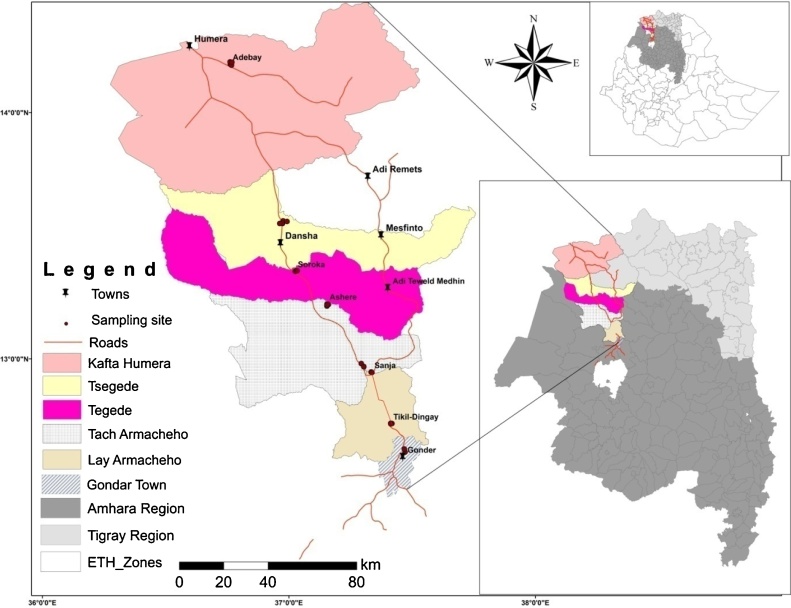
The Leishmaniases are caused by the protozoan parasites of the genus Leishmania and are transmitted to humans by the bite of infected female phlebotomine sand flies. Both visceral and cutaneous leishmaniases are widely distributed in different parts of Ethiopia. The aim of this study was to determine the diversity and altitudinal distribution of phlebotomine sand flies from Kafta Humera to Gondar town in northwest Ethiopia.
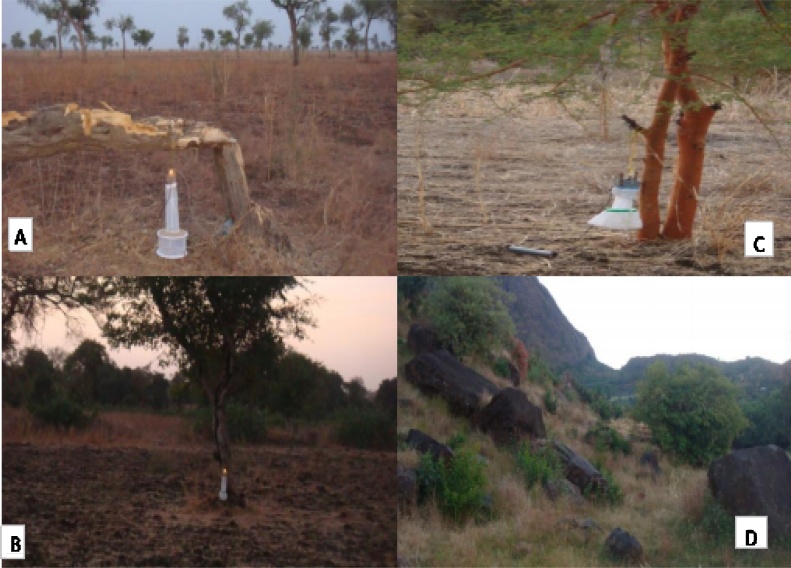
Seven localities were selected with distinct altitudinal variations between 550m above sea level (m a.s.l) and 2300m a.s.l. In each locality, sand flies were collected using standard CDC light traps and sticky traps during the active sand fly season from December 2012 to May 2013. Shannon-Weiner species diversity index and Jaccard's coefficient were used to estimate species diversity and similarity between altitudes and localities, respectively.
A total of 89,044 sand flies (41,798 males and 47, 246 females) were collected from the seven localities/towns throughout the study period. Twenty-two species belonging to 11 species in the genus Phlebotomus and 11 species in the genus Sergentomyia were documented. Of these, Sergentomyia clydei (25.87%), S. schwetzi (25.21%), S. africana (24.65%), S. bedfordi (8.89%), Phlebotomus orientalis (6.43%), and S. antennata (4.8%) were the most prevalent species. The remaining 10 Phlebotomus species and six Sergentomyia were less frequent catches. In CDC light trap and sticky trap, higher species diversity and richness for both male and female sand flies was observed at low altitude ranging from 550 to 699m a.s.l in Adebay village in Kafta Humera district whereas low species richness and high evenness of both sexes were also observed in an altitude 1950-2300m a.s.l.
The results revealed that the presence of leishmaniasis vectors such as P. orientalis, P. longipes, P. papatasi, and P. duboscqi in different altitudes in northwest Ethiopia. P. orientalis a vector of L. donovani, occurred between altitude 500-1100m a.s.l, the area could be at high risk of VL. P. longipes a vector of L. aethiopica, was recorded in the highland area in Tikil-Dingay and Gondar town, implicating the possibility of CL transmission. Hence, further investigation into vector competence in relation to leishmaniasis (VL and CL) in the region is very vital.
利什曼病由利什曼原虫属的原生动物寄生虫引起,通过受感染的雌性白蛉叮咬传播给人类。内脏利什曼病和皮肤利什曼病在埃塞俄比亚的不同地区广泛分布。本研究的目的是确定埃塞俄比亚西北部从卡法胡梅拉到贡德尔镇的白蛉的多样性和海拔分布。
选择了七个海拔高度有明显差异的地点,海拔范围在海平面以上550米(m a.s.l)至2300米a.s.l之间。在每个地点,于2012年12月至2013年5月白蛉活跃季节,使用标准的疾控中心诱蚊灯和粘虫板收集白蛉。香农 - 威纳物种多样性指数和雅卡尔系数分别用于估计海拔高度和地点之间的物种多样性和相似性。
在整个研究期间,从这七个地点/城镇共收集到89,044只白蛉(41,798只雄性和47,246只雌性)。记录了属于白蛉属11个物种和司蛉属11个物种的22个物种。其中,克莱德司蛉(25.87%)、施韦茨司蛉(25.21%)、非洲司蛉(24.65%)、贝德福特司蛉(8.89%)、东方白蛉(6.43%)和触角司蛉(4.8%)是最常见的物种。其余10种白蛉属物种和6种司蛉属物种捕获频率较低。在疾控中心诱蚊灯和粘虫板中,在卡法胡梅拉区阿德贝伊村海拔550至699米a.s.l的低海拔地区,观察到雄性和雌性白蛉的物种多样性和丰富度较高,而在海拔1950 - 2300米a.s.l也观察到两性的物种丰富度较低但均匀度较高。
结果显示,在埃塞俄比亚西北部不同海拔地区存在杜氏利什曼原虫、埃塞俄比亚利什曼原虫、热带利什曼原虫和杜氏白蛉等利什曼病传播媒介。作为杜氏利什曼原虫传播媒介的东方白蛉出现在海拔500 - 1100米a.s.l之间,该地区可能面临内脏利什曼病的高风险。作为埃塞俄比亚利什曼原虫传播媒介的长管白蛉在提基尔 - 丁盖和贡德尔镇的高地地区被记录到,这意味着存在皮肤利什曼病传播的可能性。因此,进一步调查该地区与利什曼病(内脏利什曼病和皮肤利什曼病)相关的媒介能力至关重要。