Institute of Pathology, University of Bern, Bern, Switzerland.
Graduate School for Cellular and Biomedical Sciences, University of Bern, Bern, Switzerland.
Mol Cancer. 2018 Feb 19;17(1):44. doi: 10.1186/s12943-018-0781-5.
Epidermal growth factor receptor (EGFR) mutations enable constitutive active downstream signaling of PI3K/AKT, KRAS/ERK and JAK/STAT pathways, and promote tumor progression by inducing uncontrolled proliferation, evasion of apoptosis and migration of non-small cell lung cancer (NSCLC). In addition, such EGFR mutations increase the susceptibility of patients with NSCLC to tyrosine kinase inhibitor (TKI) therapy, but treated patients will invariably relapse with resistant disease. A global understanding of underlying molecular mechanisms of EGFR signaling may improve the management of NSCLC patients.
microarray analysis was performed to identify PI3K/AKT-regulated miRNAs. Phosphoproteomic analysis and cell based assays were performed using NSCLC cell lines lentivirally transduced with anti-miR or miR overexpressing constructs.
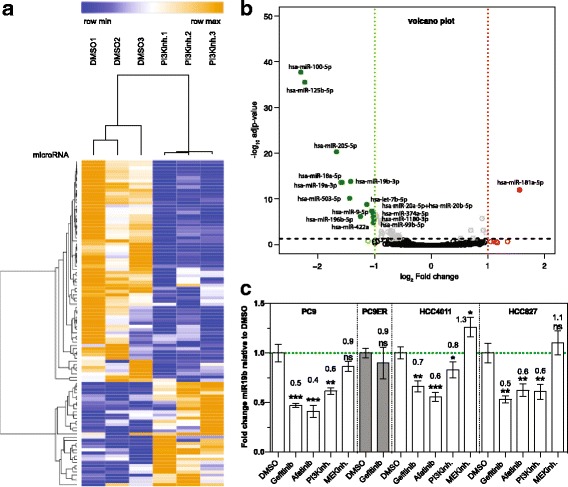
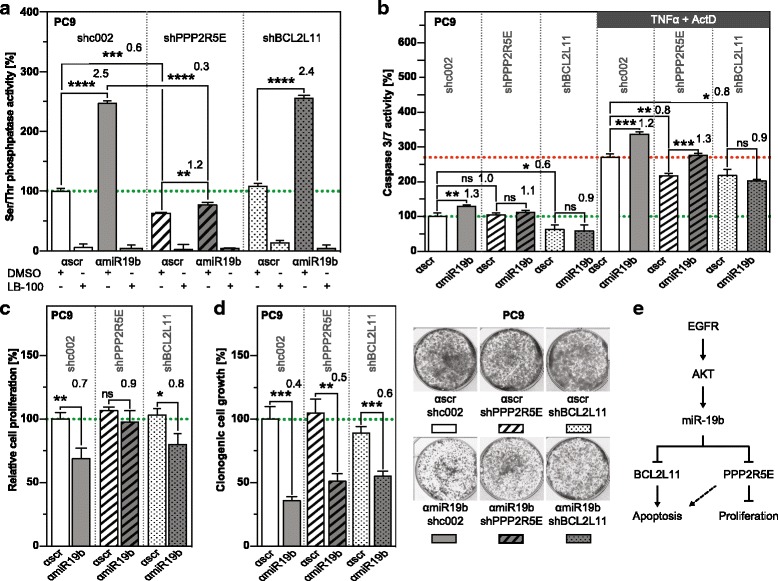
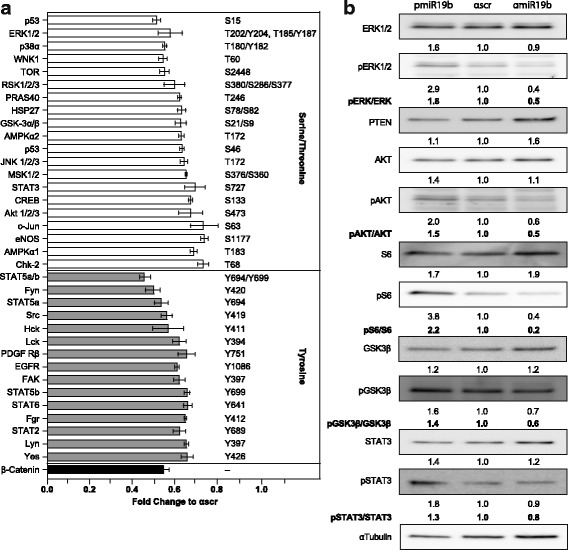
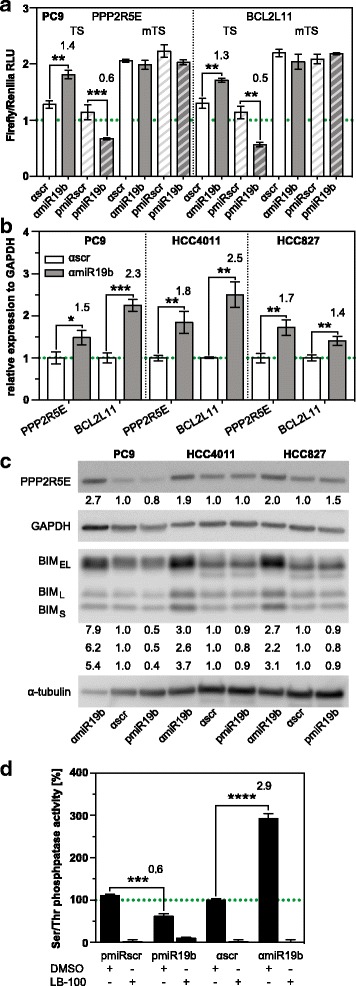
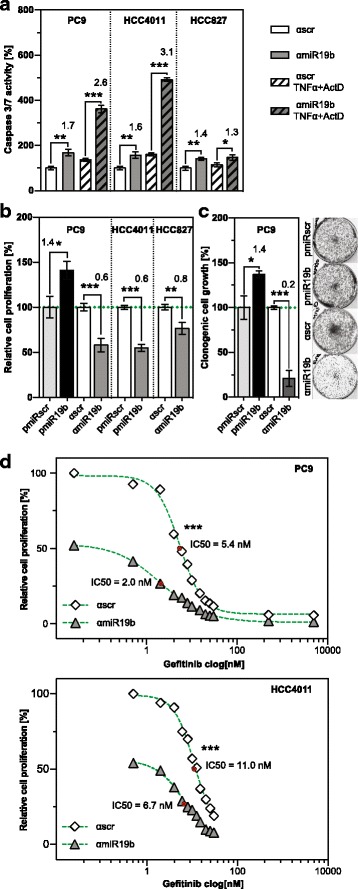
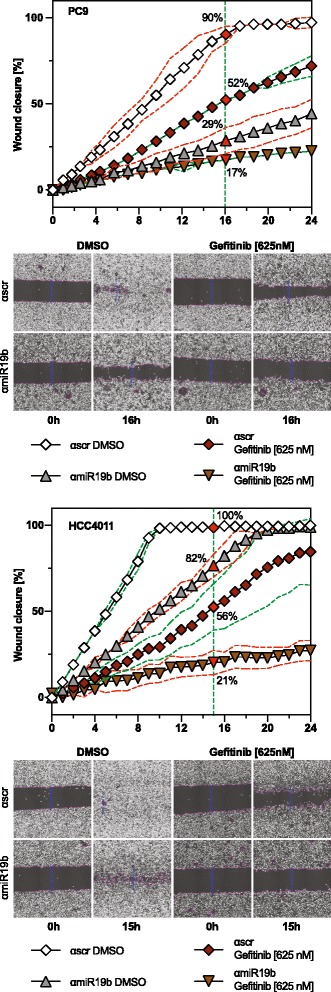
Here, we show that 17 miRNAs including members of the miR-17~ 92 cluster are dysregulated following PI3K/AKT inhibition of EGFR mutant NSCLC cells. Bioinformatics analysis revealed that dysregulated miRNAs act in a concerted manner to enhance the activity of the EGFR signaling pathway. These findings were closely mirrored by attenuation of miR-17~ 92 family member miR-19b in NSCLC cell lines which resulted in reduced phosphorylation of ERK, AKT and STAT and effector proteins in EGFR mutant NSCLC cells. Consistent with this finding, cell cycle progression, clonogenic growth and migration were reduced and apoptosis was enhanced. Co-treatment of NSCLC cells with the tyrosine kinase inhibitor (TKI) gefitinib and anti-miR-19b construct reduced migration and clonogenic growth in a synergistic manner suggesting that EGFR and miR-19b act together to control oncogenic processes. Serine/threonine phosphatase PP2A subunit PPP2R5E and BCL2L11 encoding BIM were identified as major targets of miR-19b by target validation assays. Consistent with this finding, PP2A activity was strongly enhanced in NSCLC transduced with anti-miR-19b construct, but not in cells co-transduced with anti-miR-19b and shPPP2R5E, suggesting that PPP2R5E is a major constituent of the PP2A complex. Accordingly, enhanced proliferation by miR-19b was due to targeting PPP2R5E. In contrast, apoptosis resistance was mainly due to targeting BCL2L11.
Our results provide insight into the importance of targeting PPP2R5E and BCL2L11 by miR-19b in oncogenic processes of NSCLC. Attenuation of miR-19b expression could potentially be exploited in adjuvant therapy of EGFR mutant NSCLC.
表皮生长因子受体 (EGFR) 突变使 PI3K/AKT、KRAS/ERK 和 JAK/STAT 通路的下游信号持续激活,通过诱导不受控制的增殖、逃避细胞凋亡和非小细胞肺癌 (NSCLC) 的迁移来促进肿瘤进展。此外,这种 EGFR 突变增加了 NSCLC 患者对酪氨酸激酶抑制剂 (TKI) 治疗的敏感性,但接受治疗的患者最终会因耐药性疾病而复发。对 EGFR 信号转导的潜在分子机制的全面了解可能会改善 NSCLC 患者的管理。
使用 EGFR 突变型 NSCLC 细胞系的慢病毒转导的抗 miR 或 miR 过表达构建体进行 microarray 分析以鉴定 PI3K/AKT 调节的 miRNAs。进行磷酸化蛋白质组学分析和基于细胞的测定。
在这里,我们表明,包括 miR-1792 簇成员在内的 17 个 miRNA 在 EGFR 突变型 NSCLC 细胞中 PI3K/AKT 抑制后失调。生物信息学分析表明,失调的 miRNA 以协同方式发挥作用,增强 EGFR 信号通路的活性。这些发现与 NSCLC 细胞系中 miR-1792 家族成员 miR-19b 的衰减非常吻合,导致 EGFR 突变型 NSCLC 细胞中 ERK、AKT 和 STAT 的磷酸化和效应蛋白减少。与此发现一致,细胞周期进程、集落形成生长和迁移减少,凋亡增强。NSCLC 细胞与酪氨酸激酶抑制剂 (TKI) 吉非替尼和抗 miR-19b 构建体共同处理以协同方式降低迁移和集落形成生长,表明 EGFR 和 miR-19b 共同控制致癌过程。丝氨酸/苏氨酸磷酸酶 PP2A 亚基 PPP2R5E 和编码 BIM 的 BCL2L11 被鉴定为 miR-19b 的主要靶标通过靶标验证测定。与该发现一致,与对照相比,转导抗 miR-19b 构建体的 NSCLC 中 PP2A 活性强烈增强,但与共转导抗 miR-19b 和 shPPP2R5E 的细胞相比则没有增强,表明 PPP2R5E 是 PP2A 复合物的主要组成部分。因此,miR-19b 的增殖增强归因于对 PPP2R5E 的靶向。相反,凋亡抵抗主要归因于对 BCL2L11 的靶向。
我们的结果提供了对 miR-19b 在 NSCLC 致癌过程中靶向 PPP2R5E 和 BCL2L11 的重要性的深入了解。miR-19b 表达的减弱可能会在 EGFR 突变型 NSCLC 的辅助治疗中得到利用。