Chatterjee Kaushik, Ambekar Prakash
Department of Psychiatry, Armed Forces Medical College, Pune, India.
Department of Psychiatry, Indian Institute of Medical Science and Research Medical College, Jalna, Maharashtra, India.
Ind Psychiatry J. 2017 Jan-Jun;26(1):82-85. doi: 10.4103/ipj.ipj_59_17.
Shift-workers commonly suffer from insomnia. This study evaluates different domains of insomnia.
This study was aimed to study sleep and insomnia in rotating shift-workers and compare with day-workers.
This was case-control study. The sleep of rotating shift-workers is compared with day workers using Athens Insomnia Scale.
Rotating shift-workers had significantly higher scores on Athens insomnia scale on domains of initial, intermediate and terminal insomnia than day workers. Duration and quality of sleep and sense of well-being are lower in rotating shift-workers. Rotating shift-workers also experienced more day-time sleepiness than day workers. However, there was no difference in perceived physical and mental functioning between the two groups.
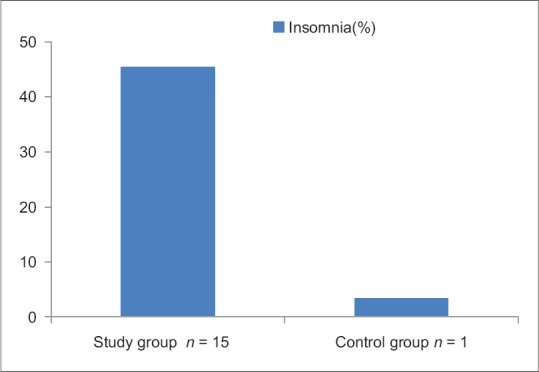
Individuals working in rotating shifts for more than 15 days have significantly higher prevalence of insomnia than day-workers.
轮班工作者常受失眠困扰。本研究评估失眠的不同方面。
本研究旨在研究轮班工作者的睡眠与失眠情况,并与日班工作者进行比较。
这是一项病例对照研究。使用雅典失眠量表比较轮班工作者与日班工作者的睡眠情况。
在初始失眠、中间失眠和末期失眠方面,轮班工作者在雅典失眠量表上的得分显著高于日班工作者。轮班工作者的睡眠时长、质量及幸福感较低。轮班工作者白天的困倦感也比日班工作者更强。然而,两组在感知到的身体和心理功能方面没有差异。
连续轮班工作超过15天的个体失眠患病率显著高于日班工作者。