Nandeesh B N, Naskar Sharmistha, Shashtri Arun H, Arivazhagan A, Santosh Vani
Department of Neuropathology, National Institute of Mental Health and Neurosciences, Bengaluru, Karnataka, India.
Department of Clinical Neurosciences, National Institute of Mental Health and Neurosciences, Bengaluru, Karnataka, India.
J Neurosci Rural Pract. 2018 Jan-Mar;9(1):86-91. doi: 10.4103/jnrp.jnrp_417_17.
Despite advances in the treatment of glioblastoma (GBM), the prognosis of patients continues to remain dismal. This unfavorable prognosis is mainly attributed to the tumor's propensity for progression and recurrence, which in turn is due to the highly aggressive nature of the persisting GBM cells that actively egress from the main tumor mass into the surrounding normal brain tissue. Such a recurrent tumor described to have a more malignant potential is highly invasive and resistant to current therapies, probably due to increased stemness and preferential selection of therapy-resistant clones of tumor cells. However, there is a paucity of literature on the expression of biomarkers in the recurrent GBM tumors that could have a role in conferring this aggressiveness.
To identify the differences in the expression pattern of selected biomarkers in paired tissue samples of GBM.
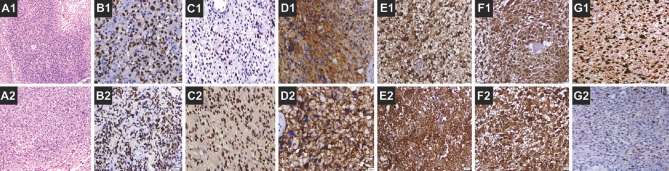
A retrospective study on 30 paired samples of GBM (newly diagnosed/primary and recurrent) archived in the Department of Neuropathology, NIMHANS (2006-2009), was carried out. After obtaining clinical and demographic details, tumors were characterized histomorphologically and immunohistochemically on formalin-fixed paraffin-embedded tissues with reference to expression of biomarkers such as p53, epidermal growth factor receptor (EGFR), insulin-like growth factor binding protein 3 (IGFBP-3), sex determining region Y-box 2 (SOX2), and topoisomerase 2 A (Top2A). The results were statistically analyzed.
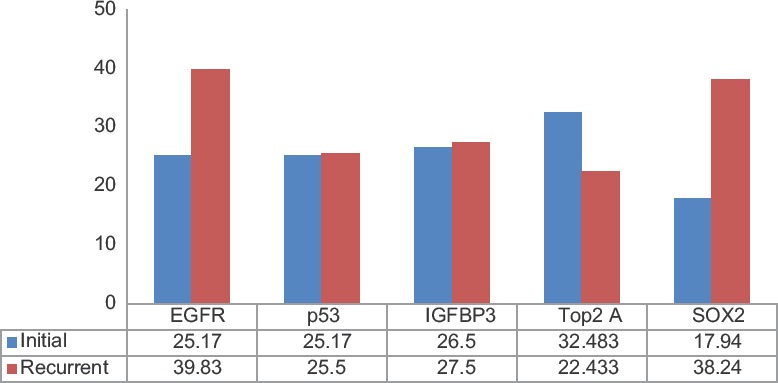
It was observed that while p53 and IGFBP-3 expression remained unaltered in paired samples, a significant increase in the expression of EGFR ( < 0.01) was noted in the recurrent tumors. Among the other biomarkers, SOX2 expression was higher in the recurrent tumors when compared to the primary tumors ( < 0.01). Conversely, the expression of Top2A was reduced in recurrent tumors ( = 0.05). Mild elevation in the expression of IGFBP-3 was observed in recurrent tumors but was not statistically significant.
A significant increase in the expression of SOX2 in recurrent tumors probably indicates the presence of undifferentiated cells with stem-like properties in these tumors. EGFR is known to mediate SOX2 expression thereby resulting in stemness of the glioma cancer cells, which could further explain its overexpression in recurrent GBMs. Furthermore, a decreased expression of TOP2A observed in the recurrent tumors could probably be due to reduction in chemosensitivity to temozolomide, which has been shown in earlier studies. We also noted that p53 expression remained unaltered in the recurrent tumors when compared to the primary, suggesting the absence of preferential clonal expansion of p53 mutant cells following exposure to radiochemotherapy. Our study reiterates the fact that GBM recurrences are associated with molecular alterations that probably contribute to radiochemoresistance, increased invasiveness, therapeutic efficacy, and stemness.
尽管胶质母细胞瘤(GBM)的治疗取得了进展,但患者的预后仍然很差。这种不良预后主要归因于肿瘤的进展和复发倾向,而这又是由于持续存在的GBM细胞具有高度侵袭性,它们会主动从主要肿瘤块侵入周围正常脑组织。这种具有更高恶性潜能的复发性肿瘤具有高度侵袭性且对当前疗法耐药,这可能是由于干性增加以及对治疗耐药的肿瘤细胞克隆的优先选择。然而,关于复发性GBM肿瘤中生物标志物的表达及其在赋予这种侵袭性方面可能发挥的作用,相关文献较少。
确定GBM配对组织样本中所选生物标志物表达模式的差异。
对存档于NIMHANS神经病理学系(2006 - 2009年)的30对GBM样本(新诊断/原发性和复发性)进行回顾性研究。获取临床和人口统计学细节后,参照p53、表皮生长因子受体(EGFR)、胰岛素样生长因子结合蛋白3(IGFBP - 3)、性别决定区Y框2(SOX2)和拓扑异构酶2A(Top2A)等生物标志物的表达,对福尔马林固定石蜡包埋组织进行组织形态学和免疫组织化学特征分析。对结果进行统计学分析。
观察到在配对样本中p53和IGFBP - 3的表达保持不变,而复发性肿瘤中EGFR的表达显著增加(<0.01)。在其他生物标志物中,与原发性肿瘤相比,复发性肿瘤中SOX2的表达更高(<0.01)。相反,复发性肿瘤中Top2A的表达降低(=0.05)。复发性肿瘤中观察到IGFBP - 3表达有轻度升高,但无统计学意义。
复发性肿瘤中SOX2表达的显著增加可能表明这些肿瘤中存在具有干细胞样特性的未分化细胞。已知EGFR介导SOX2表达,从而导致胶质瘤癌细胞的干性,这可以进一步解释其在复发性GBM中的过表达。此外,复发性肿瘤中观察到的TOP2A表达降低可能是由于对替莫唑胺的化疗敏感性降低,早期研究已表明这一点。我们还注意到,与原发性肿瘤相比,复发性肿瘤中p53表达保持不变,这表明在接受放化疗后p53突变细胞没有优先的克隆扩增。我们的研究重申了一个事实,即GBM复发与分子改变有关,这些改变可能导致放化疗耐药、侵袭性增加、治疗效果及干性增强。