1Centre for Epidemiology and Biostatistics, Melbourne School of Population and Global Health, University of Melbourne, Parkville, Victoria Australia.
2Genetic Epidemiology Laboratory, Department of Pathology, University of Melbourne, Parkville, Victoria Australia.
Clin Epigenetics. 2018 Feb 9;10:18. doi: 10.1186/s13148-018-0452-9. eCollection 2018.
Smoking has been reported to be associated with peripheral blood DNA methylation, but the causal aspects of the association have rarely been investigated. We aimed to investigate the association and underlying causation between smoking and blood methylation.
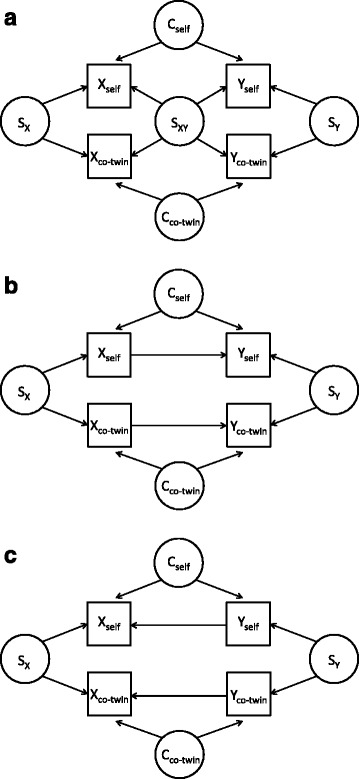
The methylation profile of DNA from the peripheral blood, collected as dried blood spots stored on Guthrie cards, was measured for 479 Australian women including 66 monozygotic twin pairs, 66 dizygotic twin pairs, and 215 sisters of twins from 130 twin families using the Infinium HumanMethylation450K BeadChip array. Linear regression was used to estimate associations between methylation at ~ 410,000 cytosine-guanine dinucleotides (CpGs) and smoking status. A regression-based methodology for twins, Inference about Causation through Examination of Familial Confounding (ICE FALCON), was used to assess putative causation.
At a 5% false discovery rate, 39 CpGs located at 27 loci, including previously reported , , and , were found to be differentially methylated across never, former and current smokers. For all 39 CpG sites, current smokers had the lowest methylation level. Our study provides the first replication for two previously reported CpG sites, cg06226150 () and cg21733098 (). From the ICE FALCON analysis with smoking status as the predictor and methylation score as the outcome, a woman's methylation score was associated with her co-twin's smoking status, and the association attenuated towards the null conditioning on her own smoking status, consistent with smoking status causing changes in methylation. To the contrary, using methylation score as the predictor and smoking status as the outcome, a woman's smoking status was not associated with her co-twin's methylation score, consistent with changes in methylation not causing smoking status.
For middle-aged women, peripheral blood DNA methylation at several genomic locations is associated with smoking. Our study suggests that smoking has a causal effect on peripheral blood DNA methylation, but not vice versa.
吸烟已被报道与外周血 DNA 甲基化有关,但这种关联的因果关系很少被研究。我们旨在调查吸烟与血液甲基化之间的关联和潜在因果关系。
我们使用 Infinium HumanMethylation450K BeadChip 芯片测量了来自外周血的 DNA 甲基化图谱,这些样本是从澳大利亚的 130 个双胞胎家庭中采集的 479 名女性(包括 66 对同卵双胞胎、66 对异卵双胞胎和 215 对双胞胎的姐妹)的干血斑中获得的。线性回归用于估计 410000 个胞嘧啶-鸟嘌呤二核苷酸(CpG)位点的甲基化与吸烟状况之间的关联。用于双胞胎的基于回归的方法,通过检查家族性混杂进行因果推断(ICE FALCON),用于评估潜在的因果关系。
在 5%的错误发现率下,在 27 个基因座的 39 个 CpG 中,包括先前报道的、、和,在从不吸烟者、前吸烟者和当前吸烟者中发现存在差异甲基化。对于所有 39 个 CpG 位点,当前吸烟者的甲基化水平最低。我们的研究首次复制了两个先前报道的 CpG 位点,cg06226150()和 cg21733098()。从 ICE FALCON 分析来看,以吸烟状况为预测因子,甲基化评分作为结果,一个女性的甲基化评分与她的同卵双胞胎的吸烟状况有关,并且这种关联在考虑到她自己的吸烟状况后趋于零,这与吸烟状况导致甲基化变化一致。相反,使用甲基化评分作为预测因子,吸烟状况作为结果,一个女性的吸烟状况与她的同卵双胞胎的甲基化评分无关,这与甲基化变化不会导致吸烟状况一致。
对于中年女性,几个基因组位置的外周血 DNA 甲基化与吸烟有关。我们的研究表明,吸烟对外周血 DNA 甲基化有因果关系,但反之则不然。