Department of Anesthesiology and Critical Care, University of Wuerzburg, Oberduerrbacher Str.6, 97080, Wuerzburg, Germany.
Eur J Med Res. 2018 Feb 20;23(1):10. doi: 10.1186/s40001-018-0308-y.
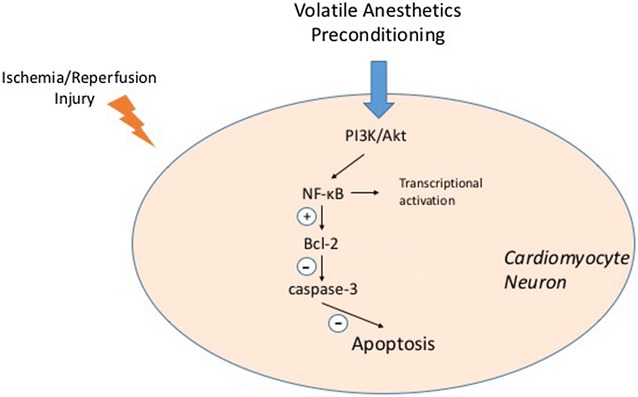
Volatile anesthetic-induced preconditioning (APC) has shown to have cardiac and cerebral protective properties in both pre-clinical models and clinical trials. Interestingly, accumulating evidences demonstrate that, except from some specific characters, the underlying molecular mechanisms of APC-induced protective effects in myocytes and neurons are very similar; they share several major intracellular signaling pathways, including mediating mitochondrial function, release of inflammatory cytokines and cell apoptosis. Among all the experimental results, cortical spreading depolarization is a relative newly discovered cellular mechanism of APC, which, however, just exists in central nervous system. Applying volatile anesthetic preconditioning to clinical practice seems to be a promising cardio-and neuroprotective strategy. In this review, we also summarized and discussed the results of recent clinical research of APC. Despite all the positive experimental evidences, large-scale, long-term, more precisely controlled clinical trials focusing on the perioperative use of volatile anesthetics for organ protection are still needed.
挥发性麻醉剂诱导的预处理(APC)已在临床前模型和临床试验中显示出具有心脏和脑保护作用。有趣的是,越来越多的证据表明,除了一些特定的特征外,APC 在心肌细胞和神经元中诱导保护作用的潜在分子机制非常相似;它们共享几种主要的细胞内信号通路,包括调节线粒体功能、释放炎症细胞因子和细胞凋亡。在所有的实验结果中,皮质扩散性抑制是 APC 中一个相对较新发现的细胞机制,但它仅存在于中枢神经系统中。将挥发性麻醉剂预处理应用于临床实践似乎是一种有前途的心脏和神经保护策略。在这篇综述中,我们还总结和讨论了 APC 的最新临床研究结果。尽管有所有积极的实验证据,但仍需要进行大规模、长期、更精确控制的临床试验,重点关注围手术期使用挥发性麻醉剂进行器官保护。