Voelkerding K, Klessig D F
J Virol. 1986 Nov;60(2):353-62. doi: 10.1128/JVI.60.2.353-362.1986.
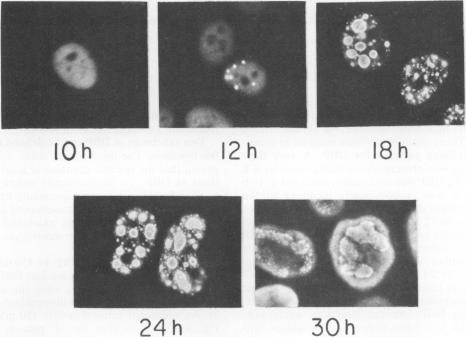
The synthesis, accumulation, and subcellular distribution of the adenovirus serotype 5 DNA-binding protein (DBP) has been examined during the infectious cycle in HeLa cells. With the onset of viral DNA replication and entry into the late phase, two nuclear subclasses of DBP are distinguishable by immunofluorescence microscopy and can be separately isolated by in situ cell fractionation. The first subclass, represented by diffuse-staining DBP, is released by the addition of 1% Nonidet P-40-150 mM NaCl. The second subclass of DBP, which is sequestered into intranuclear globular structures, requires a high ionic strength (2 M NaCl) for extraction and appears to be associated with centers of active viral DNA replication. This association is based on the observations that: DBP within the globules and viral DNA, as detected by in situ hybridization, form identical structures that colocalize within the nuclei of infected cells, the formation of DBP globular structures requires the onset and continuation of viral DNA replication, and once formed, the globular structures can be perturbed by modulating viral DNA synthesis.
在HeLa细胞的感染周期中,对腺病毒5型DNA结合蛋白(DBP)的合成、积累及亚细胞分布进行了研究。随着病毒DNA复制的开始并进入晚期,通过免疫荧光显微镜可区分出DBP的两个核亚类,并且可以通过原位细胞分级分离将它们分别分离出来。第一个亚类以弥漫性染色的DBP为代表,通过添加1%的诺乃洗涤剂P-40-150 mM氯化钠即可释放出来。第二个DBP亚类被隔离在核内球状结构中,提取需要高离子强度(2 M氯化钠),并且似乎与活跃的病毒DNA复制中心相关。这种关联基于以下观察结果:通过原位杂交检测,球状结构内的DBP和病毒DNA形成相同的结构,且在受感染细胞的核内共定位;DBP球状结构的形成需要病毒DNA复制的开始和持续;一旦形成,球状结构可通过调节病毒DNA合成而受到干扰。