Dhanasekaran Renumathy, Gabay-Ryan Meital, Baylot Virginie, Lai Ian, Mosley Adriane, Huang Xinqiang, Zabludoff Sonya, Li Jian, Kaimal Vivek, Karmali Priya, Felsher Dean W
Division of Gastroenterology and Hepatology, Department of Medicine, Stanford University School of Medicine, Stanford, CA, USA.
Division of Oncology, Department of Medicine, Stanford University School of Medicine, Stanford, CA, USA.
Oncotarget. 2017 Nov 9;9(5):5517-5528. doi: 10.18632/oncotarget.22342. eCollection 2018 Jan 19.
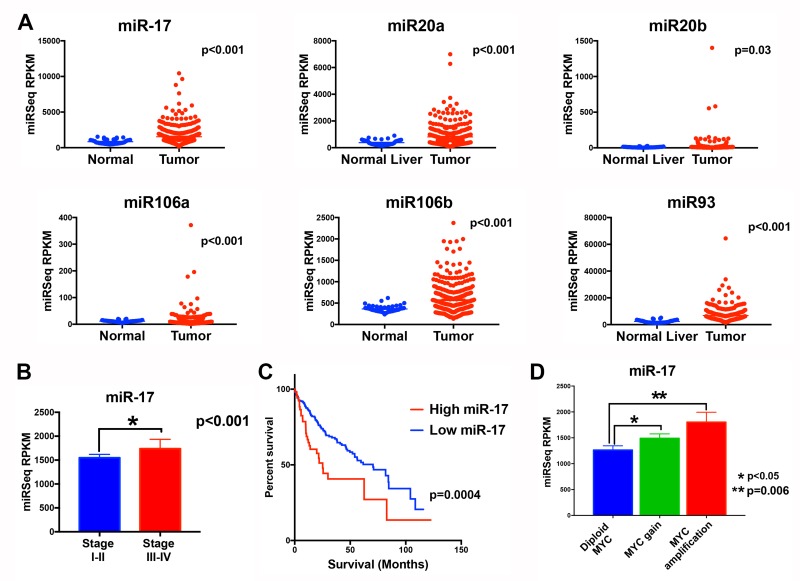
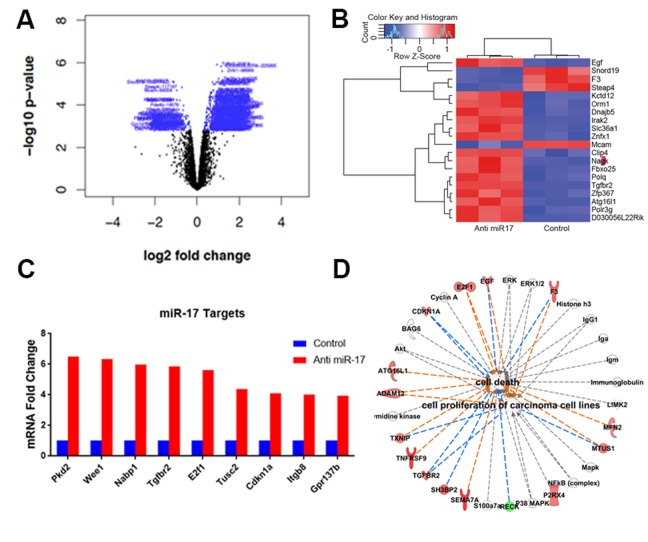
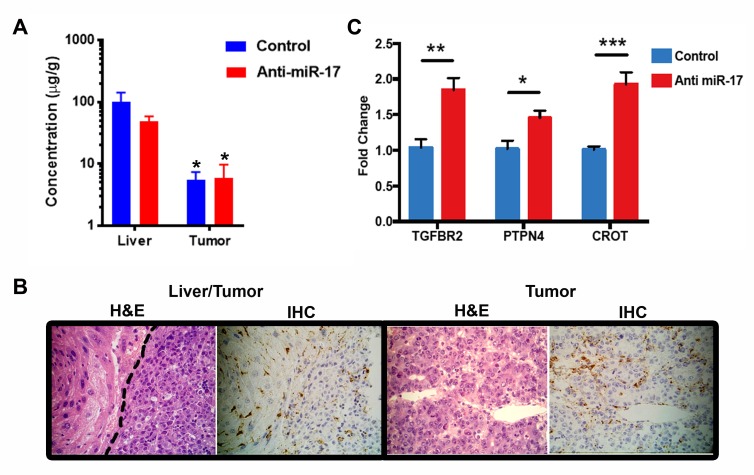
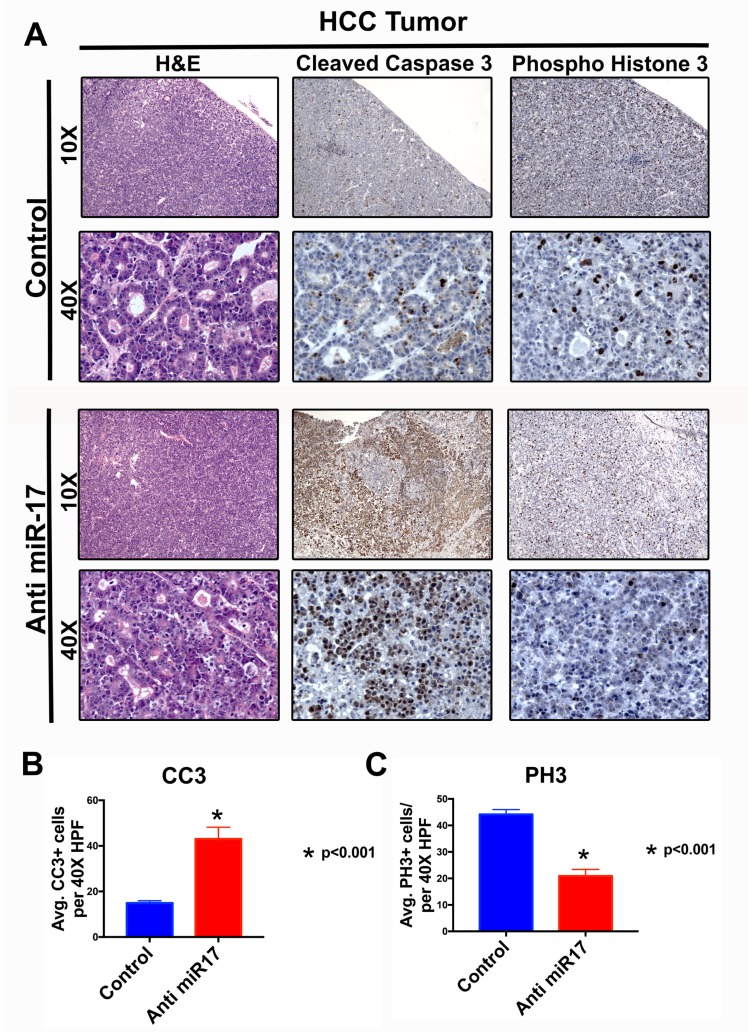
Hepatocellular carcinoma (HCC) remains a significant clinical challenge with few therapeutic options. Genomic amplification and/or overexpression of the MYC oncogene is a common molecular event in HCC, thus making it an attractive target for drug therapy. Unfortunately, currently there are no direct drug therapies against MYC. As an alternative strategy, microRNAs regulated by MYC may be downstream targets for therapeutic blockade. MiR-17 family is a microRNA family transcriptionally regulated by MYC and it is commonly overexpressed in human HCCs. In this study, we performed systemic delivery of a novel lipid nanoparticle (LNP) encapsulating an anti-miR-17 oligonucleotide in a conditional transgenic mouse model of MYC driven HCC. Treatment with anti-miR-17 , but not with a control anti-miRNA, resulted in significant de-repression of direct targets of miR-17, robust apoptosis, decreased proliferation and led to delayed tumorigenesis in MYC-driven HCCs. Global gene expression profiling revealed engagement of miR-17 target genes and inhibition of key transcriptional programs of MYC, including cell cycle progression and proliferation. Hence, anti-miR-17 is an effective therapy for MYC-driven HCC.
肝细胞癌(HCC)仍然是一个重大的临床挑战,治疗选择有限。MYC致癌基因的基因组扩增和/或过表达是HCC中常见的分子事件,因此使其成为药物治疗的一个有吸引力的靶点。不幸的是,目前尚无针对MYC的直接药物疗法。作为一种替代策略,受MYC调控的微小RNA可能是治疗阻断的下游靶点。MiR-17家族是一个受MYC转录调控的微小RNA家族,在人类HCC中通常过表达。在本研究中,我们在MYC驱动的HCC条件转基因小鼠模型中,通过新型脂质纳米颗粒(LNP)全身递送包裹抗miR-17寡核苷酸。用抗miR-17而非对照抗微小RNA进行治疗,导致miR-17直接靶点的显著去抑制、强烈的细胞凋亡、增殖减少,并导致MYC驱动的HCC肿瘤发生延迟。全基因组表达谱分析揭示了miR-17靶基因的参与以及对MYC关键转录程序的抑制,包括细胞周期进程和增殖。因此,抗miR-17是治疗MYC驱动的HCC的有效疗法。