Ziebart Andreas, Huber Ulrich, Jeske Sandra, Laban Simon, Doescher Johannes, Hoffmann Thomas K, Brunner Cornelia, Jackson Edwin K, Schuler Patrick J
Department of Neurosurgery, University Hospital Mannheim, University of Heidelberg, Mannheim, Germany.
Department of Otolaryngology, Head and Neck Surgery, Ulm University Medical Center, Ulm, Germany.
Oncotarget. 2017 Dec 20;9(5):5834-5847. doi: 10.18632/oncotarget.23533. eCollection 2018 Jan 19.
Head and neck squamous cell carcinoma (HNSCC) strongly suppresses the immune system, resulting in increased metastasis and recurrent disease. Chemotherapy is part of the multimodal treatment but may further immunosuppression. Recently, we demonstrated that regulatory B cells (Breg), defined as CD19CD39CD73 B cells, play a significant role in the production of immunosuppressive, extracellular adenosine (ADO). Here, we tested the influence of chemotherapy on Breg function.
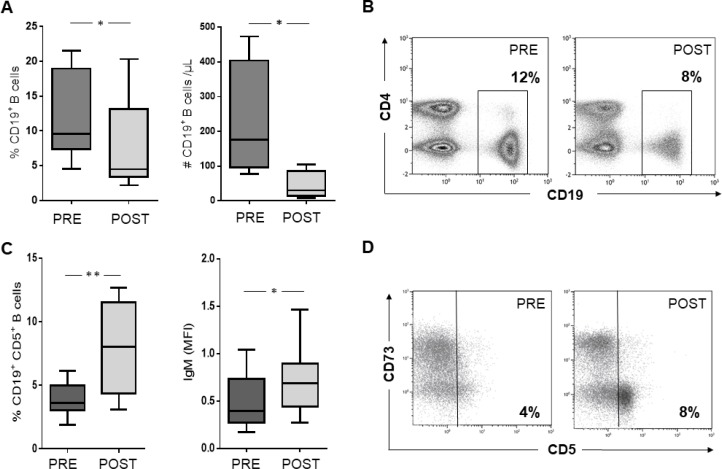
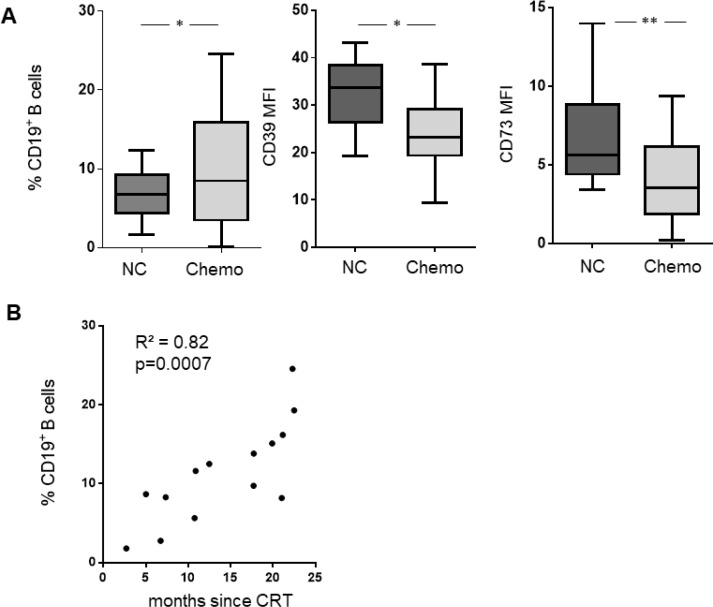
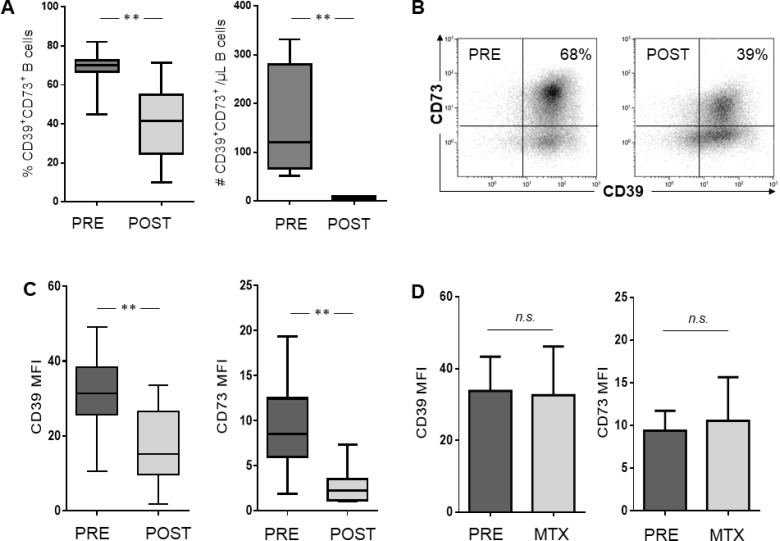
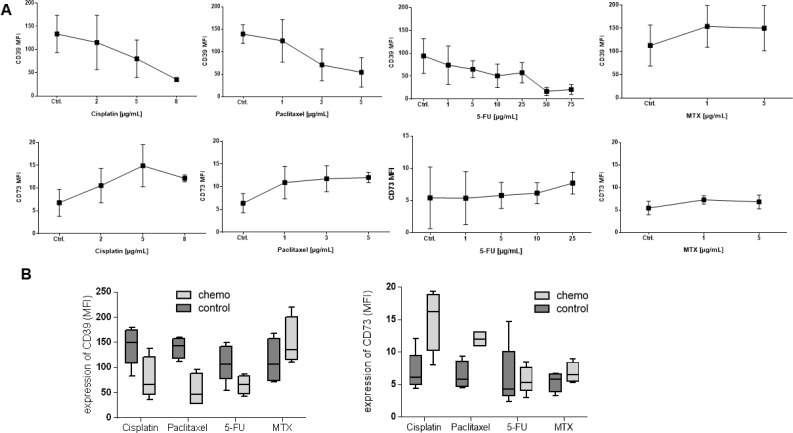
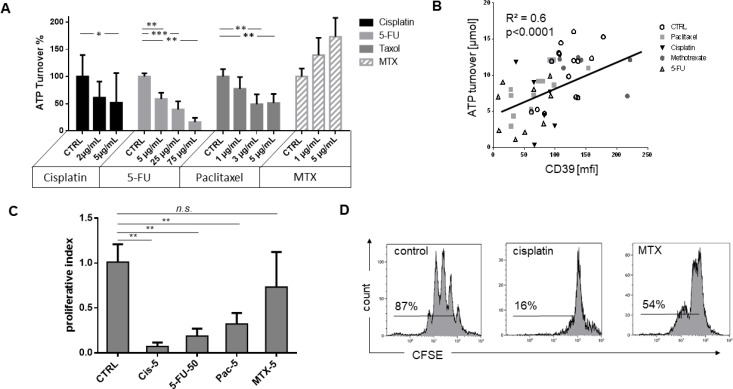
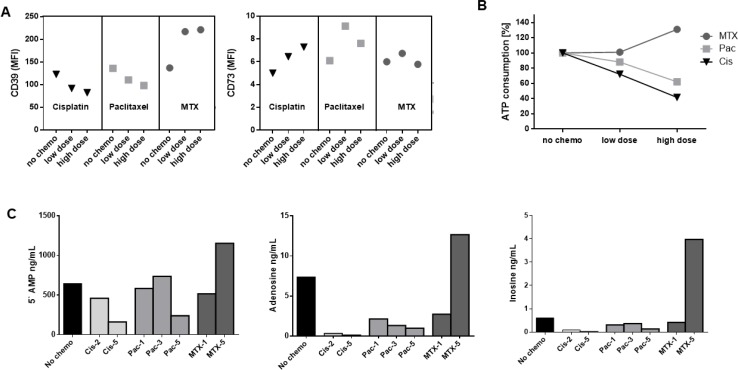
In HNSCC patients, Breg were diminished in absolute number and frequency after chemotherapy (paired samples). Chemotherapeutic drugs had variable effects; while platinum-based chemotherapy decreased the expression of CD39, methotrexate led to a functional increase in CD39 expression and increased production of immunosuppressive ADO. These findings were confirmed in a second patient cohort. Surface expression of CD39 correlated strongly with the production of ADO as measured by mass spectrometry.
Platinum-based anti-tumor-therapy reduces the number of adenosine-producing B cells and, consequently, potential immunosuppression within the tumor environment. Breg function in terms of ADO production and their potential capacity to suppress CD4 T cells are promoted by methotrexate treatment amplifying anti-inflammatory therapeutic effects. Our results add to the understanding of how chemotherapeutic drugs can influence the human immune system and may therefore help to orchestrate standard oncologic therapy with new immune modulating approaches.
Mononuclear cells were collected prospectively from HNSCC patients before and after chemotherapy ( = 18), from healthy donors ( = 20), and an additional cohort sampled several months after chemotherapy ( = 14). Frequency, phenotype, and function of Breg were determined by multicolor flow cytometry, ATP luminescence assay as well as mass spectrometry measuring 5'-AMP, ADO, and inosine. Isolated B cells were incubated with chemotherapeutic drugs (cisplatin, methotrexate, paclitaxel, 5-fluorouracil) for functional studies.
头颈部鳞状细胞癌(HNSCC)会强烈抑制免疫系统,导致转移增加和疾病复发。化疗是多模式治疗的一部分,但可能会进一步导致免疫抑制。最近,我们证明了被定义为CD19⁺CD39⁺CD73⁺的调节性B细胞(Breg)在免疫抑制性细胞外腺苷(ADO)的产生中起重要作用。在此,我们测试了化疗对Breg功能的影响。
在HNSCC患者中,化疗后Breg的绝对数量和频率均减少(配对样本)。化疗药物有不同的作用;铂类化疗降低了CD39的表达,而甲氨蝶呤导致CD39表达功能性增加并增加了免疫抑制性ADO的产生。这些发现在第二个患者队列中得到了证实。CD39的表面表达与通过质谱测量的ADO产生密切相关。
铂类抗肿瘤治疗减少了产生腺苷的B细胞数量,从而减少了肿瘤环境中的潜在免疫抑制。甲氨蝶呤治疗可促进Breg在ADO产生方面的功能及其抑制CD4⁺ T细胞的潜在能力,增强抗炎治疗效果。我们的结果有助于理解化疗药物如何影响人体免疫系统,因此可能有助于将标准肿瘤治疗与新的免疫调节方法相结合。
前瞻性收集HNSCC患者化疗前后(n = 18)、健康供者(n = 20)的单核细胞,以及化疗后数月的另一队列患者(n = 14)的单核细胞。通过多色流式细胞术、ATP发光测定法以及测量5'-AMP、ADO和肌苷的质谱法来确定Breg的频率、表型和功能。将分离的B细胞与化疗药物(顺铂、甲氨蝶呤、紫杉醇、5-氟尿嘧啶)孵育以进行功能研究。