Division of Allergy and Infectious Diseases, Department of Medicine and the Center for AIDS and STD, University of Washington School of Medicine, Seattle WA.
Division of Global Health and Tuberculosis, Centers for Disease Control and Prevention.
Sex Transm Dis. 2018 Jun;45(6):422-428. doi: 10.1097/OLQ.0000000000000771.
Symptomatic vaginal discharge is a common gynecological condition managed syndromically in most developing countries. In Zimbabwe, women presenting with symptomatic vaginal discharge are treated with empirical regimens that commonly cover both sexually transmitted infections (STIs) and reproductive tract infections, typically including a combination of an intramuscular injection of kanamycin, and oral doxycycline and metronidazole regimens. This study was conducted to determine the current etiology of symptomatic vaginal discharge and assess adequacy of current syndromic management guidelines.
We enrolled 200 women with symptomatic vaginal discharge presenting at 6 STI clinics in Zimbabwe. Microscopy was used to detect bacterial vaginosis and yeast infection. Nucleic acid amplifications tests were used to detect Neisseria gonorrhoeae, Chlamydia trachomatis, Trichomonas vaginalis, and Mycoplasma genitalium. In addition, serologic testing was performed to detect human immunodeficiency virus (HIV) infection.
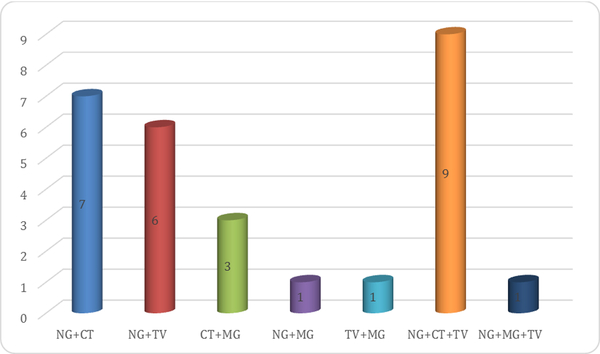
Of the 200 women, 146 (73%) had an etiology detected, including bacterial vaginosis (24.7%); N. gonorrhoeae (24.0%); yeast infection (20.7%); T. vaginalis (19.0%); C. trachomatis (14.0%) and M. genitalium (7.0%). Among women with STIs (N = 90), 62 (68.9%) had a single infection, 18 (20.0%) had a dual infection, and 10 (11.1%) had 3 infections.Of 158 women who consented to HIV testing, 64 (40.5%) were HIV infected.The syndromic management regimen covered 115 (57.5%) of the women in the sample who had gonorrhea, chlamydia, M. genitalium, or bacterial vaginosis, whereas 85 (42.5%) of women were treated without such diagnosis.
Among women presenting with symptomatic vaginal discharge, bacterial vaginosis was the most common etiology, and gonorrhea was the most frequently detected STI. The current syndromic management algorithm is suboptimal for coverage of women presenting with symptomatic vaginal discharge; addition of point of care testing could compliment the effectiveness of the syndromic approach.
有症状的阴道分泌物是大多数发展中国家常见的妇科病症,通常采用综合征方法进行管理。在津巴布韦,出现有症状的阴道分泌物的女性通常采用经验性治疗方案,这些方案通常涵盖性传播感染(STI)和生殖道感染,包括肌肉注射卡那霉素,以及口服多西环素和甲硝唑方案。本研究旨在确定有症状的阴道分泌物的当前病因,并评估当前综合征管理指南的充分性。
我们招募了 200 名在津巴布韦 6 家性传播感染诊所就诊的有症状的阴道分泌物女性。采用显微镜检查法检测细菌性阴道病和酵母菌感染。采用核酸扩增试验检测淋病奈瑟菌、沙眼衣原体、阴道毛滴虫和生殖支原体。此外,还进行了血清学检测以检测人类免疫缺陷病毒(HIV)感染。
在 200 名女性中,有 146 名(73%)检测到病因,包括细菌性阴道病(24.7%)、淋病奈瑟菌(24.0%)、酵母菌感染(20.7%)、阴道毛滴虫(19.0%)、沙眼衣原体(14.0%)和生殖支原体(7.0%)。在有 STI 的女性中(N=90),62 名(68.9%)有单一感染,18 名(20.0%)有双重感染,10 名(11.1%)有 3 种感染。在同意进行 HIV 检测的 158 名女性中,有 64 名(40.5%)感染了 HIV。该综合征管理方案涵盖了样本中 115 名(57.5%)患有淋病、衣原体、生殖支原体或细菌性阴道病的女性,而 85 名(42.5%)女性未经此类诊断就接受了治疗。
在出现有症状的阴道分泌物的女性中,细菌性阴道病是最常见的病因,淋病是最常见的性传播感染。当前的综合征管理算法不能充分覆盖出现有症状的阴道分泌物的女性;添加即时检测可增强综合征方法的效果。