Department of Biochemistry, University of Zurich, 8057 Zurich, Switzerland.
Structural Biology and NMR Laboratory, The Linderstrøm-Lang Centre for Protein Science and Integrative Structural Biology at University of Copenhagen (ISBUC), Department of Biology, University of Copenhagen, 2200 Copenhagen N, Denmark.
Nature. 2018 Mar 1;555(7694):61-66. doi: 10.1038/nature25762. Epub 2018 Feb 21.
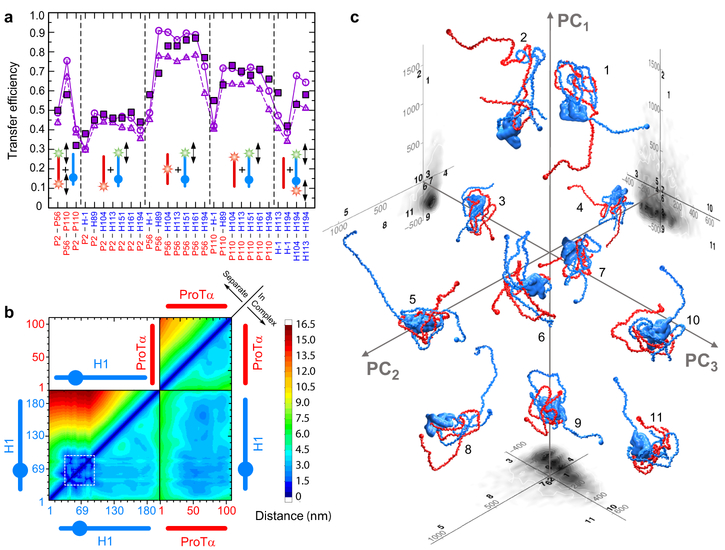
Molecular communication in biology is mediated by protein interactions. According to the current paradigm, the specificity and affinity required for these interactions are encoded in the precise complementarity of binding interfaces. Even proteins that are disordered under physiological conditions or that contain large unstructured regions commonly interact with well-structured binding sites on other biomolecules. Here we demonstrate the existence of an unexpected interaction mechanism: the two intrinsically disordered human proteins histone H1 and its nuclear chaperone prothymosin-α associate in a complex with picomolar affinity, but fully retain their structural disorder, long-range flexibility and highly dynamic character. On the basis of closely integrated experiments and molecular simulations, we show that the interaction can be explained by the large opposite net charge of the two proteins, without requiring defined binding sites or interactions between specific individual residues. Proteome-wide sequence analysis suggests that this interaction mechanism may be abundant in eukaryotes.
在生物学中,分子通讯是由蛋白质相互作用介导的。根据当前的范例,这些相互作用所需的特异性和亲和力是由结合界面的精确互补性编码的。即使在生理条件下是无序的蛋白质,或者含有大的无结构区域的蛋白质,通常也与其他生物分子上的结构良好的结合位点相互作用。在这里,我们证明了一种意外的相互作用机制的存在:两种固有无序的人类蛋白质组蛋白 H1 和其核伴侣原胸腺素-α以皮摩尔亲和力结合形成复合物,但完全保留其结构无序、长程灵活性和高度动态特性。基于紧密结合的实验和分子模拟,我们表明,这种相互作用可以用两种蛋白质的大的相反净电荷来解释,而不需要定义的结合位点或特定单个残基之间的相互作用。蛋白质组范围内的序列分析表明,这种相互作用机制在真核生物中可能很丰富。