Zuloaga Fernando Omar, Salariato Diego Leonel, Scataglini Amalia
Instituto de Botánica Darwinion, San Isidro, Buenos Aires, Argentina.
PLoS One. 2018 Feb 21;13(2):e0191529. doi: 10.1371/journal.pone.0191529. eCollection 2018.
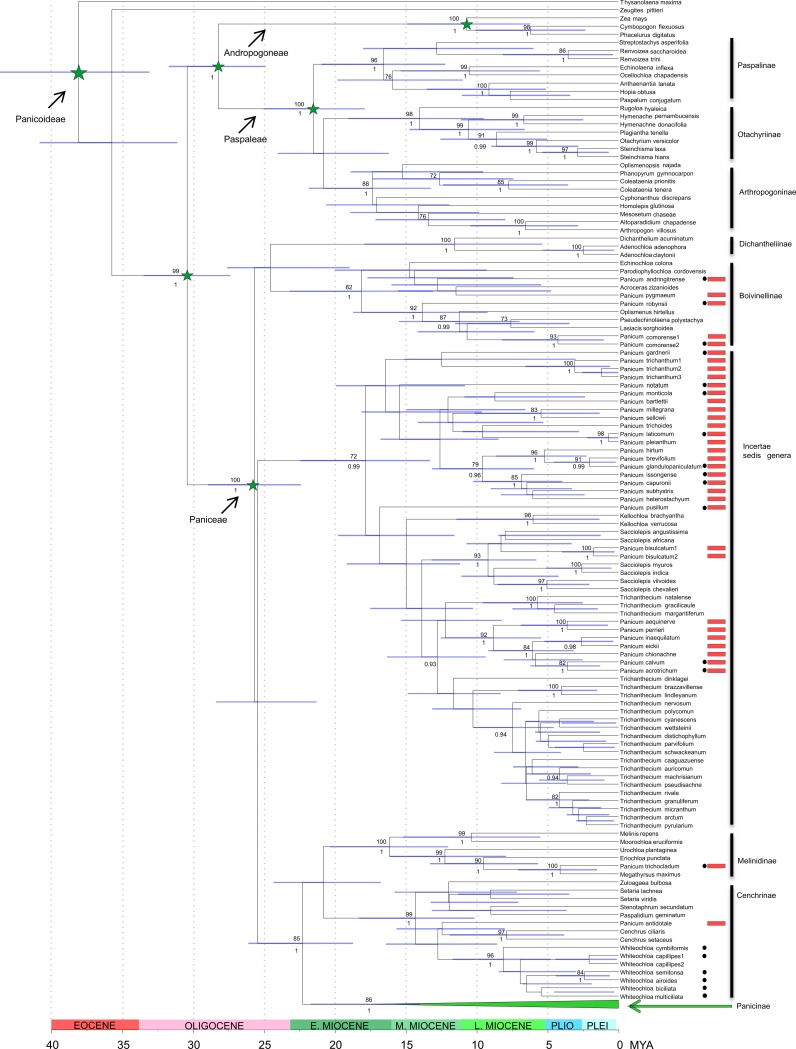
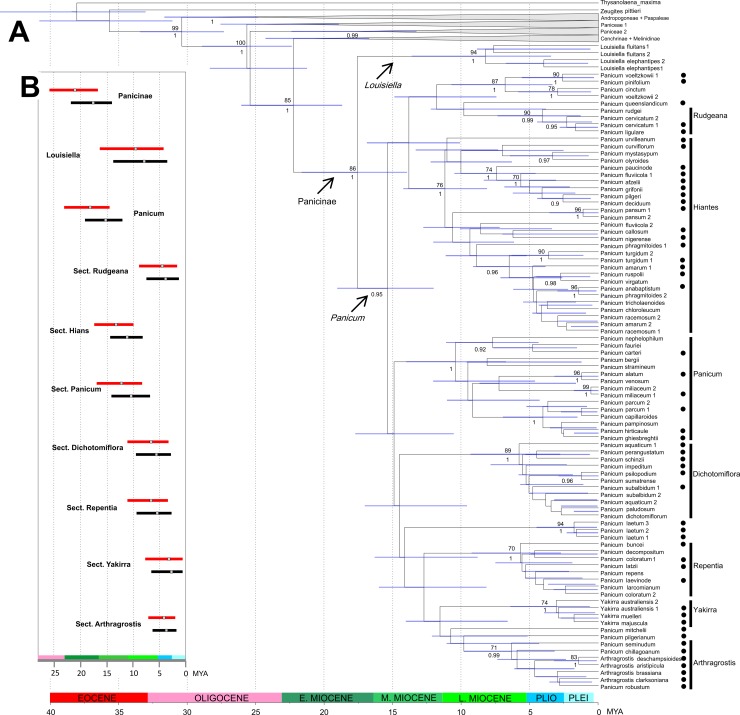
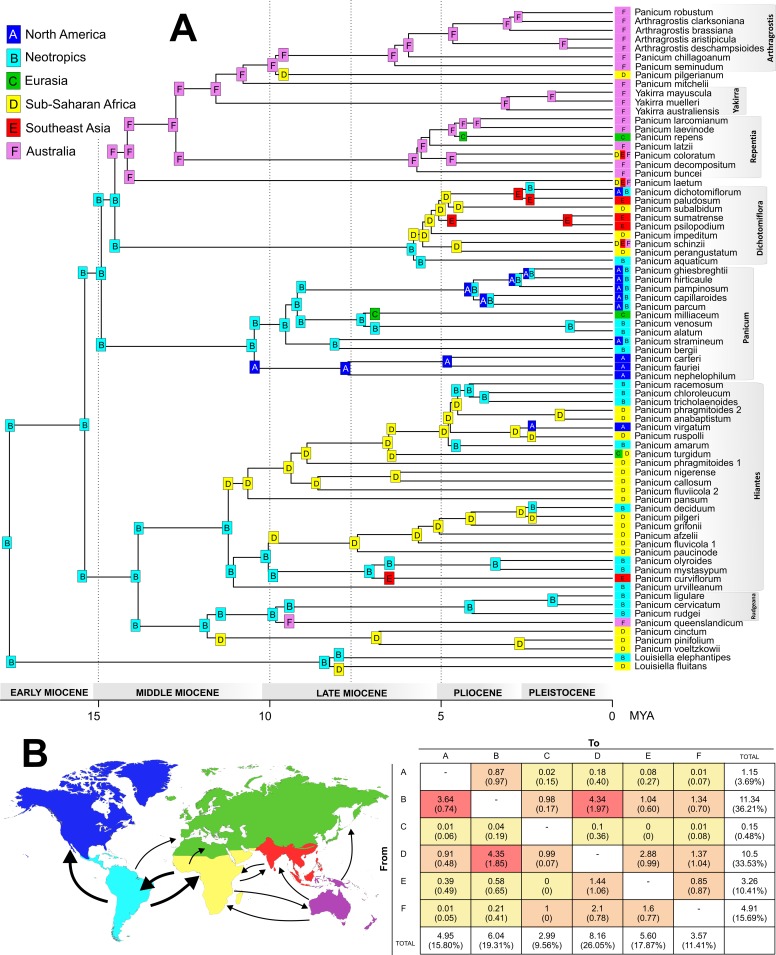
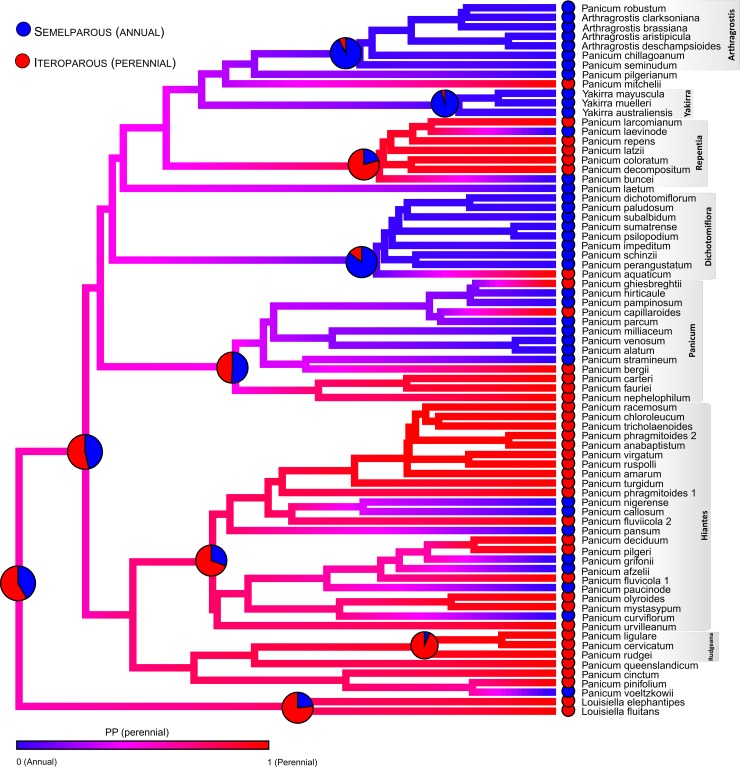
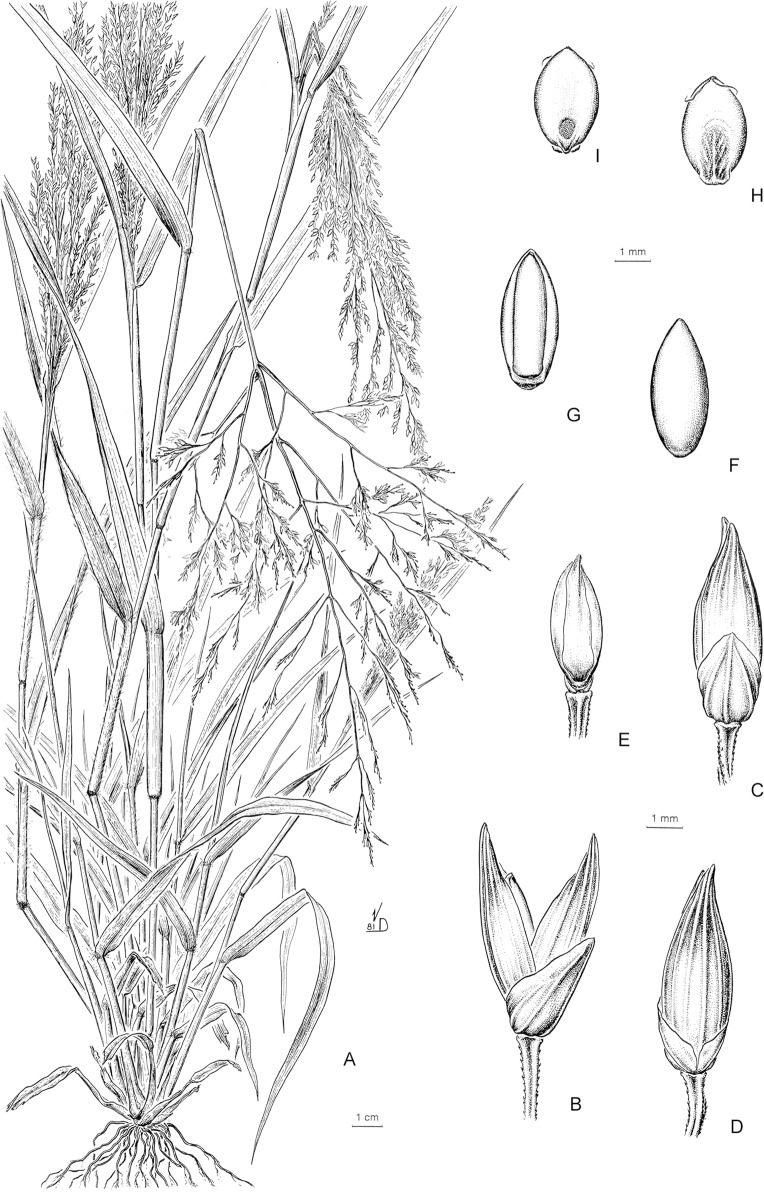
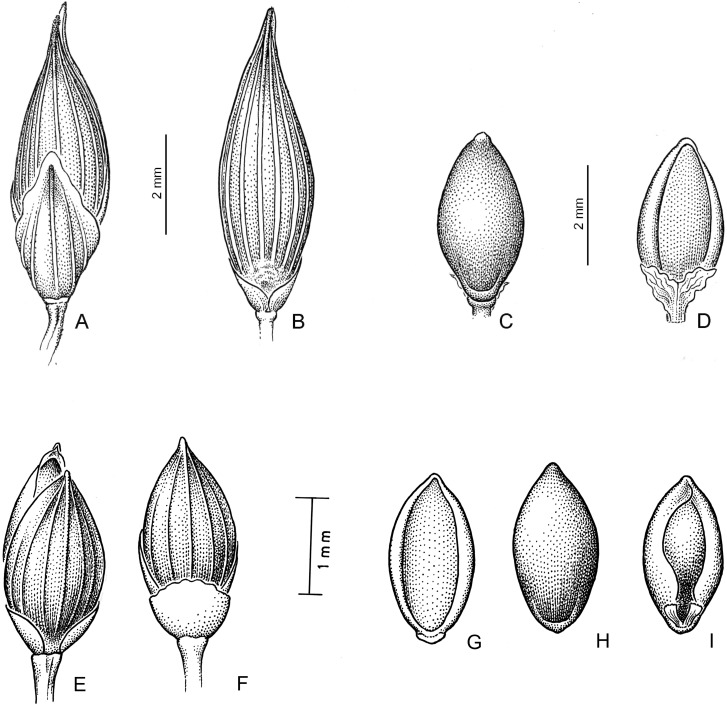
Panicum sensu stricto is a genus of grasses (Poaceae) with nearly, according to this study, 163 species distributed worldwide. This genus is included in the subtribe Panicinae together with Louisiella, the latter with 2 species. Panicum and subtribe Panicinae are characterized by including annual or perennial taxa with open and lax panicles, and spikelets with the lower glume reduced; all taxa also share a basic chromosome number of x = 9 and a Kranz leaf blade anatomy typical of the NAD-me subtype photosynthetic pathway. Nevertheless, the phylogenetic placements of many Panicum species, and the circumscription of the genus, remained untested. Therefore, phylogenetic analyses were conducted using sequence data from the ndhF plastid region, in an extensive worldwide sampling of Panicum and related genera, in order to infer evolutionary relationships and to provide a phylogenetic framework to review the classification of the genus. Diversification times, historical biogeography and evolutionary patterns of the life history (annual vs. perennial) in the subtribe and Panicum were also studied. Results obtained provide strong support for a monophyletic Panicum including 71 species and 7 sections, of which sections Arthragrostis and Yakirra are new in the genus; 7 new combinations are made here. Furthermore, 32 species traditionally assigned to Panicum were excluded from the genus, and discussed in other subtribes of Paniceae. Our study suggested that early diversification in subtribe Panicinae and Panicum occurred through the Early-Mid Miocene in the Neotropics, while the subsequent diversification of its sections mainly occurred in the Late Miocene-Pleistocene, involving multiple dispersals to all continents. Our analyses also showed that transition rates and changes between annual and perennial life history in Panicum were quite frequent, suggesting considerable lability of this trait. Changes of the life history, together with C4 photosynthesis, and the multiple dispersal events since the Mid Miocene, seem to have facilitated a widespread distribution of the genus. All these findings contribute to a better understanding of the systematics and evolution of Panicum.
狭义黍属是禾本科的一个属,根据本研究,该属有近163个物种分布于全球。该属与路易斯黍属一同被归入黍亚族,后者有2个物种。黍属和黍亚族的特征包括一年生或多年生类群,圆锥花序开展且疏松,小穗的下颖退化;所有类群还共享基本染色体数x = 9以及典型的NAD - me亚型光合途径的花环型叶片解剖结构。然而,许多黍属物种的系统发育位置以及该属的界定仍未得到验证。因此,利用叶绿体ndhF区域的序列数据,对黍属及相关属进行了广泛的全球采样,以进行系统发育分析,从而推断进化关系,并提供一个系统发育框架来审视该属的分类。还研究了黍亚族和黍属的分化时间、历史生物地理学以及生活史(一年生与多年生)的进化模式。所获得的结果有力支持了一个包含71个物种和7个组的单系黍属,其中节芒黍组和亚基黍组是该属新组;本文还提出了7个新组合。此外,传统上归入黍属的32个物种被排除出该属,并在黍族的其他亚族中进行了讨论。我们的研究表明,黍亚族和黍属的早期分化发生在中新世早期 - 中期的新热带地区,而其随后各组的分化主要发生在中新世晚期 - 更新世,涉及多次扩散到所有大陆。我们的分析还表明,黍属一年生和多年生生活史之间的转变率和变化相当频繁,表明该性状具有相当大的易变性。生活史的变化,连同C4光合作用,以及自中新世中期以来的多次扩散事件,似乎促进了该属的广泛分布。所有这些发现有助于更好地理解黍属的系统学和进化。