Ravi Rajani, Noonan Kimberly A, Pham Vui, Bedi Rishi, Zhavoronkov Alex, Ozerov Ivan V, Makarev Eugene, V Artemov Artem, Wysocki Piotr T, Mehra Ranee, Nimmagadda Sridhar, Marchionni Luigi, Sidransky David, Borrello Ivan M, Izumchenko Evgeny, Bedi Atul
Department of Otolaryngology-Head and Neck Cancer Research, Johns Hopkins University School of Medicine, Baltimore, MD, 21231, USA.
Sidney Kimmel Comprehensive Cancer Center, Johns Hopkins University School of Medicine, Baltimore, MD, 21231, USA.
Nat Commun. 2018 Feb 21;9(1):741. doi: 10.1038/s41467-017-02696-6.
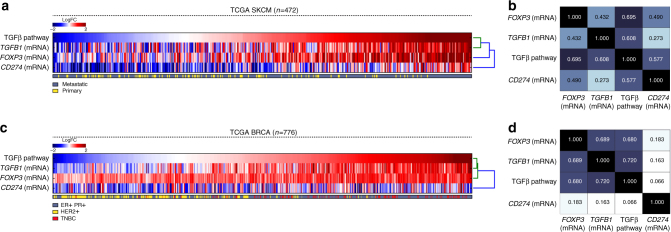
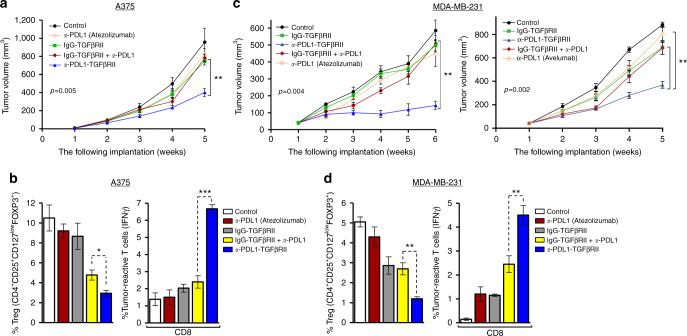
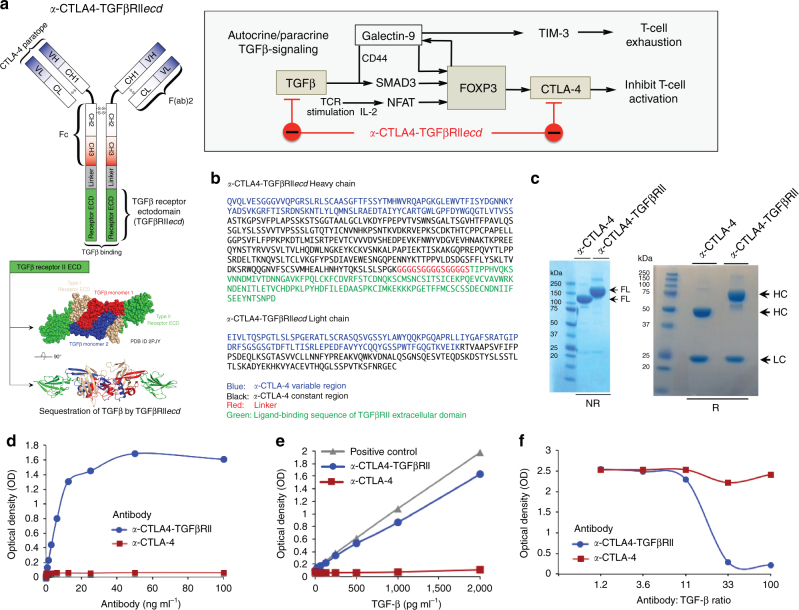
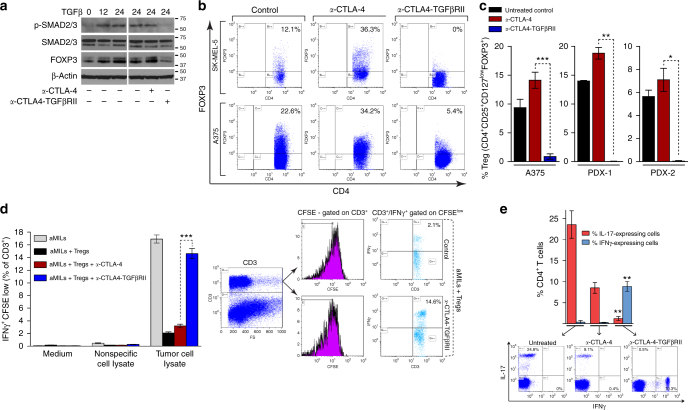
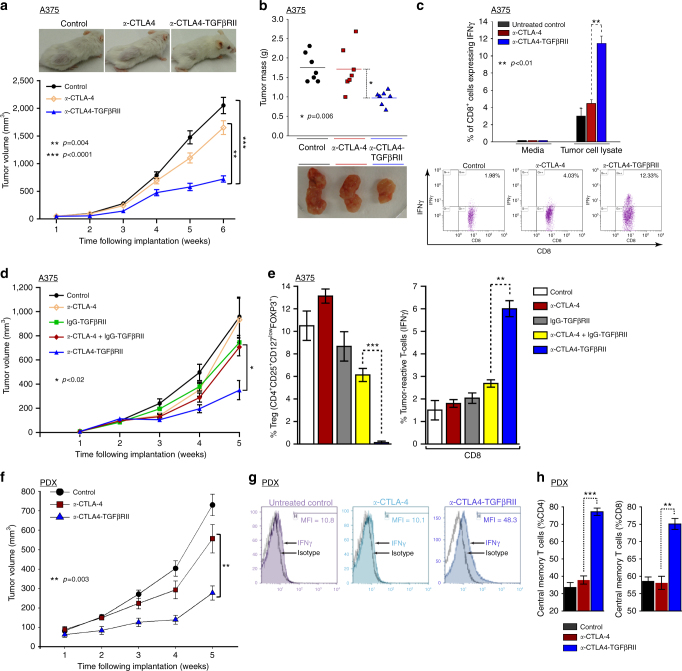
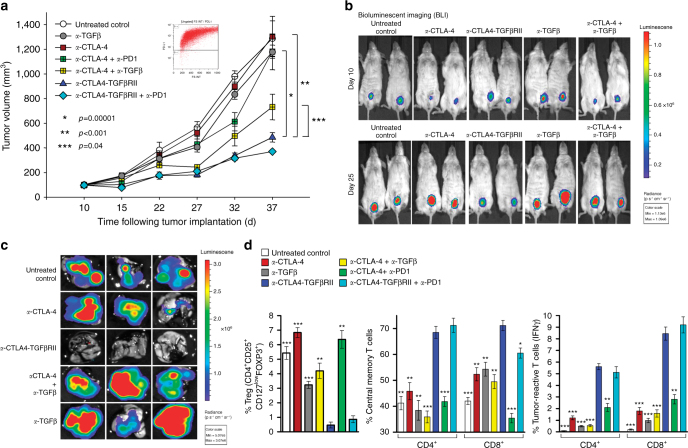
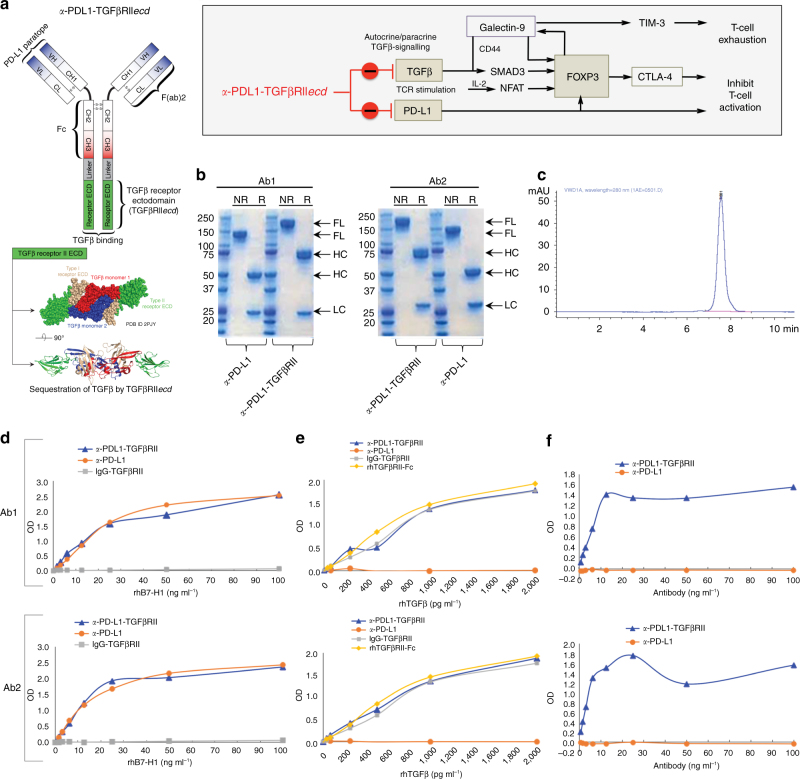
A majority of cancers fail to respond to immunotherapy with antibodies targeting immune checkpoints, such as cytotoxic T-lymphocyte antigen-4 (CTLA-4) or programmed death-1 (PD-1)/PD-1 ligand (PD-L1). Cancers frequently express transforming growth factor-β (TGFβ), which drives immune dysfunction in the tumor microenvironment by inducing regulatory T cells (Tregs) and inhibiting CD8 and T1 cells. To address this therapeutic challenge, we invent bifunctional antibody-ligand traps (Y-traps) comprising an antibody targeting CTLA-4 or PD-L1 fused to a TGFβ receptor II ectodomain sequence that simultaneously disables autocrine/paracrine TGFβ in the target cell microenvironment (a-CTLA4-TGFβRIIecd and a-PDL1-TGFβRIIecd). a-CTLA4-TGFβRIIecd is more effective in reducing tumor-infiltrating Tregs and inhibiting tumor progression compared with CTLA-4 antibody (Ipilimumab). Likewise, a-PDL1-TGFβRIIecd exhibits superior antitumor efficacy compared with PD-L1 antibodies (Atezolizumab or Avelumab). Our data demonstrate that Y-traps counteract TGFβ-mediated differentiation of Tregs and immune tolerance, thereby providing a potentially more effective immunotherapeutic strategy against cancers that are resistant to current immune checkpoint inhibitors.
大多数癌症对靶向免疫检查点的抗体免疫疗法没有反应,这些免疫检查点如细胞毒性T淋巴细胞抗原4(CTLA-4)或程序性死亡1(PD-1)/PD-1配体(PD-L1)。癌症经常表达转化生长因子-β(TGFβ),它通过诱导调节性T细胞(Tregs)和抑制CD8和T1细胞来驱动肿瘤微环境中的免疫功能障碍。为应对这一治疗挑战,我们发明了双功能抗体-配体陷阱(Y陷阱),它由靶向CTLA-4或PD-L1的抗体与TGFβ受体II胞外域序列融合而成,可同时消除靶细胞微环境中的自分泌/旁分泌TGFβ(a-CTLA4-TGFβRIIecd和a-PDL1-TGFβRIIecd)。与CTLA-4抗体(伊匹单抗)相比,a-CTLA4-TGFβRIIecd在减少肿瘤浸润性Tregs和抑制肿瘤进展方面更有效。同样,与PD-L1抗体(阿特珠单抗或阿维鲁单抗)相比,a-PDL1-TGFβRIIecd表现出更高的抗肿瘤疗效。我们的数据表明,Y陷阱可抵消TGFβ介导的Tregs分化和免疫耐受,从而为对抗目前对免疫检查点抑制剂耐药的癌症提供一种可能更有效的免疫治疗策略。