Duan Chao, Wang Han, Chen Ying, Chu Ping, Xing Tianyu, Gao Chao, Yue Zhixia, Zheng Jie, Jin Mei, Gu Weiyue, Ma Xiaoli
1Beijing Key Laboratory of Pediatric Hematology Oncology, National Discipline of Pediatrics, Ministry of Education, MOE Key Laboratory of Major Diseases in Children, Hematology Oncology Center, Beijing Children's Hospital, Capital Medical University, National Center for Children's Health, No. 56 Nanlishi Road, Beijing, 100045 China.
Joy Orient Translational Medicine Research Center for the Sequences Analysis and Blast, Beijing, China.
Cancer Cell Int. 2018 Feb 17;18:21. doi: 10.1186/s12935-018-0521-3. eCollection 2018.
We ought to explore the acquired somatic alterations, shedding light on genetic basis of somatic alterations in NB patients with chemotherapy.
Marrow blood samples from NB patients were collected before treatment, after the 2nd and 4th chemotherapy for baseline research and continuous monitoring by whole exome sequencing. Plasma cell free DNA (cfDNA) was prepared for baseline research. Finger nail cells were extracted as self control. The clinical data was analyzed.
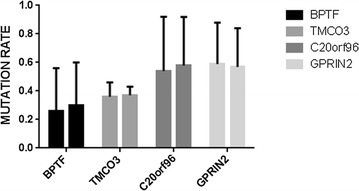
From December 2014 to February 2016, 27 cases of children with stage IV NB were diagnosed. The follow up time ranged from 5 to 25 months, with a median follow up time of 17 months, 20 patients were stable, one patient died of pulmonary embolism during surgery, six patients died of disease progression. Marrow blood whole exome sequencing demonstrated that several novel somatic mutations were identified in all three trios comply or against the trendy of tumor size variation. Of note, six recurrent mutations in bromodomain PHD finger transcription factor (BPTF) were identified in nine NB patients under the continuous monitoring. The mutation rates variation was positively correlated to tumor size (CC = 0.428, P = 0.021), and patients with BPTF mutation may have a worse prognosis compared with wild type. Meanwhile, CGREF1, CUX2, GP1BA, SLC45A1 and TRA2A were mutated with the trendy oppose as therapeutic effects. The baseline research in three NB patients demonstrated that mutation rate of BPTF, TMCO3, GPRIN2 and C20orf96 in plasma cfDNA were in positive correlation with bone marrow genomic DNA (P = 0.001).
Our study showed that BPTF along with other mutations may function as a biomarker for evaluating to effects of chemotherapy to this refractory tumor, and patients with BPTF mutation might have a worse prognosis.
我们应该探索获得性体细胞改变,以阐明接受化疗的神经母细胞瘤(NB)患者体细胞改变的遗传基础。
收集NB患者治疗前、第2次和第4次化疗后的骨髓血样本,通过全外显子组测序进行基线研究和持续监测。制备血浆游离DNA(cfDNA)用于基线研究。提取指甲细胞作为自身对照。分析临床数据。
2014年12月至2016年2月,诊断出27例IV期NB患儿。随访时间为5至25个月,中位随访时间为17个月,20例患者病情稳定,1例患者在手术期间死于肺栓塞,6例患者死于疾病进展。骨髓血全外显子组测序表明,在所有三个三联体中均鉴定出几个新的体细胞突变,这些突变符合或违背肿瘤大小变化趋势。值得注意的是,在持续监测下,9例NB患者中鉴定出溴结构域PHD指转录因子(BPTF)的6个复发性突变。突变率变化与肿瘤大小呈正相关(CC = 0.428,P = 0.021),与野生型相比,BPTF突变患者的预后可能更差。同时,CGREF1、CUX2、GP1BA、SLC45A1和TRA2A的突变趋势与治疗效果相反。对3例NB患者的基线研究表明,血浆cfDNA中BPTF、TMCO3、GPRIN2和C20orf96的突变率与骨髓基因组DNA呈正相关(P = 0.001)。
我们的研究表明BPTF以及其他突变可能作为评估这种难治性肿瘤化疗效果的生物标志物,BPTF突变患者的预后可能更差。