Warlop Thibault, Detrembleur Christine, Stoquart Gaëtan, Lejeune Thierry, Jeanjean Anne
Physical and Rehabilitation Medicine Department, Cliniques Universitaires Saint-Luc, Brussels, Belgium.
Neuro Musculo Skeletal Lab, Institut de Recherche Expérimentale et Clinique, Université Catholique de Louvain, Brussels, Belgium.
Front Physiol. 2018 Feb 6;9:68. doi: 10.3389/fphys.2018.00068. eCollection 2018.
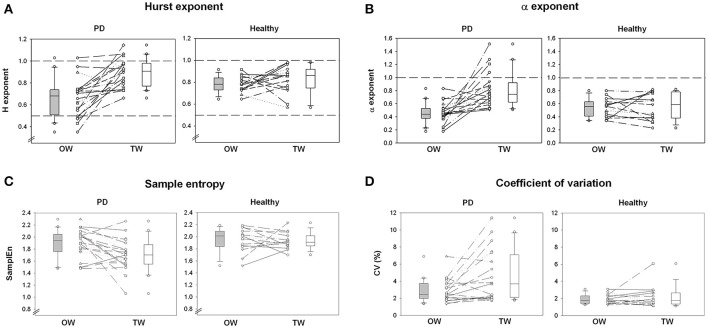
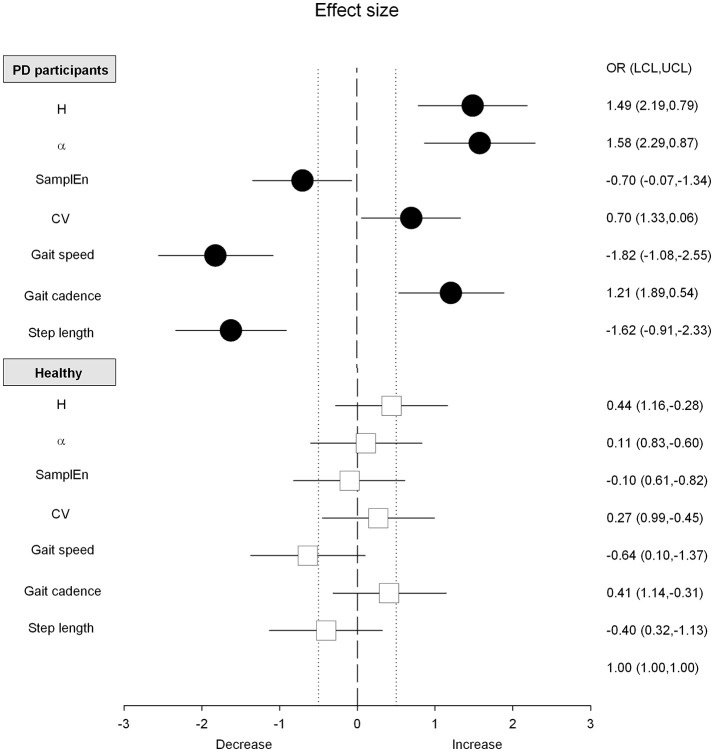
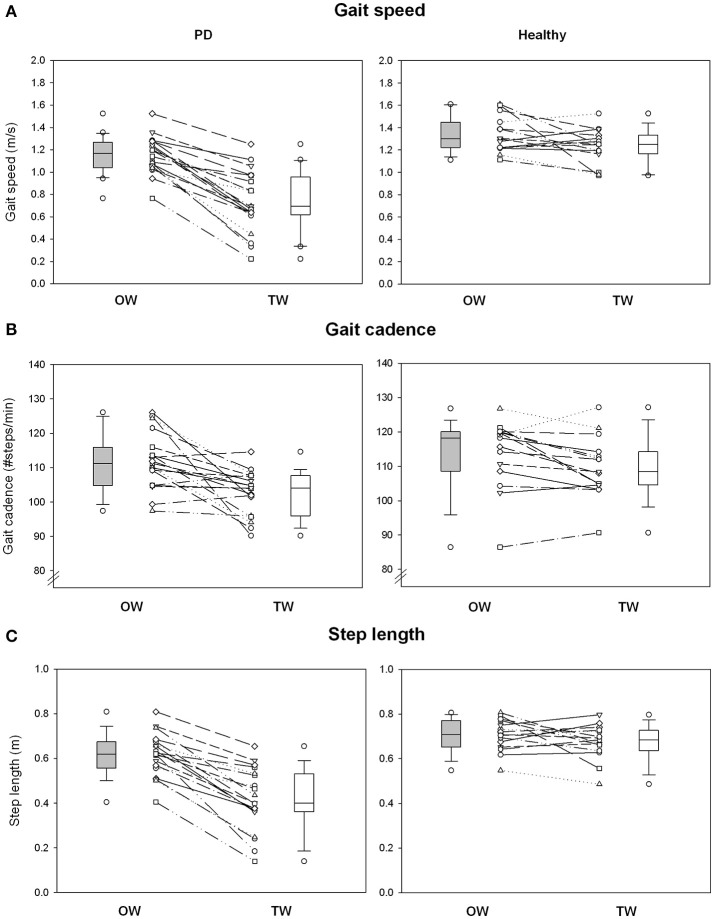
Variability raises considerable interest as a promising and sensitive marker of dysfunction in physiology, in particular in neurosciences. Both internally (e.g., pathology) and/or externally (e.g., environment) generated perturbations and the neuro-mechanical responses to them contribute to the fluctuating dynamics of locomotion. Defective internal gait control in Parkinson's disease (PD), resulting in typical timing gait disorders, is characterized by the breakdown of the temporal organization of stride duration variability. Influence of external cue on gait pattern could be detrimental or advantageous depending on situations (healthy or pathological gait pattern, respectively). As well as being an interesting rehabilitative approach in PD, treadmills are usually implemented in laboratory settings to perform instrumented gait analysis including gait variability assessment. However, possibly acting as an external pacemaker, treadmill could modulate the temporal organization of gait variability of PD patients which could invalidate any gait variability assessment. This study aimed to investigate the immediate influence of treadmill walking (TW) on the temporal organization of stride duration variability in PD and healthy population. Here, we analyzed the gait pattern of 20 PD patients and 15 healthy age-matched subjects walking on overground and on a motorized-treadmill (randomized order) at a self-selected speed. The temporal organization and regularity of time series of walking were assessed on 512 consecutive strides and assessed by the application of non-linear mathematical methods (i.e., the detrended fluctuation analysis and power spectral density; and sample entropy, for the temporal organization and regularity of gait variability, respectively). A more temporally organized and regular gait pattern seems to emerge from TW in PD while no influence was observed on healthy gait pattern. Treadmill could afford the necessary framework to regulate gait rhythmicity in PD. Overall, the results support the hypothesis of a greater dependence to regulatory inputs as an explanatory factor of treadmill influence observed in PD. Also, since treadmill misrepresents the gait as more healthy than it is, the present findings underline that gait analysis using treadmill devices should be cautiously considered in PD and especially for gait variability assessment in gait lab.
变异性作为生理学功能障碍,尤其是神经科学领域中一个有前景且敏感的标志物,引发了人们极大的兴趣。内部(如病理学)和/或外部(如环境)产生的扰动以及机体对它们的神经机械反应,共同导致了运动的波动动力学。帕金森病(PD)患者内部步态控制存在缺陷,导致典型的步态时间紊乱,其特征是步幅持续时间变异性的时间组织崩溃。外部线索对步态模式的影响可能是有害的,也可能是有益的,这取决于具体情况(分别对应健康或病理步态模式)。跑步机不仅是PD中一种有趣的康复方法,通常还用于实验室环境中进行包括步态变异性评估在内的仪器化步态分析。然而,跑步机可能起到外部起搏器的作用,它可以调节PD患者步态变异性的时间组织,这可能会使任何步态变异性评估无效。本研究旨在调查跑步机行走(TW)对PD患者和健康人群步幅持续时间变异性时间组织的即时影响。在这里,我们分析了20名PD患者和15名年龄匹配的健康受试者在地面和电动跑步机上(随机顺序)以自选速度行走时的步态模式。在连续512步中评估行走时间序列的时间组织和规律性,并分别通过应用非线性数学方法(即去趋势波动分析和功率谱密度;以及样本熵,用于步态变异性的时间组织和规律性)进行评估。在PD患者中,TW似乎产生了一种时间组织更有序、更规律的步态模式,而对健康步态模式未观察到影响。跑步机可为调节PD患者的步态节律提供必要的框架。总体而言,这些结果支持了一个假设,即对调节输入的更大依赖性是在PD中观察到的跑步机影响的一个解释因素。此外,由于跑步机将步态表现得比实际更健康,本研究结果强调,在PD中,尤其是在步态实验室进行步态变异性评估时,应谨慎考虑使用跑步机设备进行步态分析。