Meule Adrian, Reichenberger Julia, Blechert Jens
Department of Psychology, University of Salzburg, Salzburg, Austria.
Centre for Cognitive Neuroscience, University of Salzburg, Salzburg, Austria.
Front Psychol. 2018 Feb 6;9:88. doi: 10.3389/fpsyg.2018.00088. eCollection 2018.
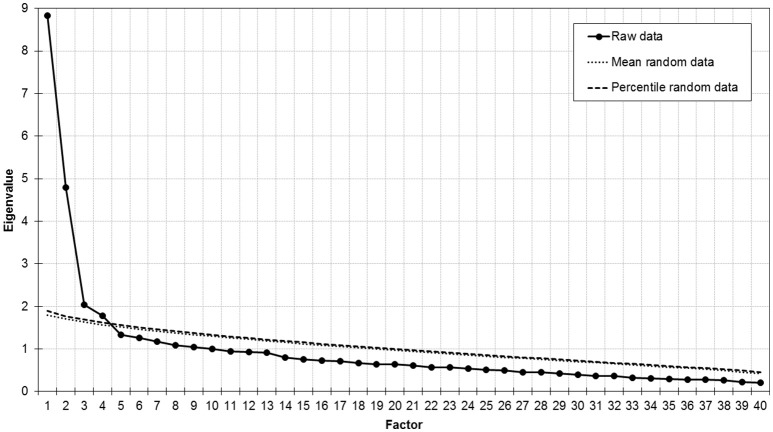
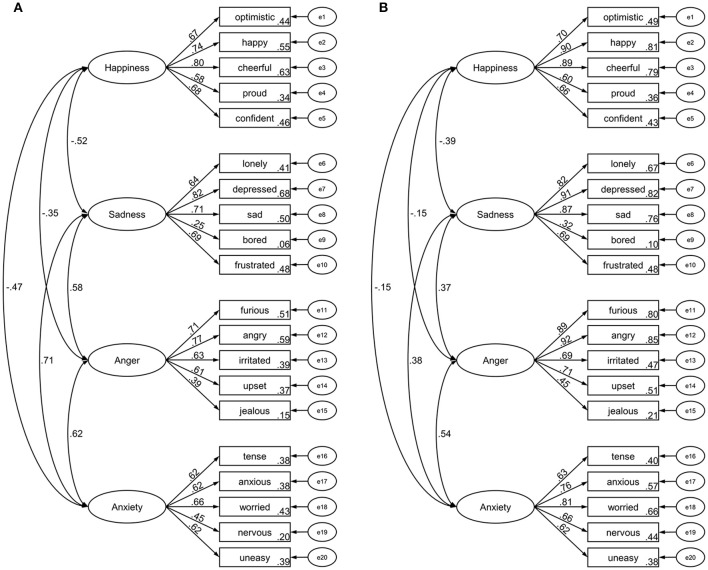
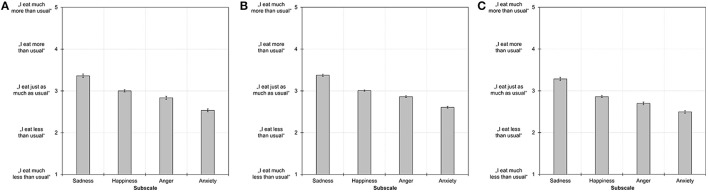
Existing self-report questionnaires for the assessment of emotional eating do not differentiate between specific types of emotions between increased or decreased food intake in response to these emotions. Therefore, we developed a new measure of emotional eating-the Salzburg Emotional Eating Scale (SEES)-for which higher scores indicate eating more than usual in response to emotions and lower scores indicate eating less than usual in response to emotions. In study 1, a pool of items describing 40 emotional states was used. Factor analysis yielded four factors, which represented both positive ( subscale) and negative emotions (, and subscales). Subsequently, the scale was reduced to 20 items (5 items for each subscale) and its four-factor structure was replicated in studies 2 and 3. In all three studies, internal consistencies of each subscale were α > 0.70 and mean subscale scores significantly differed from each other such that individuals reported the strongest tendency to eat more than usual when being sad and the strongest tendency to eat less than usual when being anxious (sadness > happiness > anger > anxiety). Higher scores on the happiness subscale related to lower scores on the negative emotions subscales, lower body mass index (BMI), and lower eating pathology. In contrast, higher scores on the negative emotions subscales related to lower scores on the happiness subscale, higher BMI, and higher eating pathology. The SEES represents a useful measure for the investigation of emotional eating by increasing both specificity (differentiation between specific emotional states) and breadth (differentiation between increase and decrease of food intake) in the assessment of the emotion-eating relationship.
现有的用于评估情绪化进食的自我报告问卷,无法区分特定类型的情绪,也无法区分因这些情绪导致的食物摄入量增加或减少。因此,我们开发了一种新的情绪化进食测量方法——萨尔茨堡情绪化进食量表(SEES),得分越高表明因情绪而进食量比平时更多,得分越低表明因情绪而进食量比平时更少。在研究1中,使用了一组描述40种情绪状态的项目。因子分析得出四个因子,分别代表积极情绪(子量表)和消极情绪(、和子量表)。随后,该量表缩减至20个项目(每个子量表5个项目),其四因子结构在研究2和研究3中得到了重复验证。在所有三项研究中,每个子量表的内部一致性均为α>0.70,且各子量表的平均得分存在显著差异,即个体报告称,悲伤时比平时吃得更多的倾向最强,焦虑时比平时吃得更少的倾向最强(悲伤>快乐>愤怒>焦虑)。快乐子量表得分越高,与消极情绪子量表得分越低、体重指数(BMI)越低以及饮食病理学得分越低相关。相反,消极情绪子量表得分越高,与快乐子量表得分越低、BMI越高以及饮食病理学得分越高相关。SEES通过在评估情绪与进食关系时提高特异性(区分特定情绪状态)和广度(区分食物摄入量的增加和减少),为研究情绪化进食提供了一种有用的测量方法。