Kelekar A, Cole M D
Mol Cell Biol. 1986 Jan;6(1):7-14. doi: 10.1128/mcb.6.1.7-14.1986.
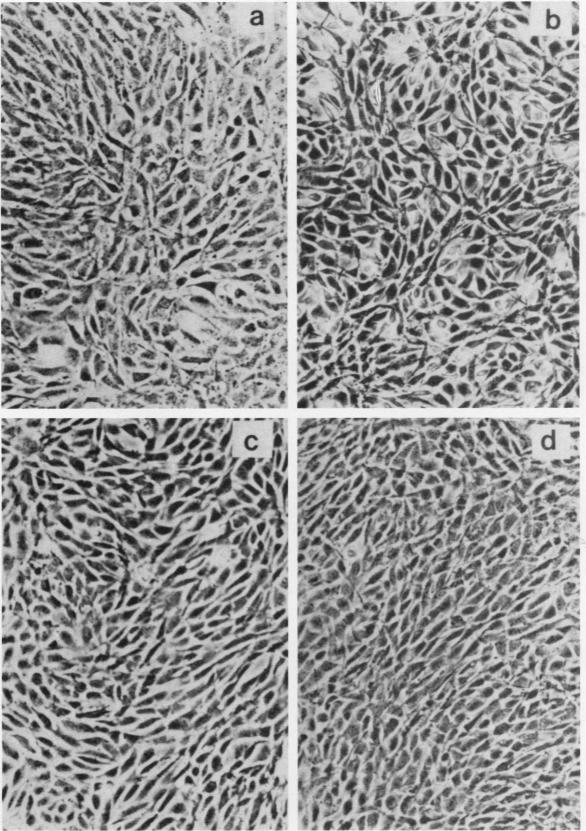
Cellular and viral oncogenes have been linked to the transformation of established cell lines in vitro, to the induction of tumors in vivo, and to the partial transformation or immortalization of primary cells. Based on the ability to cooperate with mutated ras oncogenes in the transformation of primary cells, the adenovirus E1a and cellular p53 genes have been assigned an immortalizing activity. It is demonstrated in this paper that the adenovirus type 5 E1a gene and simian virus 40 promoter-linked p53 cDNA are able to transform previously immortalized cells to a tumorigenic phenotype without a significant change in cell morphology. It is also shown that, when linked to a constitutive promoter, the normal mouse and human c-myc genes have the same transforming activity. Cells transformed by each of these oncogenes have an increased capacity to grow in the absence of growth factors and a limited anchorage-independent growth capability.
细胞癌基因和病毒癌基因已被证明与体外已建立细胞系的转化、体内肿瘤的诱导以及原代细胞的部分转化或永生化有关。基于在原代细胞转化中与突变的ras癌基因协同作用的能力,腺病毒E1a基因和细胞p53基因被赋予了永生化活性。本文证明,5型腺病毒E1a基因和猿猴病毒40启动子连接的p53 cDNA能够将先前永生化的细胞转化为致瘤表型,而细胞形态没有明显变化。还表明,当与组成型启动子连接时,正常小鼠和人c-myc基因具有相同的转化活性。由这些癌基因中的每一个转化的细胞在无生长因子的情况下具有增强的生长能力和有限的不依赖贴壁生长能力。