Fang Jing, Gillespie Cathleen, Ayala Carma, Loustalot Fleetwood
Division for Heart Disease and Stroke Prevention, National Center for Chronic Disease Prevention and Health Promotion, CDC.
MMWR Morb Mortal Wkly Rep. 2018 Feb 23;67(7):219-224. doi: 10.15585/mmwr.mm6707a4.
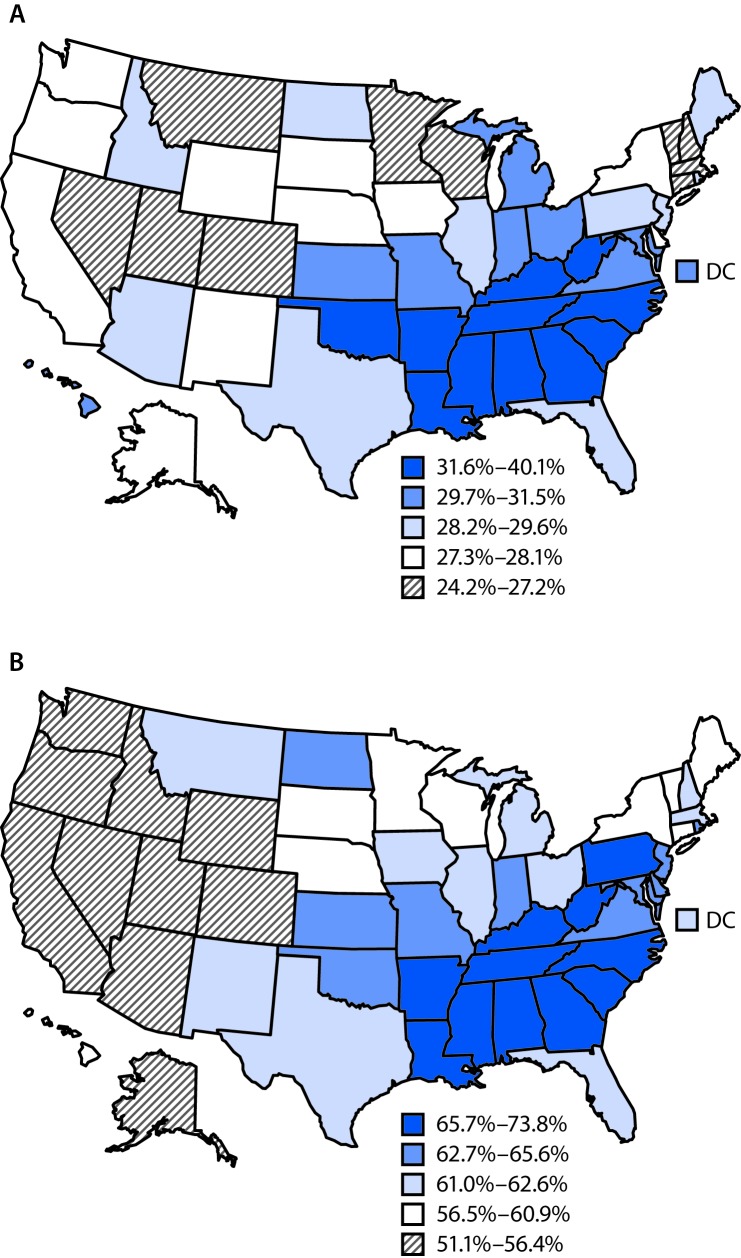
Hypertension, which affects nearly one third of adults in the United States, is a major risk factor for heart disease and stroke (1), and only approximately half of those with hypertension have their hypertension under control (2). The prevalence of hypertension is highest among non-Hispanic blacks, whereas the prevalence of antihypertensive medication use is lowest among Hispanics (1). Geographic variations have also been identified: a recent report indicated that the Southern region of the United States had the highest prevalence of hypertension as well as the highest prevalence of medication use (3). Using data from the Behavioral Risk Factor Surveillance System (BRFSS), this study found minimal change in state-level prevalence of hypertension awareness and treatment among U.S. adults during the first half of the current decade. From 2011 to 2015, the age-standardized prevalence of self-reported hypertension decreased slightly, from 30.1% to 29.8% (p = 0.031); among those with hypertension, the age-standardized prevalence of medication use also decreased slightly, from 63.0% to 61.8% (p<0.001). Persistent differences were observed by age, sex, race/ethnicity, level of education, and state of residence. Increasing hypertension awareness, as well as increasing hypertension control through lifestyle changes and consistent antihypertensive medication use, requires diverse clinical and public health intervention.
高血压影响了美国近三分之一的成年人,是心脏病和中风的主要危险因素(1),而只有大约一半的高血压患者的血压得到控制(2)。高血压患病率在非西班牙裔黑人中最高,而抗高血压药物的使用率在西班牙裔中最低(1)。地理差异也已得到确认:最近一份报告指出,美国南部地区高血压患病率和药物使用率均最高(3)。利用行为危险因素监测系统(BRFSS)的数据,本研究发现,在当前十年的前半期,美国成年人中高血压知晓率和治疗率的州级患病率变化极小。从2011年到2015年,自我报告高血压的年龄标准化患病率略有下降,从30.1%降至29.8%(p = 0.031);在高血压患者中,药物使用的年龄标准化患病率也略有下降,从63.0%降至61.8%(p<0.001)。在年龄、性别、种族/民族、教育程度和居住州方面观察到了持续的差异。提高高血压知晓率,以及通过生活方式改变和持续使用抗高血压药物来提高高血压控制率,需要多种临床和公共卫生干预措施。